
Why Gen Z's brainrot humour leaves older generations scratching their heads
A growing number of parents are asking why Gen Z finds brainrot memes funny. Psychologists say the answer lies in shared context, absurdity and a fast-evolving digital culture.
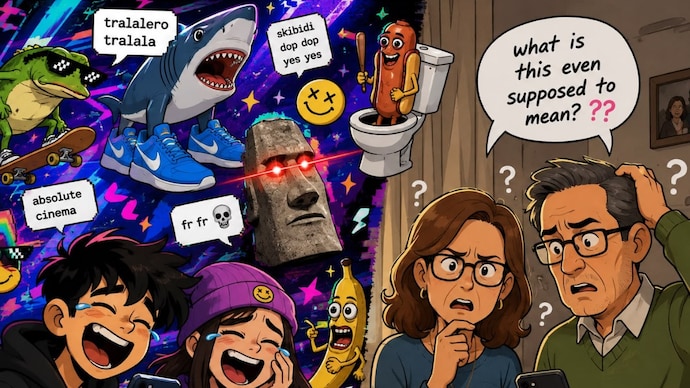

Picture this: a seal wearing sunglasses strums an electric guitar while floating through space. The background music is distorted, the captions make no grammatical sense, and somewhere in the comments, thousands of Gen Z and millennials are typing “absolute cinema,” “I’m crying,” and skull emojis.
Meanwhile, a Gen Z's parent watches the same video, looks up after five seconds and asks the only logical question: “But what’s funny?”
It’s a question that has become increasingly common in households where Gen Z and their parents share the same Wi-Fi but seemingly not the same internet.
To older generations, brainrot humour often looks like a collection of random images stitched together with loud sound effects and internet gibberish. A shark wearing trainers. An AI-generated crocodile speaking Italian. A cat dramatically falling off a chair for no apparent reason. There is no setup, no punchline and certainly no obvious joke. Yet millions of young people are doubled over laughing, sharing the clips with friends and quoting them days later.
The obvious assumption is that Gen Z simply has a strange sense of humour. But the reality is far more interesting. The joke, it turns out, often isn’t the video itself.
It’s everything that came before it.
Take a look at some of the Gen Z memes here:

And of course, we can't leave the infamous "6-7" meme out:
Unlike traditional comedy, brainrot humour rarely exists in isolation. A 15-second clip may be the latest chapter in a joke that has evolved over weeks or even months through countless remixes, edits, reactions and references.
By the time it reaches your feed, it carries an entire internet backstory. If you’ve been online long enough to watch that story unfold, your brain instantly fills in the blanks. If you haven’t, all you see is an AI-generated animal making inexplicable noises.
Think of it like walking into a room where everyone bursts into laughter because someone said a single word. The word itself isn’t funny. The shared memory behind it is.
That’s why explaining brainrot often kills the joke. Once you have to stop and unpack every reference, the spontaneity disappears. It’s the same reason inside jokes rarely survive outside the friend group that created them.
Psychologists say humour has always been about more than clever punchlines. It is also about belonging. Shared jokes reinforce shared identities, signalling that we understand the same experiences, references and cultural cues. In that sense, brainrot is less a collection of memes than a digital dialect. Understanding it tells others you’ve spent time in the same corners of the internet.
That’s also why the generation gap feels unusually wide. Parents and older adults aren’t actually missing the ability to appreciate humour. They’re missing the context. Their cultural references were built around television, films, schoolyard jokes or family anecdotes. Gen Z’s references are built around TikTok audios, viral edits, AI-generated characters and memes that can evolve three times before lunch.
For 22-year-old Kanishka Singh, the humour in brainrot memes is almost impossible to explain to her parents. “I’ve sent my mom so many memes thinking she’d at least find them amusing, but her response is always, ‘I don’t get it.’ The more I try to explain the joke, the less funny it becomes,” she says.
24-year-old Anirudh Mehta has had a similar experience. “My dad once watched one of those absurd AI memes I’d been laughing at for days and just looked at me, completely confused. He kept asking, ‘What’s the joke?’ But that’s the thing, the joke isn’t always in the video itself. It’s in knowing the trend, the references and everything that came before it. If you have to explain it, you’ve already lost the humour.”
The speed of the internet only widens that gap. A catchphrase can appear, dominate social media for a week and disappear before someone who isn’t chronically online even realises it exists. By the time older generations hear about it, Gen Z has already moved on to the next joke.
Then there’s the absurdity itself.
If older comedy often relied on storytelling, brainrot embraces chaos. There doesn’t always need to be a logical narrative because surprise has become part of the entertainment. A perfectly normal video suddenly interrupted by a dancing penguin or a seal shredding a guitar isn’t funny because it makes sense. It’s funny because it doesn’t. The sheer unpredictability catches the brain off guard.
While "brainrot" humour may seem completely random from the outside, psychologists say there's a reason why it works so well for Gen Z.
According to Dr Vishnu Gade, Consultant – Psychiatry, Arete Hospitals, the brain is constantly trying to predict what will happen next. When those expectations are disrupted in a harmless and unexpected way, it often results in laughter. This is one of the reasons why AI-generated absurdity, nonsensical catchphrases and bizarre meme formats have become so appealing to younger audiences.
"For Gen Z, frequent exposure to memes has gradually shaped a more surreal sense of humour that relies less on traditional punchlines and more on understanding the language of online culture,” Dr Gade explained.
He added that even when a meme appears to make no sense, the brain instinctively searches for patterns or hidden meaning. "Our brain is trying to find patterns or meaning in the unexpected. Even if it never fully resolves the inconsistency, that harmless confusion creates surprise and amusement. This process engages cognitive flexibility, which in turn activates the brain's reward system," he said.
Dr Gade believes this difference is also generational. "Younger generations have grown up in a fast-paced, highly digitalised environment. Continuous exposure to memes, trends and video games has, in a way, desensitised them to fragmented humour. The chaotic humour that seems completely nonsensical to older generations feels familiar and intuitive to Gen Z," he said.
Rather than being about the joke itself, Dr Gade pointed out that "brainrot" humour often works because it reflects a shared digital culture. Understanding the reference becomes part of the experience, making it as much about belonging to the same online community as it is about finding something funny.
That doesn’t mean Gen Z has abandoned humour as previous generations knew it. Rather, their comedy has adapted to the environment in which it lives. On platforms where users scroll through hundreds of videos in a single sitting, humour has become shorter, stranger and more dependent on instant recognition.
A familiar sound, an overused template or an AI-generated character can communicate an entire joke in seconds to those already fluent in the culture.
Interestingly, every generation has probably experienced its own version of this disconnect. Parents who now stare blankly at brainrot memes once laughed at references their own parents didn’t understand. Internet culture has simply accelerated the cycle. Instead of humour evolving over years through television or cinema, it now mutates almost daily through algorithms.
Perhaps that’s why asking, “What’s so funny?” is almost the wrong question.
The better question is, “Who is this joke for?”
Because brainrot isn’t trying to be universally funny. It’s designed for people who share the same digital experiences, the same references and the same endlessly scrolling timelines. For everyone else, it can feel like trying to understand a conversation in a language you’ve never learned.
So, the next time you find yourself staring at a video of a guitar-playing seal while someone half your age wipes away tears of laughter, don’t assume the joke has disappeared. Chances are, it’s simply happening somewhere your internet never took you.
And perhaps that’s the real story of brainrot. It isn’t proof that Gen Z has forgotten how to laugh. It’s proof that every generation develops its own comedic language. The only difference is that today’s language evolves at the speed of a swipe.