
Video: Houthis strike Saudi oil facilities, airport, military base in war expansion

Houthi rebels launched missiles and drones at Saudi oil, utility and military sites, wounding 73 people. The strikes have sharply escalated the Yemen conflict and renewed risks to regional oil supplies and shipping.
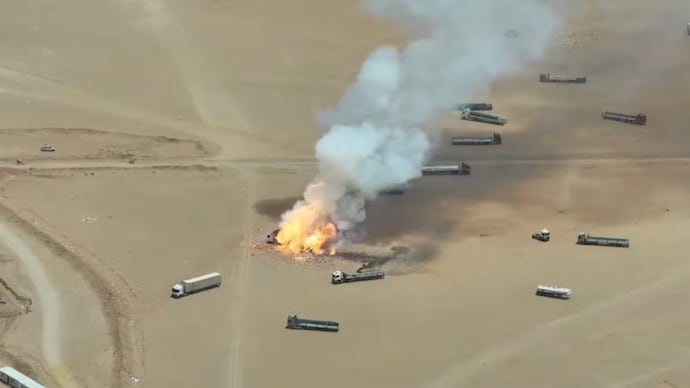

Iran-backed Houthi fighters launched a major wave of attacks against four cities in southern Saudi Arabia on Tuesday, injuring 73 people and setting oil-related facilities ablaze in a sharp escalation that threatens to widen the Middle East conflict. The strikes targeted areas stretching from the Saudi-Yemeni border to the Red Sea coast, with the Houthis claiming they had carried out a broad military operation deep inside Saudi territory.
The Iran-aligned group said it used drones and missiles against a Saudi airbase in Khamis Mushait, while also targeting facilities belonging to Saudi Arabia's state oil company in nearby Abha, the border city of Najran and Jazan, which is a major Red Sea port that is home to a refinery and power plant.
VIDEO SHOWS HUGE EXPLOSIONS
Footage released after the attacks captured the violent moment a fragmentation missile struck trucks carrying military equipment, triggering a series of explosions. Thick clouds of smoke billowed into the sky as soldiers were seen fleeing the camp amid the blasts.
Other imagery showed fires burning at locations targeted in the attacks.
NASA satellite imagery separately showed a dense cloud of black smoke hanging over the Jazan refinery, while another column of white smoke was visible rising from an oil distribution centre in Abha.
Saudi authorities confirmed fires at the targeted sites and said women and children were among the 73 people wounded. The high number of casualties indicated the seriousness of the attacks, which came after a period of relative calm and amid a much broader confrontation involving the US and Iran.
Ground-level images independently confirming the full extent of the damage were not immediately available. Access to information inside Saudi Arabia is tightly controlled, and witnesses could not immediately be reached.
The Houthis also released images of explosions involving Saudi trucks in separate strikes near the border a day earlier.
TRUCE COLLAPSE FUELS FRESH FIGHTING
The latest escalation followed a Houthi attempt in July to fly a plane from Tehran to Sanaa, challenging the Saudi-led coalition's long-running air and naval blockade. A coalition airstrike hit the runway at Sanaa airport and prevented the plane from landing. The Houthis then resumed missile and drone attacks on Saudi Arabia and attacks on Saudi shipping in the Red Sea, bringing an end to a 2022 truce that had largely halted fighting.
Saudi Arabia has led an Arab coalition against the Iran-backed group in Yemen for more than a decade. Although the conflict had eased considerably in recent years, the breakdown of the ceasefire has revived fears of a wider confrontation.
Houthi spokesman Yahya Saree accused Riyadh of escalating the conflict through airstrikes on Yemen and warned that the group would respond. Houthi-controlled media later reported that Saudi warplanes had carried out strikes in Yemen's Jubah district, east of the capital Sanaa, as well as in Taiz province in the southwest.
The renewed fighting has also displaced thousands of civilians. The International Organization for Migration said more than 18,500 people had fled their homes because of fighting along Yemen's west coast over the previous three days.
Saudi-backed Yemeni forces fighting on behalf of the internationally recognised government have recently launched a multi-pronged offensive against Houthi-held territory after the group attempted to advance on government positions.
The government, which was pushed out of the capital by the Houthis about 12 years ago, has said it wants to eventually retake all territory controlled by the group.
OIL PRICES NEAR $100 PER BARREL
The renewed violence is also threatening to deepen the conflict's economic consequences.
After a relatively clam August, fighting in the Gulf has intensified again after the US and Iran exchanged fire. The escalation has pushed global crude prices back towards the $100-a-barrel mark.
Any sustained Houthi campaign against southwestern Saudi Arabia could have consequences far beyond the immediate battlefield. The region contains critical energy infrastructure, while attacks around the Red Sea could threaten another major route for global trade and energy shipments.
IRAN THREATENS 'MARITIME EXCLUSION ZONE'
The Gulf confrontation has increasingly become a test of economic and military endurance between the US and Iran. Washington is seeking to keep oil flowing to international markets by guiding vessels through the Strait of Hormuz while simultaneously attempting to restrict Iranian oil exports through a naval blockade.
Iran, meanwhile, has announced plans to tighten its control over the strategic waterway. Tehran has said it will soon provide details of a "maritime exclusion zone" stretching from the edge of the US blockade through the strait and into the Gulf.
The escalation followed US attacks on Iranian tankers over the weekend, which Washington said were retaliation for Iranian fire directed at US warships. Tehran said it had deployed newer and more capable ballistic missiles against American naval forces.
Despite US strikes that have weakened Iran's conventional military capabilities and placed further pressure on its economy, Tehran retains the ability to launch missiles and drones against American bases across the region and vessels operating near the strait.