
100 rescues in 6 days: Meet Priya Adhikari, Nepal's first woman helicopter captain
Priya Adhikari, Nepal's first woman helicopter captain, has flown around 100 rescue missions as choppers evacuated hundreds of flood survivors at the Nepal-Tibet border. She says the scale of the disaster has tested even her high-altitude rescue experience.
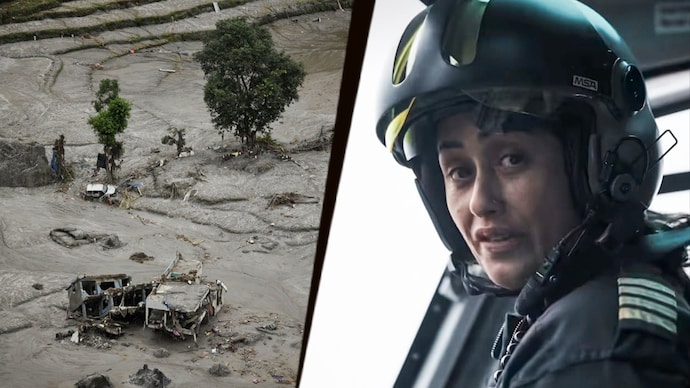

Five or six helicopters land together, their pilots constantly talking over the radio as they race to evacuate survivors from Timure, one of Nepal's flood-hit areas. On the ground, thick mud makes every landing dangerous. In the air, Priya Adhikari, Nepal's first woman helicopter captain, must constantly coordinate with the other pilots.
Adhikari, 40, has flown around 100 rescue missions in less than a week as devastating floods and mudslides in Nepal and Tibet have killed over 1,000 people and left thousands missing. Exhausted after days of flying, she told CNN's Anderson Cooper that the scale of the disaster was unlike anything she had seen before.
“Most of us are so exhausted because of all the flights we've been doing. We've been trained for this,” she said.
Around 20 helicopters have been flying continuously over Timure village in flood-hit Rasuwa district, where scores of people remain missing. "The pilots must constantly coordinate over the radio, sometimes with five or six helicopters landing at the same spot to evacuate survivors," Adhikari said.
The risks begin even before survivors are brought aboard. Adhikari said some areas have been covered in such thick mud that helicopters cannot safely land and shut down. Pilots have to remain on power throughout the rescue, she said.
But what Adhikari sees below is perhaps harder to process.
She recalled flying over Timure, where bodies lay scattered after the flash floods. More than 200 survivors were evacuated from the area during the first two days, with five or six helicopters, including Army Augusta helicopters, involved in the operation.
“Everything is gone. Five hydropower projects are gone, lives are gone,” she said.
Yet amid the devastation, Adhikari finds a reason to smile – the survivors. “Every time I go and land I see people around and waving at them,” she said. “I say, you survived.”
Adhikari stressed that the people she rescued are strangers, but that has not made the missions any less emotional. “They are not my relatives,” she said, describing the emotions she carries after seeing survivors and bodies from above.
She said the flash floods were even bigger than Nepal's devastating 2015 earthquake.
WHO IS PRIYA ADHIKARI?
Adhikari became Nepal's first woman helicopter captain after an unconventional journey into aviation, long seen as a male-dominated industry. She studied environmental science and worked as a cabin crew before a helicopter joyride changed the course of her career.
She later travelled to the Philippines for helicopter training and accumulated the flying hours required to become a captain. She ultimately became a full-time helicopter pilot in 2017.
The 40-year-old went on to specialise in high-altitude rescue flying, carrying out search-and-rescue missions in the Himalayas and rescuing injured climbers from Mount Everest. She has flown rescue missions at altitudes of up to about 6,200 metres.
Adhikari has also spoken about the skepticism she faced early in her career, when some doubted that a woman could become a helicopter captain. She eventually broke that barrier and became Nepal's first woman to hold the position.
Years of high-altitude flying and rescue missions have prepared her for dangerous situations. But the scale of Nepal's flash floods has tested even that experience.
Still, she keeps flying.
“We’ve been trained for this,” as Adhikari puts it.