Netanyahu, Eisenkot fail to bridge gaps as Israeli unity government talks hit a wall

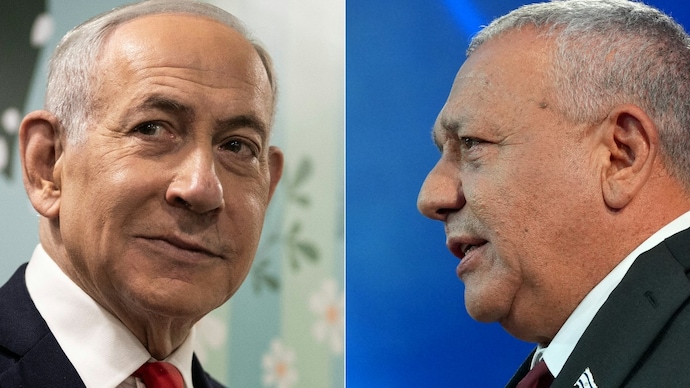
Benjamin Netanyahu and Gadi Eisenkot failed to reach a national unity agreement during Sunday's talks. The breakdown leaves Eisenkot racing to form a coalition before his mandate expires.
 Last UpdatedNov 29, 2026 20:51 IST
 Published byWritten BySatyam Singh
Israeli Prime Minister Benjamin Netanyahu's attempt to secure a national unity government with opposition leader Gadi Eisenkot appears to have hit a dead end. According to Israeli media reports, the two leaders failed to bridge their differences during a meeting on Sunday. Despite Netanyahu's offer to serve as the second prime minister under a rotational arrangement, the talks ended without an agreement, and neither side failed to make enough progress to justify another round of negotiations.
The meeting between Netanyahu and Eisenkot, chairman of the Yashar party, lasted around two hours and was intended to explore the possibility of bringing their political camps together. A joint statement issued by Likud and Yashar described the discussions as "businesslike", adding that "both sides were seeking to bridge the substantial gaps between them."
The breakdown comes at a crucial stage in government formation, as Eisenkot enters the final week of his mandate to put together a coalition.
EISENKOT REFUSES TO ABANDON ALLIES
One of the central obstacles appears to be Eisenkot's reluctance to distance himself from the parties that helped his bloc emerge with a parliamentary majority after the October 27 election. During the meeting, Eisenkot reportedly told Netanyahu that he remained committed to his existing political partners. He also indicated that Likud and its allies could join the government after its formation, provided they agreed to its guiding principles.
When asked about Yashar's preferred direction for forming the next government, Eisenkot's office offered a brief response to The Jerusalem Post: "We will be with the Jewish majority."
The statement appeared to underline Eisenkot's position that any government he leads must retain the backing of a Jewish majority in parliament, rather than depend on arrangements that would fundamentally alter his existing coalition.
Meanwhile, Netanyahu's camp was far less restrained in its assessment of the meeting. Likud sources accused Eisenkot of having little genuine interest in a national unity arrangement, arguing that his refusal to accept Netanyahu's proposed rotational agreement exposed his political priorities.
"It has become clear that Eisenkot is not interested in a national unity government," the sources told Channel 12 news, accusing him of focusing on "forming a government controlled by supporters of terrorism".
According to the report, Likud reiterated its support for forming a national unity government, while urging Eisenkot to reconsider his position and work towards an agreement.
NETANYAHU'S ROTATION OFFER FAILS TO BREAK DEADLOCK
The Sunday meeting followed a significant political announcement by Netanyahu on Saturday. For the first time, the prime minister publicly indicated that he was willing to serve as the second prime minister in a rotational arrangement, with Eisenkot taking the top position initially. This was an attempt to prevent Eisenkot from completing the formation of an alternative government without Likud. Eisenkot had responded by giving Netanyahu 24 hours to demonstrate that his proposal was genuine and inviting Likud to begin negotiations.
"If Likud is genuinely committed to unity, I am prepared to assess its seriousness over the next 24 hours," Eisenkot said.
The meeting was initially expected to take place in Herzliya but was shifted to the Kirya military headquarters in Tel Aviv. It began with a security briefing before the two leaders turned to discussions about forming a national unity government. Netanyahu's military secretary was initially present but left shortly after the meeting began. Former strategic affairs minister Ron Dermer, reportedly involved in mediating the negotiations, subsequently joined the discussions.
Despite the high-level intervention and Netanyahu's willingness to relinquish the first turn in the proposed arrangement, the meeting failed to produce a breakthrough.
BENNETT CONTINUE TALKS AS COALITION OPTIONS NARROW
While Netanyahu and Eisenkot were meeting, parallel negotiations were taking place between Yashar representatives and Naftali Bennett's B'Yachad party.
The discussions continued for more than three hours, with reports indicating considerable progress between the two sides. The question of military conscription for ultra-Orthodox Jews, however, remained a major sticking point.
Bennett is the only leader within Eisenkot's political bloc who has openly supported bringing Netanyahu and Likud into a unity government. He has argued that Netanyahu should serve as the second prime minister in a rotational arrangement, with Eisenkot leading the government initially.
His position, however, puts him at odds with other leaders in Eisenkot's bloc. Avigdor Liberman of Yisrael Beytenu and Yair Golan of the Democrats have already signed coalition agreements with Yashar and drawn a red line against joining a unity government with Netanyahu.
Liberman had also warned on Friday that Netanyahu could offer a rotational arrangement as a manoeuvre to derail the formation of an alternative government.
The uncertainty is particularly significant because Eisenkot's time to form a government is running short. He received the mandate from Israel's president on November 8 and is now entering the final week of the period allotted to him. He can, however, request an additional 14 days to complete the process.