Can board marks replace some entrance exams? Here's why the debate is back
Should one three-hour exam determine a student's future? A fresh debate is questioning whether India has become overly reliant on entrance tests such as NEET and CUET. Here's why experts are calling for fewer exams, stronger school education and a more balanced admissions system.
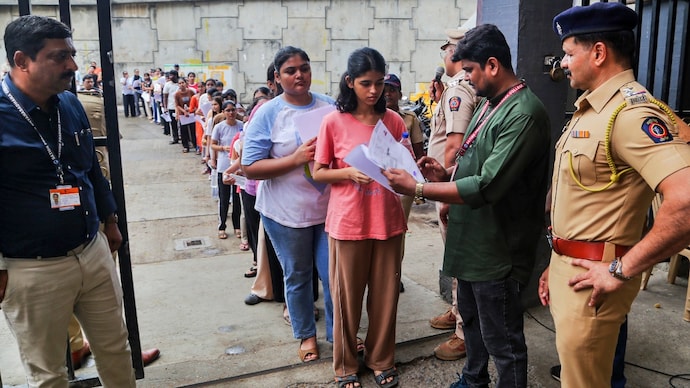
For millions of Indian students, school is no longer the finish line. It is only the warm-up.
After years of preparing for board exams, students often start from scratch for another round of high-stakes tests.
Engineering aspirants juggle JEE Main and JEE Advanced. Medical students prepare for NEET. Central university applicants sit for CUET.
Teacher recruitment, research fellowships, and several postgraduate programmes each run their own national exam. One three-hour test now often outweighs years of classroom work.
The debate has resurfaced after education entrepreneur Maheshwer Peri posted on X arguing that India should stop obsessing only over making entrance exams leak-proof, and instead ask whether the country needs this many entrance exams at all.
He suggested board exam performance, 80% or above, could serve as the minimum eligibility bar for premier institutions like IITs and AIIMS, with entrance tests reserved only for students who clear that threshold.
The replies underneath his post turned out to be their own debate, and a sharper one.
WHEN BOARD MARKS STOPPED MATTERING
For decades, board exams were the primary gateway to higher education. That changed as competition intensified and institutions needed a common yardstick across wildly different school systems.
CUET standardised admissions to central universities. NEET replaced multiple medical entrance tests with one national exam.
Critics argue that even though a common entrance exam stresses on levelling the playing field, it also drains the importance of consistent school performance, pushing students into "dummy schools" that keep them formally enrolled while they spend their real hours at coaching centres.
IS 80% EVEN A FAIR BAR?
JEE already uses a version of Peri’s idea of setting a minimum eligibility bar in the Class 12 board results to get into premier institutes in the country.
A 75% board aggregate, or top 20 percentile, is a qualifying filter before JEE itself. So a similar NEET threshold isn't unprecedented. But 80% is a notably higher bar, and the comparability problem underneath it is real.
A CBSE or ICSE 90% and a Maharashtra HSC or Bihar board 90% do not reflect the same rigour. Marking leniency varies sharply by state, and boards with looser evaluation would clear an 80% threshold far more easily than boards known for stricter checking, undermining the level playing field NEET was built to create.
There's a harder version of this worry too. Loosening the gate to board marks doesn't just filter out weak students, it risks admitting students who cleared a lenient board comfortably but can't handle actual coursework.
Technical recruiters have long described engineering graduates who score well on paper but struggle to explain foundational concepts in their own subject.
At IIT or AIIMS scale, a pure board-marks gate could produce far higher first-year dropout rates than a calibrated entrance exam does, trading one problem for a worse one.
THE NEET QUESTION
Government medical colleges charge a few lakh rupees for the full MBBS course. Private colleges can charge over a crore, sometimes close to 1.5 crore.
Government seats tend to go to stronger NEET ranks, while some expensive private colleges admit much further down the list once affordability, not exam score, becomes the real barrier.
That raises an uncomfortable question: if money already decides access to many private seats, should every medical college run on the same entrance framework?
There's history worth weighing on the other side too. AIIMS New Delhi and the Armed Forces Medical College once ran their own entrance exams and interviews for years without the scale-driven leak crises NEET now faces, largely because the applicant pool was small and self-selecting.
That's an argument for smaller, institution-specific gatekeeping. It comes with its own tradeoff: smaller exams are harder to standardise nationally and easier to allege bias in.
Supporters of keeping NEET make a blunter equity case. It is one of the few mechanisms letting a talented student from a poor family compete for a medical seat on ability rather than money. Scrapping it, they argue, hands the advantage to costlier private colleges and to admission processes with far less transparency.
THE SEAT MATH
The scale of the mismatch is the strongest argument for some kind of filter. In 2025, over 1.4 crore students appeared for Class 12 boards across CBSE, ICSE, and state boards.
IITs had roughly 17,000 seats. AIIMS and its partner institutes had around 1,900. NLUs together had about 3,600. No admission method, board marks or entrance exam, changes that basic arithmetic. It only decides who does the filtering.
This pressure isn't unique to medicine or engineering either. CAT has roughly 5,000 to 6,000 seats across top B-schools and draws about 2.5 million applicants. The bottleneck is structural across nearly every competitive Indian exam.
THE COACHING ECONOMY
The debate over entrance exams is also a debate about coaching. India's test-preparation industry is estimated to be worth more than Rs 58,000 crore, growing at 15 to 20% annually, with over 7.1 crore students enrolled in coaching classes across the country.
Cities such as Kota, Hyderabad, Delhi and Patna attract lakhs of students each year. Families often spend several lakh rupees on coaching, study material, hostel accommodation and test series.
Students from economically weaker backgrounds frequently struggle to match these resources and rely solely on classroom teaching, raising concerns about whether entrance examinations truly measure aptitude alone or also reward access to expensive preparation.
Critics argue this creates an uneven playing field.
Then there is the constant mental pressure of residing in a coaching city. Kota has become the clearest symbol of both the pressure and the possibilities for change. The city recorded 29 student suicides in 2023, the highest in eight years.
After district authorities introduced mandatory counselling, anti-suicide devices in hostels and closer monitoring, the number fell to 17 in 2024. The figures suggest that while exam pressure is real, targeted interventions can make a measurable difference.
THE FOCUS IS SHIFTING FROM LEAKS TO THE SYSTEM ITSELF
Until recently, the national conversation centred on paper leaks and exam security. Following the NEET-UG controversy in 2024, Parliament passed the Public Examinations (Prevention of Unfair Means) Act, 2024, introducing stricter penalties for organised malpractice.
In the days after Union Education Minister Dharmendra Pradhan resigned following weeks of protest over the NEET-UG leak, the government has also announced a high-level task force led by Infosys co-founder Nandan Nilekani to recommend technology-driven reforms for conducting secure examinations.
The new paper leak bill includes tougher penalties, including up to 10 years in prison and fines up to Rs 50 lakh for individuals, and up to Rs 10 crore for organised paper-leak rackets.
But voices like Maheshwer Peri's are pushing the debate in a different direction. Their argument is that making examinations leak-proof addresses only one part of the problem. The larger question, they say, is whether India's admission system has become too dependent on high-stakes entrance tests in the first place.
SO, WHAT REPLACES THEM?
That is where the debate becomes complicated.
Some educationists want board examination performance to carry greater weight and see entrance tests as a second-stage filter rather than the primary gateway.
Others argue that this would simply shift the pressure from entrance examinations to board exams, while also raising questions about differences in marking standards across school boards.
Another view is to retain national entrance tests but redesign them to assess analytical ability and problem-solving rather than speed, memorisation and coaching.
There is broad agreement that the current system deserves scrutiny. What remains unresolved is what a better alternative would look like.
Peri's social media post may have reignited the conversation, but it has also exposed a deeper question that Indian education has grappled with for years: Should a student's future be shaped primarily by one competitive examination, or is it time to build an admission system that values years of learning as much as one day's performance?
For millions of Indian students, school is no longer the finish line. It is only the warm-up.
After years of preparing for board exams, students often start from scratch for another round of high-stakes tests.
Engineering aspirants juggle JEE Main and JEE Advanced. Medical students prepare for NEET. Central university applicants sit for CUET.
Teacher recruitment, research fellowships, and several postgraduate programmes each run their own national exam. One three-hour test now often outweighs years of classroom work.
The debate has resurfaced after education entrepreneur Maheshwer Peri posted on X arguing that India should stop obsessing only over making entrance exams leak-proof, and instead ask whether the country needs this many entrance exams at all.
He suggested board exam performance, 80% or above, could serve as the minimum eligibility bar for premier institutions like IITs and AIIMS, with entrance tests reserved only for students who clear that threshold.
The replies underneath his post turned out to be their own debate, and a sharper one.
WHEN BOARD MARKS STOPPED MATTERING
For decades, board exams were the primary gateway to higher education. That changed as competition intensified and institutions needed a common yardstick across wildly different school systems.
CUET standardised admissions to central universities. NEET replaced multiple medical entrance tests with one national exam.
Critics argue that even though a common entrance exam stresses on levelling the playing field, it also drains the importance of consistent school performance, pushing students into "dummy schools" that keep them formally enrolled while they spend their real hours at coaching centres.
IS 80% EVEN A FAIR BAR?
JEE already uses a version of Peri’s idea of setting a minimum eligibility bar in the Class 12 board results to get into premier institutes in the country.
A 75% board aggregate, or top 20 percentile, is a qualifying filter before JEE itself. So a similar NEET threshold isn't unprecedented. But 80% is a notably higher bar, and the comparability problem underneath it is real.
A CBSE or ICSE 90% and a Maharashtra HSC or Bihar board 90% do not reflect the same rigour. Marking leniency varies sharply by state, and boards with looser evaluation would clear an 80% threshold far more easily than boards known for stricter checking, undermining the level playing field NEET was built to create.
There's a harder version of this worry too. Loosening the gate to board marks doesn't just filter out weak students, it risks admitting students who cleared a lenient board comfortably but can't handle actual coursework.
Technical recruiters have long described engineering graduates who score well on paper but struggle to explain foundational concepts in their own subject.
At IIT or AIIMS scale, a pure board-marks gate could produce far higher first-year dropout rates than a calibrated entrance exam does, trading one problem for a worse one.
THE NEET QUESTION
Government medical colleges charge a few lakh rupees for the full MBBS course. Private colleges can charge over a crore, sometimes close to 1.5 crore.
Government seats tend to go to stronger NEET ranks, while some expensive private colleges admit much further down the list once affordability, not exam score, becomes the real barrier.
That raises an uncomfortable question: if money already decides access to many private seats, should every medical college run on the same entrance framework?
There's history worth weighing on the other side too. AIIMS New Delhi and the Armed Forces Medical College once ran their own entrance exams and interviews for years without the scale-driven leak crises NEET now faces, largely because the applicant pool was small and self-selecting.
That's an argument for smaller, institution-specific gatekeeping. It comes with its own tradeoff: smaller exams are harder to standardise nationally and easier to allege bias in.
Supporters of keeping NEET make a blunter equity case. It is one of the few mechanisms letting a talented student from a poor family compete for a medical seat on ability rather than money. Scrapping it, they argue, hands the advantage to costlier private colleges and to admission processes with far less transparency.
THE SEAT MATH
The scale of the mismatch is the strongest argument for some kind of filter. In 2025, over 1.4 crore students appeared for Class 12 boards across CBSE, ICSE, and state boards.
IITs had roughly 17,000 seats. AIIMS and its partner institutes had around 1,900. NLUs together had about 3,600. No admission method, board marks or entrance exam, changes that basic arithmetic. It only decides who does the filtering.
This pressure isn't unique to medicine or engineering either. CAT has roughly 5,000 to 6,000 seats across top B-schools and draws about 2.5 million applicants. The bottleneck is structural across nearly every competitive Indian exam.
THE COACHING ECONOMY
The debate over entrance exams is also a debate about coaching. India's test-preparation industry is estimated to be worth more than Rs 58,000 crore, growing at 15 to 20% annually, with over 7.1 crore students enrolled in coaching classes across the country.
Cities such as Kota, Hyderabad, Delhi and Patna attract lakhs of students each year. Families often spend several lakh rupees on coaching, study material, hostel accommodation and test series.
Students from economically weaker backgrounds frequently struggle to match these resources and rely solely on classroom teaching, raising concerns about whether entrance examinations truly measure aptitude alone or also reward access to expensive preparation.
Critics argue this creates an uneven playing field.
Then there is the constant mental pressure of residing in a coaching city. Kota has become the clearest symbol of both the pressure and the possibilities for change. The city recorded 29 student suicides in 2023, the highest in eight years.
After district authorities introduced mandatory counselling, anti-suicide devices in hostels and closer monitoring, the number fell to 17 in 2024. The figures suggest that while exam pressure is real, targeted interventions can make a measurable difference.
THE FOCUS IS SHIFTING FROM LEAKS TO THE SYSTEM ITSELF
Until recently, the national conversation centred on paper leaks and exam security. Following the NEET-UG controversy in 2024, Parliament passed the Public Examinations (Prevention of Unfair Means) Act, 2024, introducing stricter penalties for organised malpractice.
In the days after Union Education Minister Dharmendra Pradhan resigned following weeks of protest over the NEET-UG leak, the government has also announced a high-level task force led by Infosys co-founder Nandan Nilekani to recommend technology-driven reforms for conducting secure examinations.
The new paper leak bill includes tougher penalties, including up to 10 years in prison and fines up to Rs 50 lakh for individuals, and up to Rs 10 crore for organised paper-leak rackets.
But voices like Maheshwer Peri's are pushing the debate in a different direction. Their argument is that making examinations leak-proof addresses only one part of the problem. The larger question, they say, is whether India's admission system has become too dependent on high-stakes entrance tests in the first place.
SO, WHAT REPLACES THEM?
That is where the debate becomes complicated.
Some educationists want board examination performance to carry greater weight and see entrance tests as a second-stage filter rather than the primary gateway.
Others argue that this would simply shift the pressure from entrance examinations to board exams, while also raising questions about differences in marking standards across school boards.
Another view is to retain national entrance tests but redesign them to assess analytical ability and problem-solving rather than speed, memorisation and coaching.
There is broad agreement that the current system deserves scrutiny. What remains unresolved is what a better alternative would look like.
Peri's social media post may have reignited the conversation, but it has also exposed a deeper question that Indian education has grappled with for years: Should a student's future be shaped primarily by one competitive examination, or is it time to build an admission system that values years of learning as much as one day's performance?
For millions of Indian students, school is no longer the finish line. It is only the warm-up.
After years of preparing for board exams, students often start from scratch for another round of high-stakes tests.
Engineering aspirants juggle JEE Main and JEE Advanced. Medical students prepare for NEET. Central university applicants sit for CUET.
Teacher recruitment, research fellowships, and several postgraduate programmes each run their own national exam. One three-hour test now often outweighs years of classroom work.
The debate has resurfaced after education entrepreneur Maheshwer Peri posted on X arguing that India should stop obsessing only over making entrance exams leak-proof, and instead ask whether the country needs this many entrance exams at all.
He suggested board exam performance, 80% or above, could serve as the minimum eligibility bar for premier institutions like IITs and AIIMS, with entrance tests reserved only for students who clear that threshold.
The replies underneath his post turned out to be their own debate, and a sharper one.
WHEN BOARD MARKS STOPPED MATTERING
For decades, board exams were the primary gateway to higher education. That changed as competition intensified and institutions needed a common yardstick across wildly different school systems.
CUET standardised admissions to central universities. NEET replaced multiple medical entrance tests with one national exam.
Critics argue that even though a common entrance exam stresses on levelling the playing field, it also drains the importance of consistent school performance, pushing students into "dummy schools" that keep them formally enrolled while they spend their real hours at coaching centres.
IS 80% EVEN A FAIR BAR?
JEE already uses a version of Peri’s idea of setting a minimum eligibility bar in the Class 12 board results to get into premier institutes in the country.
A 75% board aggregate, or top 20 percentile, is a qualifying filter before JEE itself. So a similar NEET threshold isn't unprecedented. But 80% is a notably higher bar, and the comparability problem underneath it is real.
A CBSE or ICSE 90% and a Maharashtra HSC or Bihar board 90% do not reflect the same rigour. Marking leniency varies sharply by state, and boards with looser evaluation would clear an 80% threshold far more easily than boards known for stricter checking, undermining the level playing field NEET was built to create.
There's a harder version of this worry too. Loosening the gate to board marks doesn't just filter out weak students, it risks admitting students who cleared a lenient board comfortably but can't handle actual coursework.
Technical recruiters have long described engineering graduates who score well on paper but struggle to explain foundational concepts in their own subject.
At IIT or AIIMS scale, a pure board-marks gate could produce far higher first-year dropout rates than a calibrated entrance exam does, trading one problem for a worse one.
THE NEET QUESTION
Government medical colleges charge a few lakh rupees for the full MBBS course. Private colleges can charge over a crore, sometimes close to 1.5 crore.
Government seats tend to go to stronger NEET ranks, while some expensive private colleges admit much further down the list once affordability, not exam score, becomes the real barrier.
That raises an uncomfortable question: if money already decides access to many private seats, should every medical college run on the same entrance framework?
There's history worth weighing on the other side too. AIIMS New Delhi and the Armed Forces Medical College once ran their own entrance exams and interviews for years without the scale-driven leak crises NEET now faces, largely because the applicant pool was small and self-selecting.
That's an argument for smaller, institution-specific gatekeeping. It comes with its own tradeoff: smaller exams are harder to standardise nationally and easier to allege bias in.
Supporters of keeping NEET make a blunter equity case. It is one of the few mechanisms letting a talented student from a poor family compete for a medical seat on ability rather than money. Scrapping it, they argue, hands the advantage to costlier private colleges and to admission processes with far less transparency.
THE SEAT MATH
The scale of the mismatch is the strongest argument for some kind of filter. In 2025, over 1.4 crore students appeared for Class 12 boards across CBSE, ICSE, and state boards.
IITs had roughly 17,000 seats. AIIMS and its partner institutes had around 1,900. NLUs together had about 3,600. No admission method, board marks or entrance exam, changes that basic arithmetic. It only decides who does the filtering.
This pressure isn't unique to medicine or engineering either. CAT has roughly 5,000 to 6,000 seats across top B-schools and draws about 2.5 million applicants. The bottleneck is structural across nearly every competitive Indian exam.
THE COACHING ECONOMY
The debate over entrance exams is also a debate about coaching. India's test-preparation industry is estimated to be worth more than Rs 58,000 crore, growing at 15 to 20% annually, with over 7.1 crore students enrolled in coaching classes across the country.
Cities such as Kota, Hyderabad, Delhi and Patna attract lakhs of students each year. Families often spend several lakh rupees on coaching, study material, hostel accommodation and test series.
Students from economically weaker backgrounds frequently struggle to match these resources and rely solely on classroom teaching, raising concerns about whether entrance examinations truly measure aptitude alone or also reward access to expensive preparation.
Critics argue this creates an uneven playing field.
Then there is the constant mental pressure of residing in a coaching city. Kota has become the clearest symbol of both the pressure and the possibilities for change. The city recorded 29 student suicides in 2023, the highest in eight years.
After district authorities introduced mandatory counselling, anti-suicide devices in hostels and closer monitoring, the number fell to 17 in 2024. The figures suggest that while exam pressure is real, targeted interventions can make a measurable difference.
THE FOCUS IS SHIFTING FROM LEAKS TO THE SYSTEM ITSELF
Until recently, the national conversation centred on paper leaks and exam security. Following the NEET-UG controversy in 2024, Parliament passed the Public Examinations (Prevention of Unfair Means) Act, 2024, introducing stricter penalties for organised malpractice.
In the days after Union Education Minister Dharmendra Pradhan resigned following weeks of protest over the NEET-UG leak, the government has also announced a high-level task force led by Infosys co-founder Nandan Nilekani to recommend technology-driven reforms for conducting secure examinations.
The new paper leak bill includes tougher penalties, including up to 10 years in prison and fines up to Rs 50 lakh for individuals, and up to Rs 10 crore for organised paper-leak rackets.
But voices like Maheshwer Peri's are pushing the debate in a different direction. Their argument is that making examinations leak-proof addresses only one part of the problem. The larger question, they say, is whether India's admission system has become too dependent on high-stakes entrance tests in the first place.
SO, WHAT REPLACES THEM?
That is where the debate becomes complicated.
Some educationists want board examination performance to carry greater weight and see entrance tests as a second-stage filter rather than the primary gateway.
Others argue that this would simply shift the pressure from entrance examinations to board exams, while also raising questions about differences in marking standards across school boards.
Another view is to retain national entrance tests but redesign them to assess analytical ability and problem-solving rather than speed, memorisation and coaching.
There is broad agreement that the current system deserves scrutiny. What remains unresolved is what a better alternative would look like.
Peri's social media post may have reignited the conversation, but it has also exposed a deeper question that Indian education has grappled with for years: Should a student's future be shaped primarily by one competitive examination, or is it time to build an admission system that values years of learning as much as one day's performance?

