Is Physics the toughest Olympiad? India's five-gold triumph makes the case
India's clean sweep at the 56th International Physics Olympiad is more than a historic achievement. It makes a compelling case for the Physics Olympiad as one of the world's toughest academic competitions, where success demands not just mastery of theory but exceptional experimental skill and scientific thinking.
When conversations turn to the world's toughest academic competitions, the International Mathematical Olympiad (IMO) is usually the first name that comes up. Yet the International Physics Olympiad (IPhO) demands an equally rare combination of intellectual rigour, creativity and perseverance, while receiving only a fraction of the recognition.
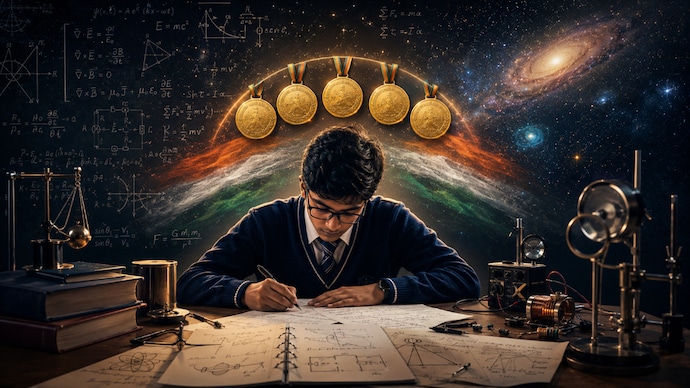
India's clean sweep at the 56th IPhO in 2026, where all five team members won gold medals and the country finished joint first globally, is therefore more than a historic result. It is a timely reminder that excellence in science deserves to be celebrated just as enthusiastically as excellence in mathematics and receive the same visibility as the country's finest mathematical triumphs.
Held in Bucaramanga, Colombia, the 56th IPhO brought together 381 students from 87 countries. India shared the top position with Russia, China, Kazakhstan, South Korea and Taiwan, making the five-gold sweep one of the country's greatest achievements in international science competitions.
A COMPETITION THAT DEMANDS MORE THAN EQUATIONS
The International Mathematical Olympiad (IMO) and the International Physics Olympiad (IPhO) are widely regarded as the highest level of school-level competition in their respective disciplines, but they reward different kinds of brilliance.
The IMO is built around six proof-based problems that test logical reasoning, abstraction and mathematical creativity. Success depends on constructing elegant, rigorous arguments using pure mathematics.
The IPhO, meanwhile, takes those analytical abilities a step further by combining advanced theory with experimental science. Students spend two five-hour sessions tackling theoretical questions and laboratory experiments, where they are assessed on conceptual understanding, mathematical modelling, data analysis, experimental precision and scientific reasoning.
From mechanics and electromagnetism to optics, thermodynamics and modern physics, participants are challenged to do far more than solve complex equations. They must think like scientists --- designing experiments, interpreting observations, analysing data and applying theoretical concepts to real-world situations.
Rather than debating which Olympiad is tougher, educators say the competitions measure excellence in different ways. If the IMO celebrates mathematical elegance, the IPhO rewards the ability to bridge theory with experimentation, an equally demanding skill set.
A JOURNEY MEASURED IN YEARS, NOT WEEKS
India's clean sweep is the culmination of one of the country's most rigorous academic selection processes.
Aspiring physicists begin by clearing the National Standard Examination in Physics (NSEP) before advancing to the Indian National Physics Olympiad (INPhO). The country's brightest students are then shortlisted for the Orientation-cum-Selection Camp (OCSC), where they undergo months of intensive theoretical and laboratory training before the final five-member team is selected.
Behind every gold medal lie years of studying concepts far beyond the school curriculum, solving exceptionally challenging problems and developing scientific intuition under experienced mentors.
For Dr Saurabh Kumar, Founder & CEO, Shiksha Nation, India's clean sweep reinforces an important lesson about scientific learning.
"India's clean sweep at the International Physics Olympiad is a powerful reminder that scientific excellence is built on deep conceptual understanding, relentless curiosity, and years of disciplined preparation-not shortcuts," he says.
Kumar believes the achievement should encourage greater investment in nurturing talent in the fundamental sciences. According to him, Physics Olympiads demand the same blend of analytical thinking, creativity and resilience that Mathematics Olympiads have long been recognised for, and young scientists deserve equal appreciation.
WHY THE MATHEMATICS OLYMPIAD DOMINATES THE SPOTLIGHT
The International Mathematical Olympiad enjoys a level of recognition that few academic competitions can match.
Part of that prominence comes from history. Founded in 1959, the IMO predates the IPhO by eight years and has had decades longer to build its global reputation. Mathematics is also easier to popularise through puzzles, competitions and coaching programmes, making Olympiad culture more accessible to students and parents alike.
Physics Olympiads, by contrast, require specialised laboratories, experimental training and a deeper integration of theory with practice. As a result, the competition has largely remained within scientific and academic circles despite being just as demanding.
Both Olympiads reward originality over rote learning and have produced generations of students who have gone on to excel at leading universities and research institutions around the world. The difference lies not in prestige within academia, but in public visibility.
MENTORSHIP MAKES THE DIFFERENCE
Talent is only the starting point. Educators say it is sustained mentorship, perseverance and intellectual curiosity that transform promising students into Olympiad champions.
Career mentor and educator Pradeep Jain says India's five-gold performance is proof of what focused preparation can achieve.
"India's amazing achievement of securing five gold medals is a testament to the fact that one needs immense conceptual understanding, analytical skills, and hard work for being good in Physics," he says.
He believes India's success reflects the strength of quality mentoring and sustained effort, enabling young physicists to compete with the very best in the world.
MORE THAN A MEDAL TALLY
Every Olympiad medal tells a story of countless hours spent studying, experimenting, failing and trying again. India's historic clean sweep at the International Physics Olympiad is no different.
The achievement is a reminder that while the International Mathematical Olympiad has inspired generations of students, the Physics Olympiad deserves equal recognition for identifying some of the world's brightest young scientific minds. Celebrating these young physicists is not just about applauding five gold medals, it is about recognising the future researchers, innovators and problem-solvers who will shape tomorrow's world.
When conversations turn to the world's toughest academic competitions, the International Mathematical Olympiad (IMO) is usually the first name that comes up. Yet the International Physics Olympiad (IPhO) demands an equally rare combination of intellectual rigour, creativity and perseverance, while receiving only a fraction of the recognition.
India's clean sweep at the 56th IPhO in 2026, where all five team members won gold medals and the country finished joint first globally, is therefore more than a historic result. It is a timely reminder that excellence in science deserves to be celebrated just as enthusiastically as excellence in mathematics and receive the same visibility as the country's finest mathematical triumphs.
Held in Bucaramanga, Colombia, the 56th IPhO brought together 381 students from 87 countries. India shared the top position with Russia, China, Kazakhstan, South Korea and Taiwan, making the five-gold sweep one of the country's greatest achievements in international science competitions.
A COMPETITION THAT DEMANDS MORE THAN EQUATIONS
The International Mathematical Olympiad (IMO) and the International Physics Olympiad (IPhO) are widely regarded as the highest level of school-level competition in their respective disciplines, but they reward different kinds of brilliance.
The IMO is built around six proof-based problems that test logical reasoning, abstraction and mathematical creativity. Success depends on constructing elegant, rigorous arguments using pure mathematics.
The IPhO, meanwhile, takes those analytical abilities a step further by combining advanced theory with experimental science. Students spend two five-hour sessions tackling theoretical questions and laboratory experiments, where they are assessed on conceptual understanding, mathematical modelling, data analysis, experimental precision and scientific reasoning.
From mechanics and electromagnetism to optics, thermodynamics and modern physics, participants are challenged to do far more than solve complex equations. They must think like scientists --- designing experiments, interpreting observations, analysing data and applying theoretical concepts to real-world situations.
Rather than debating which Olympiad is tougher, educators say the competitions measure excellence in different ways. If the IMO celebrates mathematical elegance, the IPhO rewards the ability to bridge theory with experimentation, an equally demanding skill set.
A JOURNEY MEASURED IN YEARS, NOT WEEKS
India's clean sweep is the culmination of one of the country's most rigorous academic selection processes.
Aspiring physicists begin by clearing the National Standard Examination in Physics (NSEP) before advancing to the Indian National Physics Olympiad (INPhO). The country's brightest students are then shortlisted for the Orientation-cum-Selection Camp (OCSC), where they undergo months of intensive theoretical and laboratory training before the final five-member team is selected.
Behind every gold medal lie years of studying concepts far beyond the school curriculum, solving exceptionally challenging problems and developing scientific intuition under experienced mentors.
For Dr Saurabh Kumar, Founder & CEO, Shiksha Nation, India's clean sweep reinforces an important lesson about scientific learning.
"India's clean sweep at the International Physics Olympiad is a powerful reminder that scientific excellence is built on deep conceptual understanding, relentless curiosity, and years of disciplined preparation-not shortcuts," he says.
Kumar believes the achievement should encourage greater investment in nurturing talent in the fundamental sciences. According to him, Physics Olympiads demand the same blend of analytical thinking, creativity and resilience that Mathematics Olympiads have long been recognised for, and young scientists deserve equal appreciation.
WHY THE MATHEMATICS OLYMPIAD DOMINATES THE SPOTLIGHT
The International Mathematical Olympiad enjoys a level of recognition that few academic competitions can match.
Part of that prominence comes from history. Founded in 1959, the IMO predates the IPhO by eight years and has had decades longer to build its global reputation. Mathematics is also easier to popularise through puzzles, competitions and coaching programmes, making Olympiad culture more accessible to students and parents alike.
Physics Olympiads, by contrast, require specialised laboratories, experimental training and a deeper integration of theory with practice. As a result, the competition has largely remained within scientific and academic circles despite being just as demanding.
Both Olympiads reward originality over rote learning and have produced generations of students who have gone on to excel at leading universities and research institutions around the world. The difference lies not in prestige within academia, but in public visibility.
MENTORSHIP MAKES THE DIFFERENCE
Talent is only the starting point. Educators say it is sustained mentorship, perseverance and intellectual curiosity that transform promising students into Olympiad champions.
Career mentor and educator Pradeep Jain says India's five-gold performance is proof of what focused preparation can achieve.
"India's amazing achievement of securing five gold medals is a testament to the fact that one needs immense conceptual understanding, analytical skills, and hard work for being good in Physics," he says.
He believes India's success reflects the strength of quality mentoring and sustained effort, enabling young physicists to compete with the very best in the world.
MORE THAN A MEDAL TALLY
Every Olympiad medal tells a story of countless hours spent studying, experimenting, failing and trying again. India's historic clean sweep at the International Physics Olympiad is no different.
The achievement is a reminder that while the International Mathematical Olympiad has inspired generations of students, the Physics Olympiad deserves equal recognition for identifying some of the world's brightest young scientific minds. Celebrating these young physicists is not just about applauding five gold medals, it is about recognising the future researchers, innovators and problem-solvers who will shape tomorrow's world.

