She never sat for NEET. Her father's death brought her to the protest
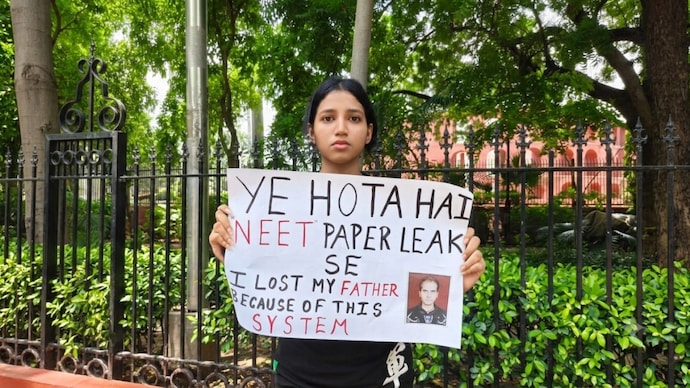
Thousands have gathered at Delhi's Jantar Mantar over the past few days, demanding accountability after the NEET paper leak. But not everyone at the NEET protest was an aspirant. For 22-year-old Sneha Aarya, it wasn't about an entrance exam: it was about losing faith in a system she says failed her family.
The crowd stretched across Jantar Mantar as I walked through the Chalo Sadan protest. Every few steps, someone was holding a placard, raising a slogan or speaking into a microphone. The gathering had grown much larger over the last two days, or so people told me. Students, parents and ordinary citizens stood side by side.
Not everyone there had appeared for NEET. Many had no direct connection with the examination at all.
There were school students, college students, working professionals and families. Volunteers moved around with cartons of water bottles. Food was being distributed. Nobody seemed to be standing alone. Strangers were helping each other, listening to one another's stories and reminding everyone why they had come.
Almost everyone I spoke to had a different reason for joining the protest.
Then I met 22-year-old Sneha Aarya, a music student from Delhi University.
She was not there because she had taken the NEET examination. She was there because, for her, corruption had already taken away someone she loved.
A PROTEST ROOTED IN PERSONAL LOSS
Sneha believes people often underestimate the impact of NEET examination paper leaks.
"People think the NEET paper leak is a small thing, but I don't think so. This exam selects doctors, people who take care of us when we are sick and when we are in danger in hospitals," she said.
For her, the debate around a fair examination is not just about admissions. It is about the kind of doctors the country produces and the trust people place in them during their most difficult moments.
That belief comes from a painful personal experience.
WHAT WAS SNEHA'S REASON FOR PROTESTING?
As we spoke, Sneha shared the story of her father.
She said that her father had faced an assault once, after which they had tried to seek justice. Allegedly, their complaint was never acted upon.
"My father was beaten up, but when we tried to file an FIR at the police station, nothing happened," she said.
Later, he developed severe chest pain. "When we reached the hospital, there was a trainee doctor who, without even examining him, said he had suffered a heart attack."
The family was immediately asked to arrange a large amount of money.
"They told us to bring the money within an hour, otherwise they wouldn't be able to save my father. They blackmailed us," she said, adding that they were scared and didn't know what to do next.
The family couldn't produce the money on time, and her father couldn't be saved.
"I think all of this doesn't happen when someone has become a doctor through hard work. These people become doctors either through support or through corruption. And paper leaks only strengthen this corrupt system," she said.
"I am against corruption," she added. "I stand with my father."
FOR SNEHA, IT'S ABOUT SAVING THE SYSTEM
For Sneha, the protest is not only about NEET. It is about protecting public institutions and ensuring that merit is not replaced by influence.
"My main demand is that the Constitution should remain the Constitution, and it shouldn't be tampered with. The fairness of the system shouldn't be harmed," she said.
She believes the problem does not lie with the country's institutions, but with the people who misuse them.
"There is no problem with the system, but the people are corrupt, and they are making the entire system corrupt," she said.
Asked to share a message for those watching the protests from a distance, she said, "Until we are united, we can fight against this corrupt system and take a stand for ourselves. We should remain united and stand together."
For Sneha, joining the protest was her way of ensuring that her personal loss became part of a larger demand for accountability: one voice among thousands calling for a fairer system.
SNEHA'S VOICE STAYED WITH ME AMONG THOUSANDS
As I continued walking through the protest site, I met many more people with different stories. Some had travelled hundreds of kilometres. Some were worried parents. Some were students preparing for competitive examinations. Others had simply come because they believed they could not stay silent.
But Sneha's story stayed with me.
In a protest driven by demands for justice, transparency and accountability, her reason for being there reached far beyond an entrance examination.
For her, it was about a father she believes the system failed.
And standing in the middle of a sea of slogans, banners and raised fists, she was not just protesting against a paper leak. She was asking a country to understand what corruption can cost.
The crowd stretched across Jantar Mantar as I walked through the Chalo Sadan protest. Every few steps, someone was holding a placard, raising a slogan or speaking into a microphone. The gathering had grown much larger over the last two days, or so people told me. Students, parents and ordinary citizens stood side by side.
Not everyone there had appeared for NEET. Many had no direct connection with the examination at all.
There were school students, college students, working professionals and families. Volunteers moved around with cartons of water bottles. Food was being distributed. Nobody seemed to be standing alone. Strangers were helping each other, listening to one another's stories and reminding everyone why they had come.
Almost everyone I spoke to had a different reason for joining the protest.
Then I met 22-year-old Sneha Aarya, a music student from Delhi University.
She was not there because she had taken the NEET examination. She was there because, for her, corruption had already taken away someone she loved.
A PROTEST ROOTED IN PERSONAL LOSS
Sneha believes people often underestimate the impact of NEET examination paper leaks.
"People think the NEET paper leak is a small thing, but I don't think so. This exam selects doctors, people who take care of us when we are sick and when we are in danger in hospitals," she said.
For her, the debate around a fair examination is not just about admissions. It is about the kind of doctors the country produces and the trust people place in them during their most difficult moments.
That belief comes from a painful personal experience.
WHAT WAS SNEHA'S REASON FOR PROTESTING?
As we spoke, Sneha shared the story of her father.
She said that her father had faced an assault once, after which they had tried to seek justice. Allegedly, their complaint was never acted upon.
"My father was beaten up, but when we tried to file an FIR at the police station, nothing happened," she said.
Later, he developed severe chest pain. "When we reached the hospital, there was a trainee doctor who, without even examining him, said he had suffered a heart attack."
The family was immediately asked to arrange a large amount of money.
"They told us to bring the money within an hour, otherwise they wouldn't be able to save my father. They blackmailed us," she said, adding that they were scared and didn't know what to do next.
The family couldn't produce the money on time, and her father couldn't be saved.
"I think all of this doesn't happen when someone has become a doctor through hard work. These people become doctors either through support or through corruption. And paper leaks only strengthen this corrupt system," she said.
"I am against corruption," she added. "I stand with my father."
FOR SNEHA, IT'S ABOUT SAVING THE SYSTEM
For Sneha, the protest is not only about NEET. It is about protecting public institutions and ensuring that merit is not replaced by influence.
"My main demand is that the Constitution should remain the Constitution, and it shouldn't be tampered with. The fairness of the system shouldn't be harmed," she said.
She believes the problem does not lie with the country's institutions, but with the people who misuse them.
"There is no problem with the system, but the people are corrupt, and they are making the entire system corrupt," she said.
Asked to share a message for those watching the protests from a distance, she said, "Until we are united, we can fight against this corrupt system and take a stand for ourselves. We should remain united and stand together."
For Sneha, joining the protest was her way of ensuring that her personal loss became part of a larger demand for accountability: one voice among thousands calling for a fairer system.
SNEHA'S VOICE STAYED WITH ME AMONG THOUSANDS
As I continued walking through the protest site, I met many more people with different stories. Some had travelled hundreds of kilometres. Some were worried parents. Some were students preparing for competitive examinations. Others had simply come because they believed they could not stay silent.
But Sneha's story stayed with me.
In a protest driven by demands for justice, transparency and accountability, her reason for being there reached far beyond an entrance examination.
For her, it was about a father she believes the system failed.
And standing in the middle of a sea of slogans, banners and raised fists, she was not just protesting against a paper leak. She was asking a country to understand what corruption can cost.
The crowd stretched across Jantar Mantar as I walked through the Chalo Sadan protest. Every few steps, someone was holding a placard, raising a slogan or speaking into a microphone. The gathering had grown much larger over the last two days, or so people told me. Students, parents and ordinary citizens stood side by side.
Not everyone there had appeared for NEET. Many had no direct connection with the examination at all.
There were school students, college students, working professionals and families. Volunteers moved around with cartons of water bottles. Food was being distributed. Nobody seemed to be standing alone. Strangers were helping each other, listening to one another's stories and reminding everyone why they had come.
Almost everyone I spoke to had a different reason for joining the protest.
Then I met 22-year-old Sneha Aarya, a music student from Delhi University.
She was not there because she had taken the NEET examination. She was there because, for her, corruption had already taken away someone she loved.
A PROTEST ROOTED IN PERSONAL LOSS
Sneha believes people often underestimate the impact of NEET examination paper leaks.
"People think the NEET paper leak is a small thing, but I don't think so. This exam selects doctors, people who take care of us when we are sick and when we are in danger in hospitals," she said.
For her, the debate around a fair examination is not just about admissions. It is about the kind of doctors the country produces and the trust people place in them during their most difficult moments.
That belief comes from a painful personal experience.
WHAT WAS SNEHA'S REASON FOR PROTESTING?
As we spoke, Sneha shared the story of her father.
She said that her father had faced an assault once, after which they had tried to seek justice. Allegedly, their complaint was never acted upon.
"My father was beaten up, but when we tried to file an FIR at the police station, nothing happened," she said.
Later, he developed severe chest pain. "When we reached the hospital, there was a trainee doctor who, without even examining him, said he had suffered a heart attack."
The family was immediately asked to arrange a large amount of money.
"They told us to bring the money within an hour, otherwise they wouldn't be able to save my father. They blackmailed us," she said, adding that they were scared and didn't know what to do next.
The family couldn't produce the money on time, and her father couldn't be saved.
"I think all of this doesn't happen when someone has become a doctor through hard work. These people become doctors either through support or through corruption. And paper leaks only strengthen this corrupt system," she said.
"I am against corruption," she added. "I stand with my father."
FOR SNEHA, IT'S ABOUT SAVING THE SYSTEM
For Sneha, the protest is not only about NEET. It is about protecting public institutions and ensuring that merit is not replaced by influence.
"My main demand is that the Constitution should remain the Constitution, and it shouldn't be tampered with. The fairness of the system shouldn't be harmed," she said.
She believes the problem does not lie with the country's institutions, but with the people who misuse them.
"There is no problem with the system, but the people are corrupt, and they are making the entire system corrupt," she said.
Asked to share a message for those watching the protests from a distance, she said, "Until we are united, we can fight against this corrupt system and take a stand for ourselves. We should remain united and stand together."
For Sneha, joining the protest was her way of ensuring that her personal loss became part of a larger demand for accountability: one voice among thousands calling for a fairer system.
SNEHA'S VOICE STAYED WITH ME AMONG THOUSANDS
As I continued walking through the protest site, I met many more people with different stories. Some had travelled hundreds of kilometres. Some were worried parents. Some were students preparing for competitive examinations. Others had simply come because they believed they could not stay silent.
But Sneha's story stayed with me.
In a protest driven by demands for justice, transparency and accountability, her reason for being there reached far beyond an entrance examination.
For her, it was about a father she believes the system failed.
And standing in the middle of a sea of slogans, banners and raised fists, she was not just protesting against a paper leak. She was asking a country to understand what corruption can cost.

