Money, household chores push girls to drop out in Classes 9-10: Government data
Parliament data shows girls' dropout rates have fallen, but secondary school remains the sharpest breaking point, especially in Classes 9 and 10. The figures highlight how household work, money worries and parental attitudes still push many girls out despite better school facilities.
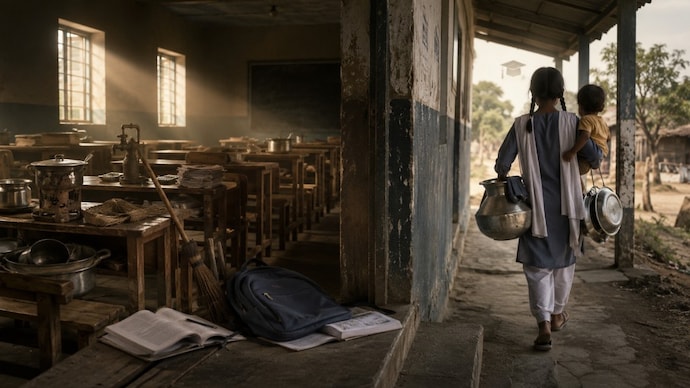
India has made steady progress in keeping girls in school, but the biggest challenge begins when they enter secondary education. Government data tabled in Parliament shows that while girls' dropout rates have fallen to their lowest level in three years, the sharpest exits continue to occur in Classes 9 and 10, driven largely by household responsibilities, financial constraints, and parental attitudes toward education.
According to data from the Unified District Information System for Education Plus (UDISE+) for 2025-26, eight out of every 100 girls enrolled in secondary school dropped out before completing their education.
Although the secondary dropout rate declined to 8 percent from 12.6 percent in 2023-24 and 9.6 percent in 2024-25, it remains significantly higher than at earlier stages of schooling.
The figures were shared by Minister of State for Education Jayant Chaudhary in a written reply to a Lok Sabha question raised by MP Gurmeet Singh Meet Hayer. The ministry's response categorises dropout rates across primary, upper primary and secondary education.
The contrast is striking. Nationally, the dropout rate for girls at the primary level stands at just 0.1 per cent, rises to 3.4 percent at the upper primary level, and then more than doubles to 8 percent in secondary school.
In effect, girls are nearly 80 times more likely to leave school at the secondary stage than during their primary education.
WHY GIRLS ARE LEAVING SCHOOL
The government's explanation, based on findings from the Periodic Labour Force Survey (PLFS) 2023-24, points to a combination of economic and social pressures.
Many girls leave school to supplement household income, take up domestic chores, or because their parents do not consider further education necessary. These reasons become more pronounced as girls reach adolescence, when families often begin balancing the costs of education against work responsibilities, caregiving, or, in some cases, early marriage.
The trend suggests that the transition from middle school to secondary school remains the most vulnerable point in a girl's educational journey.
STATES WITH THE HIGHEST DROPOUT RATES
Despite an overall decline in secondary school dropout rates among girls, the problem remains unevenly distributed across the country.
Ladakh topped the list with a dropout rate of 15.6 percent, followed by Assam and Karnataka at 13.9 percent. Gujarat recorded 13.3 percent, while Arunachal Pradesh and Nagaland each reported 12.4 percent.
The variation points to multiple factors beyond economic conditions. Distance to schools, limited transport, safety concerns, entrenched gender norms and early marriage continue to disrupt girls' education in many parts of India.
TOILET COVERAGE IMPROVES, BUT LINK TO DROPOUTS REMAINS UNCLEAR
The parliamentary question that prompted the government's response focused on sanitation facilities in schools.
According to UDISE+ 2025-26, 95.4 percent of government schools now have separate functional toilets for girls, covering more than 9.5 lakh schools nationwide.
Delhi, Goa and Chandigarh have achieved full coverage, while Arunachal Pradesh, where only 67.9 percent of schools have functional girls' toilets, and Mizoram, at 72.7 percent, continue to lag behind.
However, the Education Ministry noted that it has not conducted any central study establishing a direct link between the availability of girls' toilets and female dropout rates.
To improve menstrual hygiene management, the Samagra Shiksha scheme supports the installation of sanitary pad vending machines and incinerators in schools. Separately, the Health Ministry's menstrual hygiene programme reaches around 53.9 lakh adolescent girls every month through the distribution of sanitary napkins and awareness campaigns.
THE LARGER CHALLENGE
The latest data underscores that improving school infrastructure alone may not be enough to keep girls in classrooms. While access to toilets has expanded and overall dropout rates have declined, the sharp rise in exits during Classes 9 and 10 highlights the persistence of deeper economic and social barriers.
Reducing secondary school dropouts will require interventions that extend beyond school campuses, from financial support for vulnerable families and better access to secondary schools to sustained efforts to shift social attitudes around girls' education.
Until those barriers are addressed, the transition to secondary school is likely to remain the point at which too many girls are forced to leave their education behind.
India has made steady progress in keeping girls in school, but the biggest challenge begins when they enter secondary education. Government data tabled in Parliament shows that while girls' dropout rates have fallen to their lowest level in three years, the sharpest exits continue to occur in Classes 9 and 10, driven largely by household responsibilities, financial constraints, and parental attitudes toward education.
According to data from the Unified District Information System for Education Plus (UDISE+) for 2025-26, eight out of every 100 girls enrolled in secondary school dropped out before completing their education.
Although the secondary dropout rate declined to 8 percent from 12.6 percent in 2023-24 and 9.6 percent in 2024-25, it remains significantly higher than at earlier stages of schooling.
The figures were shared by Minister of State for Education Jayant Chaudhary in a written reply to a Lok Sabha question raised by MP Gurmeet Singh Meet Hayer. The ministry's response categorises dropout rates across primary, upper primary and secondary education.
The contrast is striking. Nationally, the dropout rate for girls at the primary level stands at just 0.1 per cent, rises to 3.4 percent at the upper primary level, and then more than doubles to 8 percent in secondary school.
In effect, girls are nearly 80 times more likely to leave school at the secondary stage than during their primary education.
WHY GIRLS ARE LEAVING SCHOOL
The government's explanation, based on findings from the Periodic Labour Force Survey (PLFS) 2023-24, points to a combination of economic and social pressures.
Many girls leave school to supplement household income, take up domestic chores, or because their parents do not consider further education necessary. These reasons become more pronounced as girls reach adolescence, when families often begin balancing the costs of education against work responsibilities, caregiving, or, in some cases, early marriage.
The trend suggests that the transition from middle school to secondary school remains the most vulnerable point in a girl's educational journey.
STATES WITH THE HIGHEST DROPOUT RATES
Despite an overall decline in secondary school dropout rates among girls, the problem remains unevenly distributed across the country.
Ladakh topped the list with a dropout rate of 15.6 percent, followed by Assam and Karnataka at 13.9 percent. Gujarat recorded 13.3 percent, while Arunachal Pradesh and Nagaland each reported 12.4 percent.
The variation points to multiple factors beyond economic conditions. Distance to schools, limited transport, safety concerns, entrenched gender norms and early marriage continue to disrupt girls' education in many parts of India.
TOILET COVERAGE IMPROVES, BUT LINK TO DROPOUTS REMAINS UNCLEAR
The parliamentary question that prompted the government's response focused on sanitation facilities in schools.
According to UDISE+ 2025-26, 95.4 percent of government schools now have separate functional toilets for girls, covering more than 9.5 lakh schools nationwide.
Delhi, Goa and Chandigarh have achieved full coverage, while Arunachal Pradesh, where only 67.9 percent of schools have functional girls' toilets, and Mizoram, at 72.7 percent, continue to lag behind.
However, the Education Ministry noted that it has not conducted any central study establishing a direct link between the availability of girls' toilets and female dropout rates.
To improve menstrual hygiene management, the Samagra Shiksha scheme supports the installation of sanitary pad vending machines and incinerators in schools. Separately, the Health Ministry's menstrual hygiene programme reaches around 53.9 lakh adolescent girls every month through the distribution of sanitary napkins and awareness campaigns.
THE LARGER CHALLENGE
The latest data underscores that improving school infrastructure alone may not be enough to keep girls in classrooms. While access to toilets has expanded and overall dropout rates have declined, the sharp rise in exits during Classes 9 and 10 highlights the persistence of deeper economic and social barriers.
Reducing secondary school dropouts will require interventions that extend beyond school campuses, from financial support for vulnerable families and better access to secondary schools to sustained efforts to shift social attitudes around girls' education.
Until those barriers are addressed, the transition to secondary school is likely to remain the point at which too many girls are forced to leave their education behind.
India has made steady progress in keeping girls in school, but the biggest challenge begins when they enter secondary education. Government data tabled in Parliament shows that while girls' dropout rates have fallen to their lowest level in three years, the sharpest exits continue to occur in Classes 9 and 10, driven largely by household responsibilities, financial constraints, and parental attitudes toward education.
According to data from the Unified District Information System for Education Plus (UDISE+) for 2025-26, eight out of every 100 girls enrolled in secondary school dropped out before completing their education.
Although the secondary dropout rate declined to 8 percent from 12.6 percent in 2023-24 and 9.6 percent in 2024-25, it remains significantly higher than at earlier stages of schooling.
The figures were shared by Minister of State for Education Jayant Chaudhary in a written reply to a Lok Sabha question raised by MP Gurmeet Singh Meet Hayer. The ministry's response categorises dropout rates across primary, upper primary and secondary education.
The contrast is striking. Nationally, the dropout rate for girls at the primary level stands at just 0.1 per cent, rises to 3.4 percent at the upper primary level, and then more than doubles to 8 percent in secondary school.
In effect, girls are nearly 80 times more likely to leave school at the secondary stage than during their primary education.
WHY GIRLS ARE LEAVING SCHOOL
The government's explanation, based on findings from the Periodic Labour Force Survey (PLFS) 2023-24, points to a combination of economic and social pressures.
Many girls leave school to supplement household income, take up domestic chores, or because their parents do not consider further education necessary. These reasons become more pronounced as girls reach adolescence, when families often begin balancing the costs of education against work responsibilities, caregiving, or, in some cases, early marriage.
The trend suggests that the transition from middle school to secondary school remains the most vulnerable point in a girl's educational journey.
STATES WITH THE HIGHEST DROPOUT RATES
Despite an overall decline in secondary school dropout rates among girls, the problem remains unevenly distributed across the country.
Ladakh topped the list with a dropout rate of 15.6 percent, followed by Assam and Karnataka at 13.9 percent. Gujarat recorded 13.3 percent, while Arunachal Pradesh and Nagaland each reported 12.4 percent.
The variation points to multiple factors beyond economic conditions. Distance to schools, limited transport, safety concerns, entrenched gender norms and early marriage continue to disrupt girls' education in many parts of India.
TOILET COVERAGE IMPROVES, BUT LINK TO DROPOUTS REMAINS UNCLEAR
The parliamentary question that prompted the government's response focused on sanitation facilities in schools.
According to UDISE+ 2025-26, 95.4 percent of government schools now have separate functional toilets for girls, covering more than 9.5 lakh schools nationwide.
Delhi, Goa and Chandigarh have achieved full coverage, while Arunachal Pradesh, where only 67.9 percent of schools have functional girls' toilets, and Mizoram, at 72.7 percent, continue to lag behind.
However, the Education Ministry noted that it has not conducted any central study establishing a direct link between the availability of girls' toilets and female dropout rates.
To improve menstrual hygiene management, the Samagra Shiksha scheme supports the installation of sanitary pad vending machines and incinerators in schools. Separately, the Health Ministry's menstrual hygiene programme reaches around 53.9 lakh adolescent girls every month through the distribution of sanitary napkins and awareness campaigns.
THE LARGER CHALLENGE
The latest data underscores that improving school infrastructure alone may not be enough to keep girls in classrooms. While access to toilets has expanded and overall dropout rates have declined, the sharp rise in exits during Classes 9 and 10 highlights the persistence of deeper economic and social barriers.
Reducing secondary school dropouts will require interventions that extend beyond school campuses, from financial support for vulnerable families and better access to secondary schools to sustained efforts to shift social attitudes around girls' education.
Until those barriers are addressed, the transition to secondary school is likely to remain the point at which too many girls are forced to leave their education behind.

