At Jantar Mantar, a movement, a mela and citizens who won't sway
From school kids to entrance-exam aspirants, the space is a swelling sea of people. Spirits run high, anger deep. Faith, food and some fashion keep the momentum alive
I somehow crossed the final barricade, showed my ID at the entrance and, in the name of INDIA TODAY, was helped up by three or four people onto a makeshift set of stairs and ushered inside—close to the stage. For a moment, it felt as though I had been lifted and tossed there. On those high, temporary steps, young volunteers sat like sentries guarding the passage.
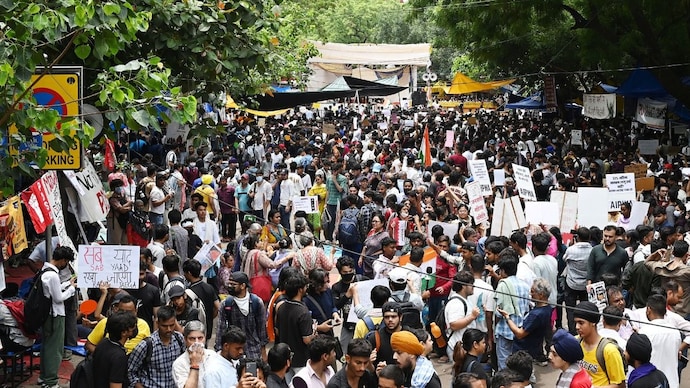
From the stage, it became clear that this was not a crowd but a swelling sea of people. From schoolchildren to young adults, they stood holding placards, the national flag and the Constitution of India. Beyond a certain distance, some sat, some stood, some clung to the poles put up as dividers.
Talking to people, I learned some students had come with their parents. Some girls had lied to their parents to be here. Some young men had taken leave from work; others had stepped straight off a train and walked to Jantar Mantar. Someone's bag was stuffed with books. Someone else's with water bottles. Some carried copies of the Constitution. Some carried posters. Some the Tricolour.
There was constant movement on the stage that day. Cockroach Janta Party (CJP) spokesperson Saurav Das and his colleagues stayed seated there. Left leader Brinda Karat, wrestler Bajrang Punia, politician Pappu Yadav and several others came and went. I asked Das where the Leader of the Opposition (Rahul Gandhi) was? I was told that a letter had been sent. I asked again: was this not supposed to be a non-political stage? He replied, “Anyone who comes with our demand is welcome.”
My attention then drifted to the left side of the stage, where, beside a photograph of Sonam Wangchuk, the Constitution of India, the Ramcharitmanas, Buddha and the spinning wheel had been placed. Beneath the stage, a few volunteers were lying down. I was told they were reportedly injured in a police clash. Behind the stage stood a first-aid area with medicines and bandages were stacked in readiness.
At one point, while I was speaking with a student, a young man began fanning me with a haath pankha. All around, young people were taking turns fanning one another. It was happening in rotation, almost instinctively. I noticed a nonstop flow of water, ORS, cold drinks, food, pizza, samosas, burgers, apples, bananas—more than enough, as if the supply should never run short. No one seemed to know exactly where it was all coming from, but it kept arriving.
Then came an announcement from the stage: “If anyone is asking where the funding is coming from, tell them where the funding is coming from. Post your bills on social media. That will answer the question.”
After that, patriotic songs were played to keep the momentum alive.
Each time the police walked past, chants of “loser, loser” rose up. The police would come and leave quietly. From the stage, an announcement would follow: “Let them pass, ignore them. The whole world is watching them. They know what they have done to us.”
From schoolchildren to competitive-exam aspirants, the space was packed to the brim. By evening, there was hardly room to throw a pin.
Speaking to some young protesters, I found the anger running deep. Coming from as far as Himachal Pradesh and Hyderabad, many were distressed by what they saw as the government’s indifferent attitude towards education. Their belief was clear: without accountability, reform is impossible.
Mahavir, who had come from the Thar region of Rajasthan, was there for the improvement of education in his village. Seema had travelled alone by bus from Mewar for the sake of her brother and her own future. Somesh was fed up with entrance exam dates being rescheduled again and again. Angel, who had just passed Class 12, had taken the Common Law Admission Test (CLAT), only to see it mired in controversy.
There were also young people like Jayshree, who had not been directly affected by any exam paper leak or a recruitment exam, yet had come from hundreds of kilometres afar because they believed that if trust in the examination system breaks, the damage will hit every young person dreaming of a better future.
The presence of people like Muan, a young professional from Manipur, suggested something larger: that the Jantar Mantar movement was no longer confined to competitive-exam candidates alone. It had also drawn in people whose studies were already complete, whose jobs were already in place, but who believed that preserving trust in the education system is a responsibility shared by society as a whole.
As I was leaving the protest site, I saw the crowd swelling even further. Getting out had become difficult too. It felt almost like a race to make reels. A wave of YouTubers had arrived. Young people were turning up in fresh, brightly coloured clothes, perhaps many of them there for the first time. Quite a few came asking where they could get food or whether ice cream was available. It was possible that the protest itself mattered very little to them.
At the same time, two girls from Class 6 stood holding placards in their hands. When I asked them why they were there, they said only this much: that they had come to a protest. Their parents, meanwhile, seemed pleased that people were taking photographs of their daughters.
The last voice that reached my ears as I walked away was that of a girl, shouting at the police near Kerala House: “If policemen are like you, then you should be ashamed of yourselves.”
Meanwhile, the crowd was in flux—some drifting in and out, others seated there as if they had claimed the place for good.
Subscribe to India Today Magazine
I somehow crossed the final barricade, showed my ID at the entrance and, in the name of INDIA TODAY, was helped up by three or four people onto a makeshift set of stairs and ushered inside—close to the stage. For a moment, it felt as though I had been lifted and tossed there. On those high, temporary steps, young volunteers sat like sentries guarding the passage.
From the stage, it became clear that this was not a crowd but a swelling sea of people. From schoolchildren to young adults, they stood holding placards, the national flag and the Constitution of India. Beyond a certain distance, some sat, some stood, some clung to the poles put up as dividers.
Talking to people, I learned some students had come with their parents. Some girls had lied to their parents to be here. Some young men had taken leave from work; others had stepped straight off a train and walked to Jantar Mantar. Someone's bag was stuffed with books. Someone else's with water bottles. Some carried copies of the Constitution. Some carried posters. Some the Tricolour.
There was constant movement on the stage that day. Cockroach Janta Party (CJP) spokesperson Saurav Das and his colleagues stayed seated there. Left leader Brinda Karat, wrestler Bajrang Punia, politician Pappu Yadav and several others came and went. I asked Das where the Leader of the Opposition (Rahul Gandhi) was? I was told that a letter had been sent. I asked again: was this not supposed to be a non-political stage? He replied, “Anyone who comes with our demand is welcome.”
My attention then drifted to the left side of the stage, where, beside a photograph of Sonam Wangchuk, the Constitution of India, the Ramcharitmanas, Buddha and the spinning wheel had been placed. Beneath the stage, a few volunteers were lying down. I was told they were reportedly injured in a police clash. Behind the stage stood a first-aid area with medicines and bandages were stacked in readiness.
At one point, while I was speaking with a student, a young man began fanning me with a haath pankha. All around, young people were taking turns fanning one another. It was happening in rotation, almost instinctively. I noticed a nonstop flow of water, ORS, cold drinks, food, pizza, samosas, burgers, apples, bananas—more than enough, as if the supply should never run short. No one seemed to know exactly where it was all coming from, but it kept arriving.
Then came an announcement from the stage: “If anyone is asking where the funding is coming from, tell them where the funding is coming from. Post your bills on social media. That will answer the question.”
After that, patriotic songs were played to keep the momentum alive.
Each time the police walked past, chants of “loser, loser” rose up. The police would come and leave quietly. From the stage, an announcement would follow: “Let them pass, ignore them. The whole world is watching them. They know what they have done to us.”
From schoolchildren to competitive-exam aspirants, the space was packed to the brim. By evening, there was hardly room to throw a pin.
Speaking to some young protesters, I found the anger running deep. Coming from as far as Himachal Pradesh and Hyderabad, many were distressed by what they saw as the government’s indifferent attitude towards education. Their belief was clear: without accountability, reform is impossible.
Mahavir, who had come from the Thar region of Rajasthan, was there for the improvement of education in his village. Seema had travelled alone by bus from Mewar for the sake of her brother and her own future. Somesh was fed up with entrance exam dates being rescheduled again and again. Angel, who had just passed Class 12, had taken the Common Law Admission Test (CLAT), only to see it mired in controversy.
There were also young people like Jayshree, who had not been directly affected by any exam paper leak or a recruitment exam, yet had come from hundreds of kilometres afar because they believed that if trust in the examination system breaks, the damage will hit every young person dreaming of a better future.
The presence of people like Muan, a young professional from Manipur, suggested something larger: that the Jantar Mantar movement was no longer confined to competitive-exam candidates alone. It had also drawn in people whose studies were already complete, whose jobs were already in place, but who believed that preserving trust in the education system is a responsibility shared by society as a whole.
As I was leaving the protest site, I saw the crowd swelling even further. Getting out had become difficult too. It felt almost like a race to make reels. A wave of YouTubers had arrived. Young people were turning up in fresh, brightly coloured clothes, perhaps many of them there for the first time. Quite a few came asking where they could get food or whether ice cream was available. It was possible that the protest itself mattered very little to them.
At the same time, two girls from Class 6 stood holding placards in their hands. When I asked them why they were there, they said only this much: that they had come to a protest. Their parents, meanwhile, seemed pleased that people were taking photographs of their daughters.
The last voice that reached my ears as I walked away was that of a girl, shouting at the police near Kerala House: “If policemen are like you, then you should be ashamed of yourselves.”
Meanwhile, the crowd was in flux—some drifting in and out, others seated there as if they had claimed the place for good.
Subscribe to India Today Magazine
I somehow crossed the final barricade, showed my ID at the entrance and, in the name of INDIA TODAY, was helped up by three or four people onto a makeshift set of stairs and ushered inside—close to the stage. For a moment, it felt as though I had been lifted and tossed there. On those high, temporary steps, young volunteers sat like sentries guarding the passage.
From the stage, it became clear that this was not a crowd but a swelling sea of people. From schoolchildren to young adults, they stood holding placards, the national flag and the Constitution of India. Beyond a certain distance, some sat, some stood, some clung to the poles put up as dividers.
Talking to people, I learned some students had come with their parents. Some girls had lied to their parents to be here. Some young men had taken leave from work; others had stepped straight off a train and walked to Jantar Mantar. Someone's bag was stuffed with books. Someone else's with water bottles. Some carried copies of the Constitution. Some carried posters. Some the Tricolour.
There was constant movement on the stage that day. Cockroach Janta Party (CJP) spokesperson Saurav Das and his colleagues stayed seated there. Left leader Brinda Karat, wrestler Bajrang Punia, politician Pappu Yadav and several others came and went. I asked Das where the Leader of the Opposition (Rahul Gandhi) was? I was told that a letter had been sent. I asked again: was this not supposed to be a non-political stage? He replied, “Anyone who comes with our demand is welcome.”
My attention then drifted to the left side of the stage, where, beside a photograph of Sonam Wangchuk, the Constitution of India, the Ramcharitmanas, Buddha and the spinning wheel had been placed. Beneath the stage, a few volunteers were lying down. I was told they were reportedly injured in a police clash. Behind the stage stood a first-aid area with medicines and bandages were stacked in readiness.
At one point, while I was speaking with a student, a young man began fanning me with a haath pankha. All around, young people were taking turns fanning one another. It was happening in rotation, almost instinctively. I noticed a nonstop flow of water, ORS, cold drinks, food, pizza, samosas, burgers, apples, bananas—more than enough, as if the supply should never run short. No one seemed to know exactly where it was all coming from, but it kept arriving.
Then came an announcement from the stage: “If anyone is asking where the funding is coming from, tell them where the funding is coming from. Post your bills on social media. That will answer the question.”
After that, patriotic songs were played to keep the momentum alive.
Each time the police walked past, chants of “loser, loser” rose up. The police would come and leave quietly. From the stage, an announcement would follow: “Let them pass, ignore them. The whole world is watching them. They know what they have done to us.”
From schoolchildren to competitive-exam aspirants, the space was packed to the brim. By evening, there was hardly room to throw a pin.
Speaking to some young protesters, I found the anger running deep. Coming from as far as Himachal Pradesh and Hyderabad, many were distressed by what they saw as the government’s indifferent attitude towards education. Their belief was clear: without accountability, reform is impossible.
Mahavir, who had come from the Thar region of Rajasthan, was there for the improvement of education in his village. Seema had travelled alone by bus from Mewar for the sake of her brother and her own future. Somesh was fed up with entrance exam dates being rescheduled again and again. Angel, who had just passed Class 12, had taken the Common Law Admission Test (CLAT), only to see it mired in controversy.
There were also young people like Jayshree, who had not been directly affected by any exam paper leak or a recruitment exam, yet had come from hundreds of kilometres afar because they believed that if trust in the examination system breaks, the damage will hit every young person dreaming of a better future.
The presence of people like Muan, a young professional from Manipur, suggested something larger: that the Jantar Mantar movement was no longer confined to competitive-exam candidates alone. It had also drawn in people whose studies were already complete, whose jobs were already in place, but who believed that preserving trust in the education system is a responsibility shared by society as a whole.
As I was leaving the protest site, I saw the crowd swelling even further. Getting out had become difficult too. It felt almost like a race to make reels. A wave of YouTubers had arrived. Young people were turning up in fresh, brightly coloured clothes, perhaps many of them there for the first time. Quite a few came asking where they could get food or whether ice cream was available. It was possible that the protest itself mattered very little to them.
At the same time, two girls from Class 6 stood holding placards in their hands. When I asked them why they were there, they said only this much: that they had come to a protest. Their parents, meanwhile, seemed pleased that people were taking photographs of their daughters.
The last voice that reached my ears as I walked away was that of a girl, shouting at the police near Kerala House: “If policemen are like you, then you should be ashamed of yourselves.”
Meanwhile, the crowd was in flux—some drifting in and out, others seated there as if they had claimed the place for good.
Subscribe to India Today Magazine

