How Delhi's old protest site hosts a new wave of dissent
On battleground Jantar Mantar, the Cockroach Janata Party and supporters of its cause remain undaunted in challenging the BJP and the government it leads
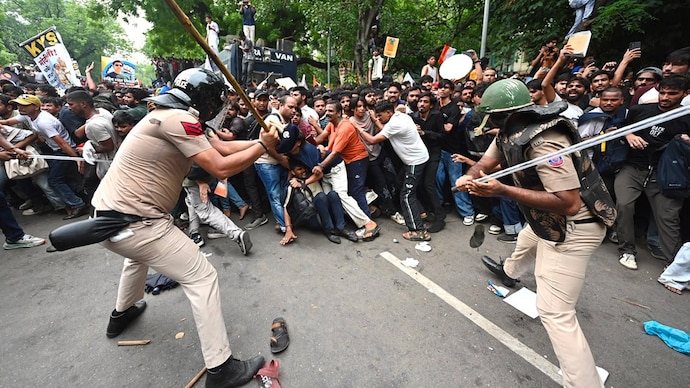
At Jantar Mantar, thousands remained on the ground after the Cockroach Janata Party’s (CJP) “Chalo Sansad” call brought students, elderly people and political supporters to the national capital. Virtually no demographic seemed unrepresented—there were children, older couples and college students with overnight bags at the protest site. Under a grey, rain-soaked sky, a thousand voices rose together in sync with A.R. Rahman’s Vande Mataram. The placards had depictions of Prime Minister Narendra Modi and education minister Dharmendra Pradhan, among others.
For those who had travelled long distances, the security restrictions became part of the story. “They shut the metro service,” says Shreeja, a second-year student from Thiruvananthapuram University College, who had arrived with two female friends. “We arrived today from Kerala by train. We wanted to leave our bags at a relative’s place in South Delhi. But we could not.”
Five central Delhi metro stations—Rajiv Chowk, Janpath, Patel Chowk, Central Secretariat and Seva Teerth—were shut down as a security precaution. Roads leading to these areas were sealed. Vehicles were checked. Mobile internet was made unavailable in parts of central Delhi. For commuters, and for protesters who had travelled to be here, the city’s centre had become hard to get into and harder to leave.
This was because the gathering had started from Sunday evening and by night there was a sizable crowd at the protest site. The restrictions followed the police denying permission for the march. The Delhi Police enforced Section 163 of the Bharatiya Nyaya Sanhita in New Delhi district, deploying rapid-response personnel and barricades. There was also an allegedly “mild” lathi-charge and use of teargas to disperse people trying to move towards Parliament. Containment seemed to be the state’s immediate answer.
The CJP, however, went ahead with its march. Sonam Wangchuk’s wife Gitanjali Angmo led supporters from Jantar Mantar while the hunger-striker remained at Safdarjung Hospital. Police blocked and dispersed people attempting to move towards Parliament. But the gathering at Jantar Mantar took on a scale and texture that people on the ground compare to the Anna Hazare-led anti-corruption protests—the last time, many said, when the site and the capital had seen anything like this. “During that time, I had taken the metro from Pitampura with my 10-year-old daughter to attend the Lokpal protests here,” says Narendranath Mishra, a Delhi-based chartered accountant who returned to the same site this time with his neighbours, “our morning walk group”. “My daughter is now in another city. She keeps asking me what’s happening.”
The mood was fervent and anxious. Neeraj Anand, a 23-year-old from Laxmi Nagar, says he has been at the site since Sunday night. He claims the police parked a car nearby and broke its windows—to blame the protestors and create the pretext for a crackdown. “This shows the government is nervous even though the protestors are peaceful,” says Anand.
Peace, and who might disrupt it, has become a central issue in the confrontation. The CJP has appealed to supporters to stay calm, saying, “We will win this only with peace and love.” At the same time, party figures have alleged that the authorities were preparing a case for forceful action. The claims remain disputed and unverified.
The agitation is over alleged irregularities and paper leak in the National Eligibility cum Entrance Test (NEET), but the immediate political focus has been on minister Pradhan. The CJP wants him to step down but he has refused, allegedly calling the party a “B-team of disruptive elements”. The BJP and the education ministry are yet to make any public statement regarding the demand for his resignation.
Since Wangchuk was forcibly removed from the protest site on July 18, his hospitalisation has become a political and emotional centre of the agitation. A Delhi court held that the authorities were within their rights to move him to Safdarjung Hospital. The court found his bodily autonomy was not violated, and that oral fluids and supplements were administered with his consent. Angmo, however, calls it an “illegal detention”. Students of Jawaharlal Nehru University (JNU) affiliated with the All India Students Association (AISA) were also on hunger strike at the site. A few celebrities, including actor Shabana Azmi, visited them on Sunday. Part of the broader student-organisational support network, AISA has raised concerns about the health of the fasting students.
From the hospital, Wangchuk has placed three demands for the withdrawal of his hunger strike: government accountability on the shortcomings in the education system; discussion on the issue in Parliament; and a visit by top leaders for giving him a personal assurance in case he is physically unfit to come out for the protest. According to Wangchuk, this is India’s “second freedom movement”.
CJP founder Abhijeet Dipke, the most prominent face of the protest, started an indefinite hunger strike in response to Wangchuk’s ouster from Jantar Mantar. Party spokesperson Saurav Das, who said there would be “no backtracking”, is also talking with the authorities even as the sit-in continues.
The landscape of political support at the site is becoming more evident. Senior Aam Aadmi Party (AAP) leaders Manish Sisodia, Sanjay Singh and former Delhi CM Atishi were seen joining the protesters, giving a solid backing to the CJP’s cause. The Congress, too, has given a political boost to the agitation with Rahul Gandhi terming Wangchuk’s removal from the site as “suppression of peaceful dissent”.
The CJP has sustained the sit-in so far, as if to say that march or not, their presence itself is the message. Parliament was kept out of reach but not the protest.
Subscribe to India Today Magazine
At Jantar Mantar, thousands remained on the ground after the Cockroach Janata Party’s (CJP) “Chalo Sansad” call brought students, elderly people and political supporters to the national capital. Virtually no demographic seemed unrepresented—there were children, older couples and college students with overnight bags at the protest site. Under a grey, rain-soaked sky, a thousand voices rose together in sync with A.R. Rahman’s Vande Mataram. The placards had depictions of Prime Minister Narendra Modi and education minister Dharmendra Pradhan, among others.
For those who had travelled long distances, the security restrictions became part of the story. “They shut the metro service,” says Shreeja, a second-year student from Thiruvananthapuram University College, who had arrived with two female friends. “We arrived today from Kerala by train. We wanted to leave our bags at a relative’s place in South Delhi. But we could not.”
Five central Delhi metro stations—Rajiv Chowk, Janpath, Patel Chowk, Central Secretariat and Seva Teerth—were shut down as a security precaution. Roads leading to these areas were sealed. Vehicles were checked. Mobile internet was made unavailable in parts of central Delhi. For commuters, and for protesters who had travelled to be here, the city’s centre had become hard to get into and harder to leave.
This was because the gathering had started from Sunday evening and by night there was a sizable crowd at the protest site. The restrictions followed the police denying permission for the march. The Delhi Police enforced Section 163 of the Bharatiya Nyaya Sanhita in New Delhi district, deploying rapid-response personnel and barricades. There was also an allegedly “mild” lathi-charge and use of teargas to disperse people trying to move towards Parliament. Containment seemed to be the state’s immediate answer.
The CJP, however, went ahead with its march. Sonam Wangchuk’s wife Gitanjali Angmo led supporters from Jantar Mantar while the hunger-striker remained at Safdarjung Hospital. Police blocked and dispersed people attempting to move towards Parliament. But the gathering at Jantar Mantar took on a scale and texture that people on the ground compare to the Anna Hazare-led anti-corruption protests—the last time, many said, when the site and the capital had seen anything like this. “During that time, I had taken the metro from Pitampura with my 10-year-old daughter to attend the Lokpal protests here,” says Narendranath Mishra, a Delhi-based chartered accountant who returned to the same site this time with his neighbours, “our morning walk group”. “My daughter is now in another city. She keeps asking me what’s happening.”
The mood was fervent and anxious. Neeraj Anand, a 23-year-old from Laxmi Nagar, says he has been at the site since Sunday night. He claims the police parked a car nearby and broke its windows—to blame the protestors and create the pretext for a crackdown. “This shows the government is nervous even though the protestors are peaceful,” says Anand.
Peace, and who might disrupt it, has become a central issue in the confrontation. The CJP has appealed to supporters to stay calm, saying, “We will win this only with peace and love.” At the same time, party figures have alleged that the authorities were preparing a case for forceful action. The claims remain disputed and unverified.
The agitation is over alleged irregularities and paper leak in the National Eligibility cum Entrance Test (NEET), but the immediate political focus has been on minister Pradhan. The CJP wants him to step down but he has refused, allegedly calling the party a “B-team of disruptive elements”. The BJP and the education ministry are yet to make any public statement regarding the demand for his resignation.
Since Wangchuk was forcibly removed from the protest site on July 18, his hospitalisation has become a political and emotional centre of the agitation. A Delhi court held that the authorities were within their rights to move him to Safdarjung Hospital. The court found his bodily autonomy was not violated, and that oral fluids and supplements were administered with his consent. Angmo, however, calls it an “illegal detention”. Students of Jawaharlal Nehru University (JNU) affiliated with the All India Students Association (AISA) were also on hunger strike at the site. A few celebrities, including actor Shabana Azmi, visited them on Sunday. Part of the broader student-organisational support network, AISA has raised concerns about the health of the fasting students.
From the hospital, Wangchuk has placed three demands for the withdrawal of his hunger strike: government accountability on the shortcomings in the education system; discussion on the issue in Parliament; and a visit by top leaders for giving him a personal assurance in case he is physically unfit to come out for the protest. According to Wangchuk, this is India’s “second freedom movement”.
CJP founder Abhijeet Dipke, the most prominent face of the protest, started an indefinite hunger strike in response to Wangchuk’s ouster from Jantar Mantar. Party spokesperson Saurav Das, who said there would be “no backtracking”, is also talking with the authorities even as the sit-in continues.
The landscape of political support at the site is becoming more evident. Senior Aam Aadmi Party (AAP) leaders Manish Sisodia, Sanjay Singh and former Delhi CM Atishi were seen joining the protesters, giving a solid backing to the CJP’s cause. The Congress, too, has given a political boost to the agitation with Rahul Gandhi terming Wangchuk’s removal from the site as “suppression of peaceful dissent”.
The CJP has sustained the sit-in so far, as if to say that march or not, their presence itself is the message. Parliament was kept out of reach but not the protest.
Subscribe to India Today Magazine
At Jantar Mantar, thousands remained on the ground after the Cockroach Janata Party’s (CJP) “Chalo Sansad” call brought students, elderly people and political supporters to the national capital. Virtually no demographic seemed unrepresented—there were children, older couples and college students with overnight bags at the protest site. Under a grey, rain-soaked sky, a thousand voices rose together in sync with A.R. Rahman’s Vande Mataram. The placards had depictions of Prime Minister Narendra Modi and education minister Dharmendra Pradhan, among others.
For those who had travelled long distances, the security restrictions became part of the story. “They shut the metro service,” says Shreeja, a second-year student from Thiruvananthapuram University College, who had arrived with two female friends. “We arrived today from Kerala by train. We wanted to leave our bags at a relative’s place in South Delhi. But we could not.”
Five central Delhi metro stations—Rajiv Chowk, Janpath, Patel Chowk, Central Secretariat and Seva Teerth—were shut down as a security precaution. Roads leading to these areas were sealed. Vehicles were checked. Mobile internet was made unavailable in parts of central Delhi. For commuters, and for protesters who had travelled to be here, the city’s centre had become hard to get into and harder to leave.
This was because the gathering had started from Sunday evening and by night there was a sizable crowd at the protest site. The restrictions followed the police denying permission for the march. The Delhi Police enforced Section 163 of the Bharatiya Nyaya Sanhita in New Delhi district, deploying rapid-response personnel and barricades. There was also an allegedly “mild” lathi-charge and use of teargas to disperse people trying to move towards Parliament. Containment seemed to be the state’s immediate answer.
The CJP, however, went ahead with its march. Sonam Wangchuk’s wife Gitanjali Angmo led supporters from Jantar Mantar while the hunger-striker remained at Safdarjung Hospital. Police blocked and dispersed people attempting to move towards Parliament. But the gathering at Jantar Mantar took on a scale and texture that people on the ground compare to the Anna Hazare-led anti-corruption protests—the last time, many said, when the site and the capital had seen anything like this. “During that time, I had taken the metro from Pitampura with my 10-year-old daughter to attend the Lokpal protests here,” says Narendranath Mishra, a Delhi-based chartered accountant who returned to the same site this time with his neighbours, “our morning walk group”. “My daughter is now in another city. She keeps asking me what’s happening.”
The mood was fervent and anxious. Neeraj Anand, a 23-year-old from Laxmi Nagar, says he has been at the site since Sunday night. He claims the police parked a car nearby and broke its windows—to blame the protestors and create the pretext for a crackdown. “This shows the government is nervous even though the protestors are peaceful,” says Anand.
Peace, and who might disrupt it, has become a central issue in the confrontation. The CJP has appealed to supporters to stay calm, saying, “We will win this only with peace and love.” At the same time, party figures have alleged that the authorities were preparing a case for forceful action. The claims remain disputed and unverified.
The agitation is over alleged irregularities and paper leak in the National Eligibility cum Entrance Test (NEET), but the immediate political focus has been on minister Pradhan. The CJP wants him to step down but he has refused, allegedly calling the party a “B-team of disruptive elements”. The BJP and the education ministry are yet to make any public statement regarding the demand for his resignation.
Since Wangchuk was forcibly removed from the protest site on July 18, his hospitalisation has become a political and emotional centre of the agitation. A Delhi court held that the authorities were within their rights to move him to Safdarjung Hospital. The court found his bodily autonomy was not violated, and that oral fluids and supplements were administered with his consent. Angmo, however, calls it an “illegal detention”. Students of Jawaharlal Nehru University (JNU) affiliated with the All India Students Association (AISA) were also on hunger strike at the site. A few celebrities, including actor Shabana Azmi, visited them on Sunday. Part of the broader student-organisational support network, AISA has raised concerns about the health of the fasting students.
From the hospital, Wangchuk has placed three demands for the withdrawal of his hunger strike: government accountability on the shortcomings in the education system; discussion on the issue in Parliament; and a visit by top leaders for giving him a personal assurance in case he is physically unfit to come out for the protest. According to Wangchuk, this is India’s “second freedom movement”.
CJP founder Abhijeet Dipke, the most prominent face of the protest, started an indefinite hunger strike in response to Wangchuk’s ouster from Jantar Mantar. Party spokesperson Saurav Das, who said there would be “no backtracking”, is also talking with the authorities even as the sit-in continues.
The landscape of political support at the site is becoming more evident. Senior Aam Aadmi Party (AAP) leaders Manish Sisodia, Sanjay Singh and former Delhi CM Atishi were seen joining the protesters, giving a solid backing to the CJP’s cause. The Congress, too, has given a political boost to the agitation with Rahul Gandhi terming Wangchuk’s removal from the site as “suppression of peaceful dissent”.
The CJP has sustained the sit-in so far, as if to say that march or not, their presence itself is the message. Parliament was kept out of reach but not the protest.
Subscribe to India Today Magazine

