What to expect from Parliament's monsoon battlefield
Six of the government's seven bills for the session are designed to avoid a battle, while the seventh is crafted to start one
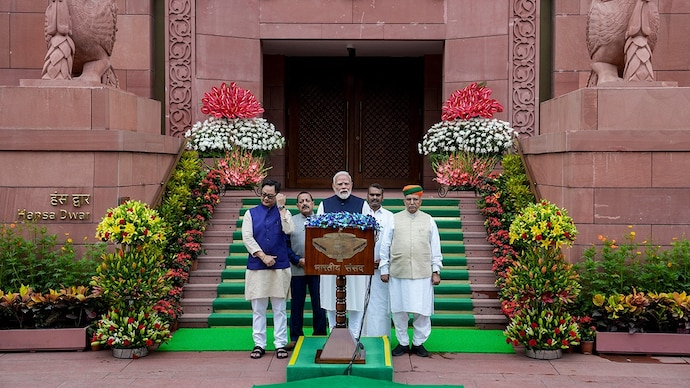
The rest of the Opposition, too, is nowhere near a comfort zone. The Aam Aadmi Party (AAP) has its hands full with electoral and organisational troubles. The Shiv Sena remains split, with both factions claiming the same legacy. Meanwhile, persistent talk of the Sharad Pawar and Ajit Pawar camps coming back together has unsettled the INDIA bloc as a reunited Nationalist Congress Party (NCP) would sit with the government, not work against it. Each of these developments takes members away from the benches that need them to hold the floor.
Numbers, however, are only one measure of the Opposition, and the INDIA bloc knows the other one is noise. A diminished bench that fights every day looks very different on the evening news from a diminished bench that has gone quiet. No wonder the Opposition’s first objective this session is to demonstrate that it has lost no vigour even where it has lost strength. The list assembled by the Opposition is designed for exactly that, and it is centred on administration, not ideology.
The Samajwadi Party (SP) under Akhilesh Yadav has raised questions of mismanagement in the Ram Janmabhoomi temple project and is expected to press them on the floor. It is a pointed line of attack, aimed at the stewardship of the temple rather than the temple itself, and the SP can do it more freely than most of the others. A party told for three decades that it stood on the wrong side of Ayodhya can ask how the site is being run without getting dragged into an argument about the site itself. Other parties will notice.
Then there is the National Eligibility cum Entrance Test (NEET), where paper leaks and cancelled sittings left lakhs of candidates stranded, leading to renewed calls for education minister Dharmendra Pradhan’s resignation. The abrupt removal of support staff attached to Union minister Bhupender Yadav is a smaller matter, but it suggests disorder inside the government and is therefore useful for the Opposition. Behind all this sit unemployment and inflation, the standing charges. Take the government’s competence and its signature project, and turn both into questions. That is the plan.
Notice that almost none of this touches the legislative list. The battles of this session will be fought largely outside the bills, in adjournment notices, question hour and the well of the House. The government’s legislative strategy makes sense only when read against that fact.
A session is, before anything else, a fixed number of hours. Every hour spent on a bill is an hour not available for a Rule 267 discussion or a debate on a minister’s future. The government cannot control what the Opposition raises, but it decides what is listed, when it comes up and how long it runs. Seven bills, most of them deliberately unprovocative and none needing the numbers a constitutional amendment demands, will fill the session with business the government is perfectly happy to be seen transacting. It also gives the chair a reasonable answer to every Rule 267 notice: listed business must proceed.
There is another calculation underneath, and it is less comfortable for the Opposition. Disruption does not stop legislation in this Parliament. If anything, it speeds it up. Bills have been cleared in both Houses amid din, in minutes, without anything resembling scrutiny. An Opposition that shuts down question hour over Pradhan creates exactly the conditions in which a technical amendment is passed unexamined. Both sides know this, which is why the Opposition’s real decision each morning is not whether it has a grievance—it has several—but whether spending the day on one is worth losing out on more.
Look at the bills against the Opposition’s list and the pairing becomes hard to miss. The Foreign Contribution (Regulation) Act (FCRA) amendment continues a line of policy visible since 2014. Foreign money should face scrutiny, the argument runs, on grounds of transparency and national security, and each revision of the law has tightened compliance for organisations that receive funds from abroad. Opposition members have already indicated where they would take this one. FCRA governs the section of civil society that produces field research and litigation, including much of the documentation behind Opposition arguments on employment and welfare delivery, and the apprehension on those benches is that the timing is not incidental. The government’s answer has not changed in a decade: transparency, not restriction. What the amendment actually says will be known only on introduction, and both sides will read it for the same thing—how much discretion it hands the Ministry of Home Affairs.
The amendment to the Prevention of Insults to National Honour Act is the exception on the list, and it is an exception by design. Giving legal protection to Vande Mataram costs nothing and requires no machinery to implement. What it does is force a confrontation the government is happy to have. Sections of the Muslim community have historically declined to sing Vande Mataram, and Muslim organisations have long argued that the verses that personify the nation as a deity sit uneasily with Islamic belief. Parties answerable to those constituencies cannot simply wave the bill through, and the government knows it.
Opposition to the bill is not a risk in the BJP’s calculation. It is the point. Any party that votes against legal protection for the national song hands the BJP a recorded vote it will replay in every campaign to come, and any party that votes for it must answer to voters who remember why their organisations objected in the first place. The SP, preparing its temple-mismanagement charge, is squeezed hardest of all: it would be fighting on Ayodhya’s administration and Vande Mataram’s sanctity in the same week. The other six bills avoid battles. This one selects the battlefield.
The economic bills are the defensive half of the agenda. The MSME Development Act amendments arrive as India argues its case as an alternative home for global supply chains even as small enterprises keep complaining about delayed payments, thin credit and regulatory drag. There is domestic politics in this, too. Small and medium enterprises are where most jobs are created, so legislation aimed at them lets ministers talk about employment without engaging with the headline numbers. It is also maintenance work on a trading and small-business constituency that took the brunt of demonetisation and the GST transition, and has never quite stopped saying so.
The Registration of Births and Deaths amendment looks technical, and the government describes it that way. A decade of digital public infrastructure, from identity to welfare transfer and financial inclusion, runs on registration data, and cleaner records make the whole thing work better. The Opposition reads the bill against a different history, because the same records touch electoral rolls, and parties that have mobilised around questions of enumeration will say so on the floor. The TMC has been the most consistent voice on this theme. It will make the argument again, this time with fewer members than it had a year ago.
The Viksit Bharat Shiksha Adhishthan Bill is the sharpest piece of scheduling on the list. It builds on the National Education Policy and redraws the institutional framework over higher education, which means the minister piloting it through the House will be Pradhan, whose resignation the Opposition intends to demand. A minister defending a reform bill has the floor, a prepared text and a reason to be at the despatch box on his own terms instead of answering for NEET. The substantive fight will be over the appointments architecture and how much purchase the states keep on a Concurrent List subject. The political fight will be over whether Pradhan spends the session discussing the future of Indian education or the failure of one examination.
The income tax amendments and the increase in the Supreme Court’s sanctioned strength are housekeeping, and both suit the government’s story. The first signals continuity and regulatory certainty. The second responds to judicial pendency, a complaint the government did not create and can be seen addressing, while also widening the pool from which appointments are made. Nobody will fight over either, which is indeed the point.
What is missing from the list matters as much as what is on it. There is no Uniform Civil Code, no electoral reform, nothing with the charge of an Article 370 moment. The BJP has shown it will spend political capital on transformative legislation, but it does so when it needs to mobilise. After Bengal, with the TMC diminished, the AAP reduced, the Sena divided and the NCP possibly reassembling on the government’s side of the House, it has no such need. A carefully chosen symbolic fight, on a ground where the Opposition’s numbers matter less than its dilemmas, is a different proposition from three weeks of ideological confrontation. The restraint on six bills and the provocation on the seventh come from the same reading of the party’s position.
The session will not be calm. The Opposition will press its list, the Centre has made the customary appeal for smooth functioning, and the fights will run through adjournment notices and the well of the House more than through the bills themselves. But there is an asymmetry in it. The Opposition will win most of the evening bulletins. The government will win most of the statute book, and one recorded vote besides. Both sides will call it a success, and neither will be wrong. This monsoon session will be remembered less for how many bills clear both Houses than for who set the terms of the argument. In Parliament, that fight usually settles the rest.
Subscribe to India Today Magazine
The rest of the Opposition, too, is nowhere near a comfort zone. The Aam Aadmi Party (AAP) has its hands full with electoral and organisational troubles. The Shiv Sena remains split, with both factions claiming the same legacy. Meanwhile, persistent talk of the Sharad Pawar and Ajit Pawar camps coming back together has unsettled the INDIA bloc as a reunited Nationalist Congress Party (NCP) would sit with the government, not work against it. Each of these developments takes members away from the benches that need them to hold the floor.
Numbers, however, are only one measure of the Opposition, and the INDIA bloc knows the other one is noise. A diminished bench that fights every day looks very different on the evening news from a diminished bench that has gone quiet. No wonder the Opposition’s first objective this session is to demonstrate that it has lost no vigour even where it has lost strength. The list assembled by the Opposition is designed for exactly that, and it is centred on administration, not ideology.
The Samajwadi Party (SP) under Akhilesh Yadav has raised questions of mismanagement in the Ram Janmabhoomi temple project and is expected to press them on the floor. It is a pointed line of attack, aimed at the stewardship of the temple rather than the temple itself, and the SP can do it more freely than most of the others. A party told for three decades that it stood on the wrong side of Ayodhya can ask how the site is being run without getting dragged into an argument about the site itself. Other parties will notice.
Then there is the National Eligibility cum Entrance Test (NEET), where paper leaks and cancelled sittings left lakhs of candidates stranded, leading to renewed calls for education minister Dharmendra Pradhan’s resignation. The abrupt removal of support staff attached to Union minister Bhupender Yadav is a smaller matter, but it suggests disorder inside the government and is therefore useful for the Opposition. Behind all this sit unemployment and inflation, the standing charges. Take the government’s competence and its signature project, and turn both into questions. That is the plan.
Notice that almost none of this touches the legislative list. The battles of this session will be fought largely outside the bills, in adjournment notices, question hour and the well of the House. The government’s legislative strategy makes sense only when read against that fact.
A session is, before anything else, a fixed number of hours. Every hour spent on a bill is an hour not available for a Rule 267 discussion or a debate on a minister’s future. The government cannot control what the Opposition raises, but it decides what is listed, when it comes up and how long it runs. Seven bills, most of them deliberately unprovocative and none needing the numbers a constitutional amendment demands, will fill the session with business the government is perfectly happy to be seen transacting. It also gives the chair a reasonable answer to every Rule 267 notice: listed business must proceed.
There is another calculation underneath, and it is less comfortable for the Opposition. Disruption does not stop legislation in this Parliament. If anything, it speeds it up. Bills have been cleared in both Houses amid din, in minutes, without anything resembling scrutiny. An Opposition that shuts down question hour over Pradhan creates exactly the conditions in which a technical amendment is passed unexamined. Both sides know this, which is why the Opposition’s real decision each morning is not whether it has a grievance—it has several—but whether spending the day on one is worth losing out on more.
Look at the bills against the Opposition’s list and the pairing becomes hard to miss. The Foreign Contribution (Regulation) Act (FCRA) amendment continues a line of policy visible since 2014. Foreign money should face scrutiny, the argument runs, on grounds of transparency and national security, and each revision of the law has tightened compliance for organisations that receive funds from abroad. Opposition members have already indicated where they would take this one. FCRA governs the section of civil society that produces field research and litigation, including much of the documentation behind Opposition arguments on employment and welfare delivery, and the apprehension on those benches is that the timing is not incidental. The government’s answer has not changed in a decade: transparency, not restriction. What the amendment actually says will be known only on introduction, and both sides will read it for the same thing—how much discretion it hands the Ministry of Home Affairs.
The amendment to the Prevention of Insults to National Honour Act is the exception on the list, and it is an exception by design. Giving legal protection to Vande Mataram costs nothing and requires no machinery to implement. What it does is force a confrontation the government is happy to have. Sections of the Muslim community have historically declined to sing Vande Mataram, and Muslim organisations have long argued that the verses that personify the nation as a deity sit uneasily with Islamic belief. Parties answerable to those constituencies cannot simply wave the bill through, and the government knows it.
Opposition to the bill is not a risk in the BJP’s calculation. It is the point. Any party that votes against legal protection for the national song hands the BJP a recorded vote it will replay in every campaign to come, and any party that votes for it must answer to voters who remember why their organisations objected in the first place. The SP, preparing its temple-mismanagement charge, is squeezed hardest of all: it would be fighting on Ayodhya’s administration and Vande Mataram’s sanctity in the same week. The other six bills avoid battles. This one selects the battlefield.
The economic bills are the defensive half of the agenda. The MSME Development Act amendments arrive as India argues its case as an alternative home for global supply chains even as small enterprises keep complaining about delayed payments, thin credit and regulatory drag. There is domestic politics in this, too. Small and medium enterprises are where most jobs are created, so legislation aimed at them lets ministers talk about employment without engaging with the headline numbers. It is also maintenance work on a trading and small-business constituency that took the brunt of demonetisation and the GST transition, and has never quite stopped saying so.
The Registration of Births and Deaths amendment looks technical, and the government describes it that way. A decade of digital public infrastructure, from identity to welfare transfer and financial inclusion, runs on registration data, and cleaner records make the whole thing work better. The Opposition reads the bill against a different history, because the same records touch electoral rolls, and parties that have mobilised around questions of enumeration will say so on the floor. The TMC has been the most consistent voice on this theme. It will make the argument again, this time with fewer members than it had a year ago.
The Viksit Bharat Shiksha Adhishthan Bill is the sharpest piece of scheduling on the list. It builds on the National Education Policy and redraws the institutional framework over higher education, which means the minister piloting it through the House will be Pradhan, whose resignation the Opposition intends to demand. A minister defending a reform bill has the floor, a prepared text and a reason to be at the despatch box on his own terms instead of answering for NEET. The substantive fight will be over the appointments architecture and how much purchase the states keep on a Concurrent List subject. The political fight will be over whether Pradhan spends the session discussing the future of Indian education or the failure of one examination.
The income tax amendments and the increase in the Supreme Court’s sanctioned strength are housekeeping, and both suit the government’s story. The first signals continuity and regulatory certainty. The second responds to judicial pendency, a complaint the government did not create and can be seen addressing, while also widening the pool from which appointments are made. Nobody will fight over either, which is indeed the point.
What is missing from the list matters as much as what is on it. There is no Uniform Civil Code, no electoral reform, nothing with the charge of an Article 370 moment. The BJP has shown it will spend political capital on transformative legislation, but it does so when it needs to mobilise. After Bengal, with the TMC diminished, the AAP reduced, the Sena divided and the NCP possibly reassembling on the government’s side of the House, it has no such need. A carefully chosen symbolic fight, on a ground where the Opposition’s numbers matter less than its dilemmas, is a different proposition from three weeks of ideological confrontation. The restraint on six bills and the provocation on the seventh come from the same reading of the party’s position.
The session will not be calm. The Opposition will press its list, the Centre has made the customary appeal for smooth functioning, and the fights will run through adjournment notices and the well of the House more than through the bills themselves. But there is an asymmetry in it. The Opposition will win most of the evening bulletins. The government will win most of the statute book, and one recorded vote besides. Both sides will call it a success, and neither will be wrong. This monsoon session will be remembered less for how many bills clear both Houses than for who set the terms of the argument. In Parliament, that fight usually settles the rest.
Subscribe to India Today Magazine
The rest of the Opposition, too, is nowhere near a comfort zone. The Aam Aadmi Party (AAP) has its hands full with electoral and organisational troubles. The Shiv Sena remains split, with both factions claiming the same legacy. Meanwhile, persistent talk of the Sharad Pawar and Ajit Pawar camps coming back together has unsettled the INDIA bloc as a reunited Nationalist Congress Party (NCP) would sit with the government, not work against it. Each of these developments takes members away from the benches that need them to hold the floor.
Numbers, however, are only one measure of the Opposition, and the INDIA bloc knows the other one is noise. A diminished bench that fights every day looks very different on the evening news from a diminished bench that has gone quiet. No wonder the Opposition’s first objective this session is to demonstrate that it has lost no vigour even where it has lost strength. The list assembled by the Opposition is designed for exactly that, and it is centred on administration, not ideology.
The Samajwadi Party (SP) under Akhilesh Yadav has raised questions of mismanagement in the Ram Janmabhoomi temple project and is expected to press them on the floor. It is a pointed line of attack, aimed at the stewardship of the temple rather than the temple itself, and the SP can do it more freely than most of the others. A party told for three decades that it stood on the wrong side of Ayodhya can ask how the site is being run without getting dragged into an argument about the site itself. Other parties will notice.
Then there is the National Eligibility cum Entrance Test (NEET), where paper leaks and cancelled sittings left lakhs of candidates stranded, leading to renewed calls for education minister Dharmendra Pradhan’s resignation. The abrupt removal of support staff attached to Union minister Bhupender Yadav is a smaller matter, but it suggests disorder inside the government and is therefore useful for the Opposition. Behind all this sit unemployment and inflation, the standing charges. Take the government’s competence and its signature project, and turn both into questions. That is the plan.
Notice that almost none of this touches the legislative list. The battles of this session will be fought largely outside the bills, in adjournment notices, question hour and the well of the House. The government’s legislative strategy makes sense only when read against that fact.
A session is, before anything else, a fixed number of hours. Every hour spent on a bill is an hour not available for a Rule 267 discussion or a debate on a minister’s future. The government cannot control what the Opposition raises, but it decides what is listed, when it comes up and how long it runs. Seven bills, most of them deliberately unprovocative and none needing the numbers a constitutional amendment demands, will fill the session with business the government is perfectly happy to be seen transacting. It also gives the chair a reasonable answer to every Rule 267 notice: listed business must proceed.
There is another calculation underneath, and it is less comfortable for the Opposition. Disruption does not stop legislation in this Parliament. If anything, it speeds it up. Bills have been cleared in both Houses amid din, in minutes, without anything resembling scrutiny. An Opposition that shuts down question hour over Pradhan creates exactly the conditions in which a technical amendment is passed unexamined. Both sides know this, which is why the Opposition’s real decision each morning is not whether it has a grievance—it has several—but whether spending the day on one is worth losing out on more.
Look at the bills against the Opposition’s list and the pairing becomes hard to miss. The Foreign Contribution (Regulation) Act (FCRA) amendment continues a line of policy visible since 2014. Foreign money should face scrutiny, the argument runs, on grounds of transparency and national security, and each revision of the law has tightened compliance for organisations that receive funds from abroad. Opposition members have already indicated where they would take this one. FCRA governs the section of civil society that produces field research and litigation, including much of the documentation behind Opposition arguments on employment and welfare delivery, and the apprehension on those benches is that the timing is not incidental. The government’s answer has not changed in a decade: transparency, not restriction. What the amendment actually says will be known only on introduction, and both sides will read it for the same thing—how much discretion it hands the Ministry of Home Affairs.
The amendment to the Prevention of Insults to National Honour Act is the exception on the list, and it is an exception by design. Giving legal protection to Vande Mataram costs nothing and requires no machinery to implement. What it does is force a confrontation the government is happy to have. Sections of the Muslim community have historically declined to sing Vande Mataram, and Muslim organisations have long argued that the verses that personify the nation as a deity sit uneasily with Islamic belief. Parties answerable to those constituencies cannot simply wave the bill through, and the government knows it.
Opposition to the bill is not a risk in the BJP’s calculation. It is the point. Any party that votes against legal protection for the national song hands the BJP a recorded vote it will replay in every campaign to come, and any party that votes for it must answer to voters who remember why their organisations objected in the first place. The SP, preparing its temple-mismanagement charge, is squeezed hardest of all: it would be fighting on Ayodhya’s administration and Vande Mataram’s sanctity in the same week. The other six bills avoid battles. This one selects the battlefield.
The economic bills are the defensive half of the agenda. The MSME Development Act amendments arrive as India argues its case as an alternative home for global supply chains even as small enterprises keep complaining about delayed payments, thin credit and regulatory drag. There is domestic politics in this, too. Small and medium enterprises are where most jobs are created, so legislation aimed at them lets ministers talk about employment without engaging with the headline numbers. It is also maintenance work on a trading and small-business constituency that took the brunt of demonetisation and the GST transition, and has never quite stopped saying so.
The Registration of Births and Deaths amendment looks technical, and the government describes it that way. A decade of digital public infrastructure, from identity to welfare transfer and financial inclusion, runs on registration data, and cleaner records make the whole thing work better. The Opposition reads the bill against a different history, because the same records touch electoral rolls, and parties that have mobilised around questions of enumeration will say so on the floor. The TMC has been the most consistent voice on this theme. It will make the argument again, this time with fewer members than it had a year ago.
The Viksit Bharat Shiksha Adhishthan Bill is the sharpest piece of scheduling on the list. It builds on the National Education Policy and redraws the institutional framework over higher education, which means the minister piloting it through the House will be Pradhan, whose resignation the Opposition intends to demand. A minister defending a reform bill has the floor, a prepared text and a reason to be at the despatch box on his own terms instead of answering for NEET. The substantive fight will be over the appointments architecture and how much purchase the states keep on a Concurrent List subject. The political fight will be over whether Pradhan spends the session discussing the future of Indian education or the failure of one examination.
The income tax amendments and the increase in the Supreme Court’s sanctioned strength are housekeeping, and both suit the government’s story. The first signals continuity and regulatory certainty. The second responds to judicial pendency, a complaint the government did not create and can be seen addressing, while also widening the pool from which appointments are made. Nobody will fight over either, which is indeed the point.
What is missing from the list matters as much as what is on it. There is no Uniform Civil Code, no electoral reform, nothing with the charge of an Article 370 moment. The BJP has shown it will spend political capital on transformative legislation, but it does so when it needs to mobilise. After Bengal, with the TMC diminished, the AAP reduced, the Sena divided and the NCP possibly reassembling on the government’s side of the House, it has no such need. A carefully chosen symbolic fight, on a ground where the Opposition’s numbers matter less than its dilemmas, is a different proposition from three weeks of ideological confrontation. The restraint on six bills and the provocation on the seventh come from the same reading of the party’s position.
The session will not be calm. The Opposition will press its list, the Centre has made the customary appeal for smooth functioning, and the fights will run through adjournment notices and the well of the House more than through the bills themselves. But there is an asymmetry in it. The Opposition will win most of the evening bulletins. The government will win most of the statute book, and one recorded vote besides. Both sides will call it a success, and neither will be wrong. This monsoon session will be remembered less for how many bills clear both Houses than for who set the terms of the argument. In Parliament, that fight usually settles the rest.
Subscribe to India Today Magazine

