How Akhilesh Yadav is using three stages in Delhi for one big gain
From the CJP's Jantar Mantar platform shunned by ally Congress to Rahul Gandhi's 7 LKM protest to Parliament, Samajwadi Party chief Akhilesh Yadav is using all stages in Delhi. The goal seems to be one, coming just ahead of the Assembly election in Uttar Pradesh.
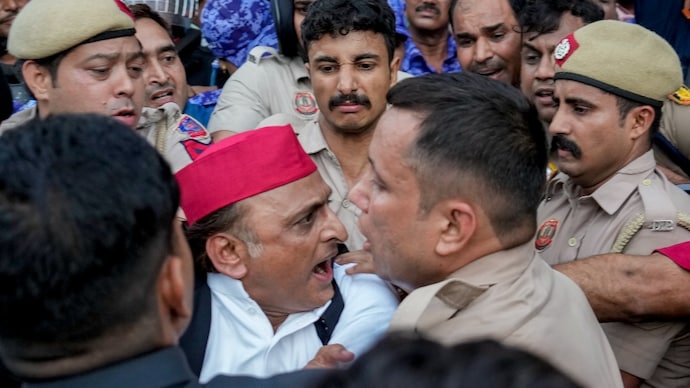
In a span of a few days, Samajwadi Party (SP) chief Akhilesh Yadav turned two of New Delhi's most politically important stages into a platform of campaign messaging. The third stage came up unexpectedly outside Prime Minister Narendra Modi's official residence, where Akhilesh made a surprise appearance, turning a sit-in by Congress leader Rahul Gandhi into another stage aimed squarely at Uttar Pradesh's youth.
Doing just more than acknowledging and reacting to the protests, the SP has appeared to use it to reinforce a political identity it wants voters to associate with it before the 2027 Uttar Pradesh Assembly election. The SP, out of power for two consecutive terms in UP, wants to be seen as the one standing with students, job aspirants and unemployed youth.
These three stages might be in New Delhi for Akhilesh and the SP. The destination isn't the national capital for now. It is Lucknow. However, the road to Lucknow seems to be passing via Delhi.
Akhilesh Yadav is emerging as the second most prominent face of the Opposition in the protests after Rahul Gandhi.
Akhilesh's use of the three stages came amid the Opposition's mobilisation around the Cockroach Janata Party's (CJP) agitation over alleged exam paper leaks and irregularities in recruitment examinations. For the SP chief, the first stage was Jantar Mantar, where party MP Dimple Yadav repeatedly visited protesters, met fasting activist Sonam Wangchuk, interacted with students and accused the BJP government of failing India's youth.
The second stage was Parliament, where Akhilesh Yadav took on the same issues inside the Lok Sabha, linking paper leaks, unemployment and the police action against protesters to what he described as the government's failures.
The third stage came outside Modi's residence at 7, Lok Kalyan Marg, where Akhilesh joined Congress MPs Rahul Gandhi (LOP, Priyanka Gandhi Vadra and other INDIA bloc leaders in a sit-in that ended with their detention by Delhi Police. Individually. Each of these separate incidents appear to be a part of the Opposition's campaign. But, together they projected a sequenced political messaging bid.
JANTAR MANTAR, THE FIRST STAGE OF SAMAJWADI PARTY, AKHILESH YADAV
Like political campaigns need a humane face before they acquire a political one, Dimple Yadav played that role for the SP.
As the CJP-led protests gathered momentum at Jantar Mantar over NEET paper leaks and alleged examination irregularities, Mainpuri MP and wife of SP chief Akhilesh Yadav, Dimple Yadav, emerged as one of the most visible Opposition leaders, who met Wangchuk and the leaders of the CJP several times. Unlike a one-off political visit, she returned to the protest site multiple times over several days.
She marched from Parliament to Jantar Mantar alongside Samajwadi Party MPs, carrying placards that questioned the integrity of the examination system.
Following clashes between protesters and police, Dimple Yadav accused the government of suppressing the voices of students instead of addressing their concerns. She alleged that the recruitment and examination system had become compromised and argued that the country's youth were being pushed into uncertainty.
The SP wants to show that while it stands with the CJP's agitation, the issues of youth unemployment and paper leaks are part of its own political agenda. Instead of just attacking the BJP from press conferences or television studios, the SP leadership appeared physically present alongside agitating students.
And, that's what the SP needs before the crucial polls. It's visibly attempting to widen its social coalition beyond traditional PDA caste arithmetic. That's where the grievances of the young offered them an attractive stage. Paper leaks and unemployment resonate across caste lines, which the SP sees as a politically powerful issue.
This plank of the SP also dovetailed with Akhilesh Yadav's broader messaging over the past year, where paper leaks, delayed recruitments and unemployment became recurring themes in his speeches. Moreover, the SP has already shown its willingness to align with Sanatana and the soft-Hindutva brand of politics.
SP's SECOND STAGE WAS THE PARLIAMENT; AKHILESH MADE GOOD USE OF IT
If the visuals of MP Dimple Yadav at Jantar Mantar generated goodwill, Akhilesh Yadav's speech in the Parliament generated headlines.
Soon after the police action against protesters, Akhilesh Yadav carried the issue into the Lok Sabha. He represents the Kannauj seat of UP in the lower house.
Akhilesh's outburst in the Lok Sabha was not restricted to the alleged police excesses. He stitched together three issues that featured in Opposition attacks against the BJP. He spoke about paper leaks, unemployment and what the Opposition describes as an increasingly insensitive approach towards Indian youth.
Akhilesh questioned why students protesting over their future were met with force instead of being provided with answers. He criticised the handling of examination irregularities and argued that repeated paper leaks had destroyed the confidence of lakhs of candidates preparing for government jobs.
During the proceedings, SP MPs, including Dimple Yadav, vocally supported him, while other Opposition MPs held coordinated protests inside the Parliament. So, by intervening in Parliament, Akhilesh ensured that the issues entered the records, dominated the news and compelled the Centre to respond and act. His statement in Parliament was an amplifier.
Akhilesh Yadav told the Lok Sabha that the Opposition was "compelled to go to the Prime Minister's residence" because its concerns were not being heard in Parliament. He questioned why the Prime Minister "can't make a statement" inside the House on issues affecting the country's youth.
Akhilesh's statement in Parliament also made sure that the SP didn't appear to be an opportunist party jumping onto a trending issue. The SP has so far presented itself as carrying the same argument from the streets into the country's highest legislative forum, the House of the People.
AKHILESH'S THIRD STAGE WAS OUTSIDE PRIME MINISTER'S RESIDENCE
The biggest stage that Akhilesh used was the streets outside 7, Lok Kalyan Marg, the official residence of the Indian Prime Minister.
Akhilesh Yadav joined Rahul Gandhi, Priyanka Gandhi Vadra and several INDIA bloc leaders in a sit-in protest demanding accountability over the police action against protesters and the broader concerns surrounding examination irregularities.
As the Delhi Police detained several Opposition leaders as they tried to continue the demonstration, the visuals started dominating spaces in television screens and social media. As the leader of the second-biggest Opposition party in the Lok Sabha, the detention outside the Prime Minister's residence carried symbolism.
As Akhilesh Yadav was detained and stuffed into a bus by the Delhi Police, SP workers gathered around it, raising slogans in his support and against the BJP government. Several cadres ran alongside the bus, cheering their leader. This turned the high-profile detention into a display of solidarity. Some reports say that Akhilesh and SP cadres even went to Chhatrasal Stadium in northern Delhi, where Rahul Gandhi had been detained along with hundreds of Congress cadres.
By protesting and standing alongside Rahul Gandhi, Akhilesh Yadav also reinforced another message. The SP is not like other regional parties that cosied up to the BJP. It wants itself to be seen as the one carrying the mantle of the Opposition against the BJP-led Centre.
WHY AKHILESH YADAV'S THREE STAGES MATTER
When one views the Akhilesh-led SP's participation in the three protests — at Jantar Mantar, in Parliament and outside the Prime Minister's residence — separately, they resemble routine Opposition politics. But viewed together they are clever and clearly sequenced political campaigns.
Each stage had a distinct purpose. Dimple Yadav's support and appearances at the Jantar Mantar established an emotional connection with students and job aspirants. Akhilesh's statement in Parliament institutionalised the argument. And the protest outside 7, Lok Kalyan Marg created a confrontation, which gave him national visibility on a day LOP Rahul Gandhi was on the same road.
Using the three stages, Akhilesh and his party carried and amplified the same message across the street, the Lok Sabha and television screens.
For the SP and Akhilesh, the three distinct but similar messaging in New Delhi were the figurative stops to its main destination in Lucknow. The SP is attempting to position itself as the principal challenger to the BJP ahead of the 2027 Uttar Pradesh Assembly election by combining its PDA politics with alleged examination irregularities, youth unemployment and delayed recruitments. Whether the strategy works remains to be seen, but right now, at least, the SP is keen to be looked at as a pro-students and a pro-youth party.
In a span of a few days, Samajwadi Party (SP) chief Akhilesh Yadav turned two of New Delhi's most politically important stages into a platform of campaign messaging. The third stage came up unexpectedly outside Prime Minister Narendra Modi's official residence, where Akhilesh made a surprise appearance, turning a sit-in by Congress leader Rahul Gandhi into another stage aimed squarely at Uttar Pradesh's youth.
Doing just more than acknowledging and reacting to the protests, the SP has appeared to use it to reinforce a political identity it wants voters to associate with it before the 2027 Uttar Pradesh Assembly election. The SP, out of power for two consecutive terms in UP, wants to be seen as the one standing with students, job aspirants and unemployed youth.
These three stages might be in New Delhi for Akhilesh and the SP. The destination isn't the national capital for now. It is Lucknow. However, the road to Lucknow seems to be passing via Delhi.
Akhilesh Yadav is emerging as the second most prominent face of the Opposition in the protests after Rahul Gandhi.
Akhilesh's use of the three stages came amid the Opposition's mobilisation around the Cockroach Janata Party's (CJP) agitation over alleged exam paper leaks and irregularities in recruitment examinations. For the SP chief, the first stage was Jantar Mantar, where party MP Dimple Yadav repeatedly visited protesters, met fasting activist Sonam Wangchuk, interacted with students and accused the BJP government of failing India's youth.
The second stage was Parliament, where Akhilesh Yadav took on the same issues inside the Lok Sabha, linking paper leaks, unemployment and the police action against protesters to what he described as the government's failures.
The third stage came outside Modi's residence at 7, Lok Kalyan Marg, where Akhilesh joined Congress MPs Rahul Gandhi (LOP, Priyanka Gandhi Vadra and other INDIA bloc leaders in a sit-in that ended with their detention by Delhi Police. Individually. Each of these separate incidents appear to be a part of the Opposition's campaign. But, together they projected a sequenced political messaging bid.
JANTAR MANTAR, THE FIRST STAGE OF SAMAJWADI PARTY, AKHILESH YADAV
Like political campaigns need a humane face before they acquire a political one, Dimple Yadav played that role for the SP.
As the CJP-led protests gathered momentum at Jantar Mantar over NEET paper leaks and alleged examination irregularities, Mainpuri MP and wife of SP chief Akhilesh Yadav, Dimple Yadav, emerged as one of the most visible Opposition leaders, who met Wangchuk and the leaders of the CJP several times. Unlike a one-off political visit, she returned to the protest site multiple times over several days.
She marched from Parliament to Jantar Mantar alongside Samajwadi Party MPs, carrying placards that questioned the integrity of the examination system.
Following clashes between protesters and police, Dimple Yadav accused the government of suppressing the voices of students instead of addressing their concerns. She alleged that the recruitment and examination system had become compromised and argued that the country's youth were being pushed into uncertainty.
The SP wants to show that while it stands with the CJP's agitation, the issues of youth unemployment and paper leaks are part of its own political agenda. Instead of just attacking the BJP from press conferences or television studios, the SP leadership appeared physically present alongside agitating students.
And, that's what the SP needs before the crucial polls. It's visibly attempting to widen its social coalition beyond traditional PDA caste arithmetic. That's where the grievances of the young offered them an attractive stage. Paper leaks and unemployment resonate across caste lines, which the SP sees as a politically powerful issue.
This plank of the SP also dovetailed with Akhilesh Yadav's broader messaging over the past year, where paper leaks, delayed recruitments and unemployment became recurring themes in his speeches. Moreover, the SP has already shown its willingness to align with Sanatana and the soft-Hindutva brand of politics.
SP's SECOND STAGE WAS THE PARLIAMENT; AKHILESH MADE GOOD USE OF IT
If the visuals of MP Dimple Yadav at Jantar Mantar generated goodwill, Akhilesh Yadav's speech in the Parliament generated headlines.
Soon after the police action against protesters, Akhilesh Yadav carried the issue into the Lok Sabha. He represents the Kannauj seat of UP in the lower house.
Akhilesh's outburst in the Lok Sabha was not restricted to the alleged police excesses. He stitched together three issues that featured in Opposition attacks against the BJP. He spoke about paper leaks, unemployment and what the Opposition describes as an increasingly insensitive approach towards Indian youth.
Akhilesh questioned why students protesting over their future were met with force instead of being provided with answers. He criticised the handling of examination irregularities and argued that repeated paper leaks had destroyed the confidence of lakhs of candidates preparing for government jobs.
During the proceedings, SP MPs, including Dimple Yadav, vocally supported him, while other Opposition MPs held coordinated protests inside the Parliament. So, by intervening in Parliament, Akhilesh ensured that the issues entered the records, dominated the news and compelled the Centre to respond and act. His statement in Parliament was an amplifier.
Akhilesh Yadav told the Lok Sabha that the Opposition was "compelled to go to the Prime Minister's residence" because its concerns were not being heard in Parliament. He questioned why the Prime Minister "can't make a statement" inside the House on issues affecting the country's youth.
Akhilesh's statement in Parliament also made sure that the SP didn't appear to be an opportunist party jumping onto a trending issue. The SP has so far presented itself as carrying the same argument from the streets into the country's highest legislative forum, the House of the People.
AKHILESH'S THIRD STAGE WAS OUTSIDE PRIME MINISTER'S RESIDENCE
The biggest stage that Akhilesh used was the streets outside 7, Lok Kalyan Marg, the official residence of the Indian Prime Minister.
Akhilesh Yadav joined Rahul Gandhi, Priyanka Gandhi Vadra and several INDIA bloc leaders in a sit-in protest demanding accountability over the police action against protesters and the broader concerns surrounding examination irregularities.
As the Delhi Police detained several Opposition leaders as they tried to continue the demonstration, the visuals started dominating spaces in television screens and social media. As the leader of the second-biggest Opposition party in the Lok Sabha, the detention outside the Prime Minister's residence carried symbolism.
As Akhilesh Yadav was detained and stuffed into a bus by the Delhi Police, SP workers gathered around it, raising slogans in his support and against the BJP government. Several cadres ran alongside the bus, cheering their leader. This turned the high-profile detention into a display of solidarity. Some reports say that Akhilesh and SP cadres even went to Chhatrasal Stadium in northern Delhi, where Rahul Gandhi had been detained along with hundreds of Congress cadres.
By protesting and standing alongside Rahul Gandhi, Akhilesh Yadav also reinforced another message. The SP is not like other regional parties that cosied up to the BJP. It wants itself to be seen as the one carrying the mantle of the Opposition against the BJP-led Centre.
WHY AKHILESH YADAV'S THREE STAGES MATTER
When one views the Akhilesh-led SP's participation in the three protests — at Jantar Mantar, in Parliament and outside the Prime Minister's residence — separately, they resemble routine Opposition politics. But viewed together they are clever and clearly sequenced political campaigns.
Each stage had a distinct purpose. Dimple Yadav's support and appearances at the Jantar Mantar established an emotional connection with students and job aspirants. Akhilesh's statement in Parliament institutionalised the argument. And the protest outside 7, Lok Kalyan Marg created a confrontation, which gave him national visibility on a day LOP Rahul Gandhi was on the same road.
Using the three stages, Akhilesh and his party carried and amplified the same message across the street, the Lok Sabha and television screens.
For the SP and Akhilesh, the three distinct but similar messaging in New Delhi were the figurative stops to its main destination in Lucknow. The SP is attempting to position itself as the principal challenger to the BJP ahead of the 2027 Uttar Pradesh Assembly election by combining its PDA politics with alleged examination irregularities, youth unemployment and delayed recruitments. Whether the strategy works remains to be seen, but right now, at least, the SP is keen to be looked at as a pro-students and a pro-youth party.
In a span of a few days, Samajwadi Party (SP) chief Akhilesh Yadav turned two of New Delhi's most politically important stages into a platform of campaign messaging. The third stage came up unexpectedly outside Prime Minister Narendra Modi's official residence, where Akhilesh made a surprise appearance, turning a sit-in by Congress leader Rahul Gandhi into another stage aimed squarely at Uttar Pradesh's youth.
Doing just more than acknowledging and reacting to the protests, the SP has appeared to use it to reinforce a political identity it wants voters to associate with it before the 2027 Uttar Pradesh Assembly election. The SP, out of power for two consecutive terms in UP, wants to be seen as the one standing with students, job aspirants and unemployed youth.
These three stages might be in New Delhi for Akhilesh and the SP. The destination isn't the national capital for now. It is Lucknow. However, the road to Lucknow seems to be passing via Delhi.
Akhilesh Yadav is emerging as the second most prominent face of the Opposition in the protests after Rahul Gandhi.
Akhilesh's use of the three stages came amid the Opposition's mobilisation around the Cockroach Janata Party's (CJP) agitation over alleged exam paper leaks and irregularities in recruitment examinations. For the SP chief, the first stage was Jantar Mantar, where party MP Dimple Yadav repeatedly visited protesters, met fasting activist Sonam Wangchuk, interacted with students and accused the BJP government of failing India's youth.
The second stage was Parliament, where Akhilesh Yadav took on the same issues inside the Lok Sabha, linking paper leaks, unemployment and the police action against protesters to what he described as the government's failures.
The third stage came outside Modi's residence at 7, Lok Kalyan Marg, where Akhilesh joined Congress MPs Rahul Gandhi (LOP, Priyanka Gandhi Vadra and other INDIA bloc leaders in a sit-in that ended with their detention by Delhi Police. Individually. Each of these separate incidents appear to be a part of the Opposition's campaign. But, together they projected a sequenced political messaging bid.
JANTAR MANTAR, THE FIRST STAGE OF SAMAJWADI PARTY, AKHILESH YADAV
Like political campaigns need a humane face before they acquire a political one, Dimple Yadav played that role for the SP.
As the CJP-led protests gathered momentum at Jantar Mantar over NEET paper leaks and alleged examination irregularities, Mainpuri MP and wife of SP chief Akhilesh Yadav, Dimple Yadav, emerged as one of the most visible Opposition leaders, who met Wangchuk and the leaders of the CJP several times. Unlike a one-off political visit, she returned to the protest site multiple times over several days.
She marched from Parliament to Jantar Mantar alongside Samajwadi Party MPs, carrying placards that questioned the integrity of the examination system.
Following clashes between protesters and police, Dimple Yadav accused the government of suppressing the voices of students instead of addressing their concerns. She alleged that the recruitment and examination system had become compromised and argued that the country's youth were being pushed into uncertainty.
The SP wants to show that while it stands with the CJP's agitation, the issues of youth unemployment and paper leaks are part of its own political agenda. Instead of just attacking the BJP from press conferences or television studios, the SP leadership appeared physically present alongside agitating students.
And, that's what the SP needs before the crucial polls. It's visibly attempting to widen its social coalition beyond traditional PDA caste arithmetic. That's where the grievances of the young offered them an attractive stage. Paper leaks and unemployment resonate across caste lines, which the SP sees as a politically powerful issue.
This plank of the SP also dovetailed with Akhilesh Yadav's broader messaging over the past year, where paper leaks, delayed recruitments and unemployment became recurring themes in his speeches. Moreover, the SP has already shown its willingness to align with Sanatana and the soft-Hindutva brand of politics.
SP's SECOND STAGE WAS THE PARLIAMENT; AKHILESH MADE GOOD USE OF IT
If the visuals of MP Dimple Yadav at Jantar Mantar generated goodwill, Akhilesh Yadav's speech in the Parliament generated headlines.
Soon after the police action against protesters, Akhilesh Yadav carried the issue into the Lok Sabha. He represents the Kannauj seat of UP in the lower house.
Akhilesh's outburst in the Lok Sabha was not restricted to the alleged police excesses. He stitched together three issues that featured in Opposition attacks against the BJP. He spoke about paper leaks, unemployment and what the Opposition describes as an increasingly insensitive approach towards Indian youth.
Akhilesh questioned why students protesting over their future were met with force instead of being provided with answers. He criticised the handling of examination irregularities and argued that repeated paper leaks had destroyed the confidence of lakhs of candidates preparing for government jobs.
During the proceedings, SP MPs, including Dimple Yadav, vocally supported him, while other Opposition MPs held coordinated protests inside the Parliament. So, by intervening in Parliament, Akhilesh ensured that the issues entered the records, dominated the news and compelled the Centre to respond and act. His statement in Parliament was an amplifier.
Akhilesh Yadav told the Lok Sabha that the Opposition was "compelled to go to the Prime Minister's residence" because its concerns were not being heard in Parliament. He questioned why the Prime Minister "can't make a statement" inside the House on issues affecting the country's youth.
Akhilesh's statement in Parliament also made sure that the SP didn't appear to be an opportunist party jumping onto a trending issue. The SP has so far presented itself as carrying the same argument from the streets into the country's highest legislative forum, the House of the People.
AKHILESH'S THIRD STAGE WAS OUTSIDE PRIME MINISTER'S RESIDENCE
The biggest stage that Akhilesh used was the streets outside 7, Lok Kalyan Marg, the official residence of the Indian Prime Minister.
Akhilesh Yadav joined Rahul Gandhi, Priyanka Gandhi Vadra and several INDIA bloc leaders in a sit-in protest demanding accountability over the police action against protesters and the broader concerns surrounding examination irregularities.
As the Delhi Police detained several Opposition leaders as they tried to continue the demonstration, the visuals started dominating spaces in television screens and social media. As the leader of the second-biggest Opposition party in the Lok Sabha, the detention outside the Prime Minister's residence carried symbolism.
As Akhilesh Yadav was detained and stuffed into a bus by the Delhi Police, SP workers gathered around it, raising slogans in his support and against the BJP government. Several cadres ran alongside the bus, cheering their leader. This turned the high-profile detention into a display of solidarity. Some reports say that Akhilesh and SP cadres even went to Chhatrasal Stadium in northern Delhi, where Rahul Gandhi had been detained along with hundreds of Congress cadres.
By protesting and standing alongside Rahul Gandhi, Akhilesh Yadav also reinforced another message. The SP is not like other regional parties that cosied up to the BJP. It wants itself to be seen as the one carrying the mantle of the Opposition against the BJP-led Centre.
WHY AKHILESH YADAV'S THREE STAGES MATTER
When one views the Akhilesh-led SP's participation in the three protests — at Jantar Mantar, in Parliament and outside the Prime Minister's residence — separately, they resemble routine Opposition politics. But viewed together they are clever and clearly sequenced political campaigns.
Each stage had a distinct purpose. Dimple Yadav's support and appearances at the Jantar Mantar established an emotional connection with students and job aspirants. Akhilesh's statement in Parliament institutionalised the argument. And the protest outside 7, Lok Kalyan Marg created a confrontation, which gave him national visibility on a day LOP Rahul Gandhi was on the same road.
Using the three stages, Akhilesh and his party carried and amplified the same message across the street, the Lok Sabha and television screens.
For the SP and Akhilesh, the three distinct but similar messaging in New Delhi were the figurative stops to its main destination in Lucknow. The SP is attempting to position itself as the principal challenger to the BJP ahead of the 2027 Uttar Pradesh Assembly election by combining its PDA politics with alleged examination irregularities, youth unemployment and delayed recruitments. Whether the strategy works remains to be seen, but right now, at least, the SP is keen to be looked at as a pro-students and a pro-youth party.

