Youth is not wasted on the young: How Gen Z is rewriting the protest playbook
Young protesters in Delhi mixed tear gas, barricade rushes and resignation slogans with reels and memes. Their humour and irreverence showed how social media and street politics now move together.
Sometimes journalists ask stupid questions. ‘Are you scared?’ was mine.
I shouted it out to three young protesters as they scurried along Sansad Marg with a cluster of others, weaving through the chaos. It was July 20, and they were marching toward Parliament in New Delhi.
This particular group had already tried to breach a police barricade three times. Each attempt had been pushed back by the Delhi Police and the Rapid Action Force. The fourth attempt was met with three rounds of tear gas. Then came the lathis.
The air was thick with cries of "Dharmendra Pradhan istifa do" (Dharmendra Pradhan, resign), thick with tear gas that burned the throat more than it stung the eyes, and thick with a resilience that kept drawing them back for a fifth attempt, then a sixth.
Through the haze, I spotted the three. Their eyes were streaming from the gas, their faces flushed with adrenaline. One had a fresh welt across his back where a lathi had landed.
"Are you scared?" I asked.
They looked at me with disdain.
"No. Why should we be scared?" one shot back. "We are disgusted."
Even as I walked away, I knew I had asked the wrong question. It should never have been, “Are you scared?”
Four days later, though, I would know the answer to that question with absolute certainty. They were not scared. This generation is not defined by fear. Whatever one may think of their politics or their methods, fear is not what drives them.
At 3 pm on July 20, near Le Meridien, the Delhi Police crackdown reached its peak. The standoff between protesters and police was coming to a head, with tensions mounting on both sides.
Having covered enough protests as a journalist, I thought I knew what to expect. But what I witnessed in those moments of intense friction was both surprising and, oddly enough, deeply amusing.
As rows of police officers clad in riot gear braced for a possible charge, and groups of protesters gathered at the barricades looking for an opening, a very different scene was unfolding in the middle of the chaos.
One young woman was calmly filming a reel about how getting her nails done before attending a protest had turned out to be a terrible idea. Just beside her, a friend had already spotted the day's most Instagram-worthy backdrop: a woman police officer, lathi in hand. With the camera rolling, she launched into an earnest riff on #FOMO. A few feet away, two young men were recording themselves tightening their shoelaces and stretching theatrically, as though warming up for a race rather than preparing to run from the police.
It was a surreal juxtaposition: the gravity of an imminent confrontation met with the instincts of the social media age. Even as the situation threatened to erupt, phones remained raised and cameras kept rolling.
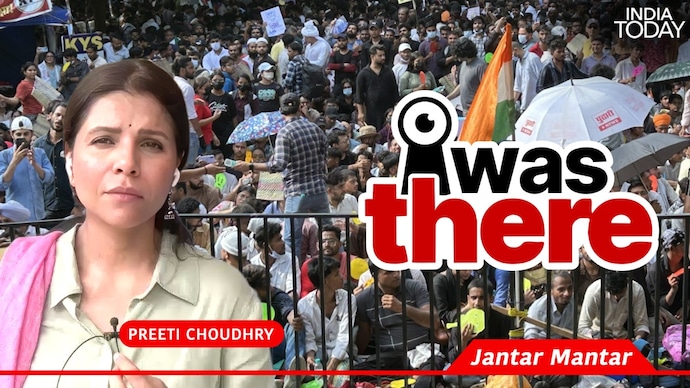
The next day, the street face-off had retreated to Jantar Mantar. My cameraperson and I made our way to the protest site, where the chants reached us long before the crowds came into view. The slogans echoed through the air well before we encountered the snaking queues of people waiting to enter.
The familiar call-and-response style of protest slogans remained, but with a distinctly Gen Z twist. Many were witty, irreverent, and unapologetically sharp -- some colourful enough to warrant an 18+ disclaimer. The same could be said for several posters and placards hoisted above the crowd.
The humid, oppressive Delhi heat hung heavily over the site. Plastic hand fans fluttered constantly, while bottles of mineral water passed through the crowd, courtesy of both volunteers and fellow protesters. If someone looked overwhelmed by the heat, it was not unusual for a complete stranger to step in, fanning them as they waited their turn to pass through a flimsy metal-detector barricade.
On July 24, the crowds entering from the Kerala Bhavan side had become almost unmanageable, even at the media entrance. For a while, I found myself caught in a crush beneath the metal detector, hemmed in by people packed so tightly that there was barely room to move.
Having covered multiple protests over the years, I have experienced my share of overcrowded demonstrations. Yet what stood out that day was something unexpected: despite the sheer density of the crowd, not a single stray hand took advantage of the situation. My experience is, of course, anecdotal, but the respect people showed for one another’s personal boundaries -- even when there was virtually no personal space -- was unlike anything I had encountered at a protest of this scale.
On the other side of the barricades, where demonstrators waited for instructions from the stage set up by CJP leaders, the protest had taken on forms that went well beyond slogans and speeches.
In one corner, a group of students, largely from Left-affiliated organisations, had created an open mic for poetry, drawing small circles of listeners who paused before melting back into the larger crowd. A few meters away was what looked like a busking spot. The performer invited voluntary contributions from passersby, promising that every rupee collected would go toward replenishing supplies for the protest.
Elsewhere, a group of youngsters sat cross-legged on a poster demanding the education minister's resignation, absorbed in a game of Uno. Nearby, another corner hosted what participants jokingly called a "relay protest" game, where fresh demonstrators quietly replaced those who had been sitting in protest, ensuring the demonstration continued uninterrupted without losing its rhythm or momentum.
The demand remained the same throughout the site: a resignation. What differed was the way that demand found expression.
As I documented the protest, I could see that it was not that they were untouched by anger. Rather, their anger mostly found expression in sarcasm, humour, and irreverence. In the face of fear, they respond with wit; in moments of tension, they answer with mockery and memes. Far from trivialising the moment, this shared language of humour has become a source of resilience at Jantar Mantar.
If Gen Z has emerged as the face of this protest, it is also because, for many gathered here, this is the first cause compelling enough to bring them out. But not everyone in the crowd is driven by conviction alone. There is also a section that has arrived because of a different force altogether: FOMO. Every viral reel, trending post, and livestream appears to draw in more curious onlookers, many eager to document the movement as much as participate in it. Protest content is being created almost as quickly as slogans are being raised.
The youth may have taken centre stage, but they are far from the only actors in this unfolding demonstration. Protesters from across the political spectrum have converged here: members of the Bhim Army, Left-leaning organisations, groups advocating for a range of regional and political causes (including statehood demands), and individuals with no organisational affiliation who simply want to register their dissent. Jantar Mantar has, once again, become a meeting point for disparate voices united by a shared space for protest.
At the same time, it would be a disservice to the overwhelming majority of peaceful demonstrators to ignore a less flattering reality. A small section of those who have attached themselves to the protest -- some from the same Gen Z cohort that dominates its visual identity -- has been involved in confrontations with the police and, on occasion, journalists.
These incidents of violence remain sporadic, but they have occurred. There have been instances of physical altercations with police personnel, intimidation and assaults on media workers, and abusive language directed at political leaders. Those moments, too, are part of the story unfolding at Jantar Mantar, even if they do not define the protest as a whole.
Before you decide what this protest is about, there is only one reliable way to understand it: be there.
I was - for four consecutive days.
That doesn't make my observations definitive, but it does make them grounded in what I saw, heard, and experienced.
This is not an attempt to romanticise a protest. It is simply an attempt to describe it as it is.
The roach infestation in central Delhi is a vibe. The protest itself is chaotic, relentlessly satirical, and steeped in Gen Z meme culture and dark internet humour. Yet beneath the jokes, the reels, and the irreverence lies something far more serious: determined political activism and an unmistakable spirit of anti-establishment defiance.
That is Jantar Mantar at this moment - a space where humour coexists with anger, where social media culture has become inseparable from street politics.
In the end, I never imagined I would say this, but when one of my favourite authors, Ernest Hemingway, echoed George Bernard Shaw’s famous line that “youth is wasted on the young,” I think they were mistaken.
No. Youth is not wasted on the young.
Sometimes journalists ask stupid questions. ‘Are you scared?’ was mine.
I shouted it out to three young protesters as they scurried along Sansad Marg with a cluster of others, weaving through the chaos. It was July 20, and they were marching toward Parliament in New Delhi.
This particular group had already tried to breach a police barricade three times. Each attempt had been pushed back by the Delhi Police and the Rapid Action Force. The fourth attempt was met with three rounds of tear gas. Then came the lathis.
The air was thick with cries of "Dharmendra Pradhan istifa do" (Dharmendra Pradhan, resign), thick with tear gas that burned the throat more than it stung the eyes, and thick with a resilience that kept drawing them back for a fifth attempt, then a sixth.
Through the haze, I spotted the three. Their eyes were streaming from the gas, their faces flushed with adrenaline. One had a fresh welt across his back where a lathi had landed.
"Are you scared?" I asked.
They looked at me with disdain.
"No. Why should we be scared?" one shot back. "We are disgusted."
Even as I walked away, I knew I had asked the wrong question. It should never have been, “Are you scared?”
Four days later, though, I would know the answer to that question with absolute certainty. They were not scared. This generation is not defined by fear. Whatever one may think of their politics or their methods, fear is not what drives them.
At 3 pm on July 20, near Le Meridien, the Delhi Police crackdown reached its peak. The standoff between protesters and police was coming to a head, with tensions mounting on both sides.
Having covered enough protests as a journalist, I thought I knew what to expect. But what I witnessed in those moments of intense friction was both surprising and, oddly enough, deeply amusing.
As rows of police officers clad in riot gear braced for a possible charge, and groups of protesters gathered at the barricades looking for an opening, a very different scene was unfolding in the middle of the chaos.
One young woman was calmly filming a reel about how getting her nails done before attending a protest had turned out to be a terrible idea. Just beside her, a friend had already spotted the day's most Instagram-worthy backdrop: a woman police officer, lathi in hand. With the camera rolling, she launched into an earnest riff on #FOMO. A few feet away, two young men were recording themselves tightening their shoelaces and stretching theatrically, as though warming up for a race rather than preparing to run from the police.
It was a surreal juxtaposition: the gravity of an imminent confrontation met with the instincts of the social media age. Even as the situation threatened to erupt, phones remained raised and cameras kept rolling.
The next day, the street face-off had retreated to Jantar Mantar. My cameraperson and I made our way to the protest site, where the chants reached us long before the crowds came into view. The slogans echoed through the air well before we encountered the snaking queues of people waiting to enter.
The familiar call-and-response style of protest slogans remained, but with a distinctly Gen Z twist. Many were witty, irreverent, and unapologetically sharp -- some colourful enough to warrant an 18+ disclaimer. The same could be said for several posters and placards hoisted above the crowd.
The humid, oppressive Delhi heat hung heavily over the site. Plastic hand fans fluttered constantly, while bottles of mineral water passed through the crowd, courtesy of both volunteers and fellow protesters. If someone looked overwhelmed by the heat, it was not unusual for a complete stranger to step in, fanning them as they waited their turn to pass through a flimsy metal-detector barricade.
On July 24, the crowds entering from the Kerala Bhavan side had become almost unmanageable, even at the media entrance. For a while, I found myself caught in a crush beneath the metal detector, hemmed in by people packed so tightly that there was barely room to move.
Having covered multiple protests over the years, I have experienced my share of overcrowded demonstrations. Yet what stood out that day was something unexpected: despite the sheer density of the crowd, not a single stray hand took advantage of the situation. My experience is, of course, anecdotal, but the respect people showed for one another’s personal boundaries -- even when there was virtually no personal space -- was unlike anything I had encountered at a protest of this scale.
On the other side of the barricades, where demonstrators waited for instructions from the stage set up by CJP leaders, the protest had taken on forms that went well beyond slogans and speeches.
In one corner, a group of students, largely from Left-affiliated organisations, had created an open mic for poetry, drawing small circles of listeners who paused before melting back into the larger crowd. A few meters away was what looked like a busking spot. The performer invited voluntary contributions from passersby, promising that every rupee collected would go toward replenishing supplies for the protest.
Elsewhere, a group of youngsters sat cross-legged on a poster demanding the education minister's resignation, absorbed in a game of Uno. Nearby, another corner hosted what participants jokingly called a "relay protest" game, where fresh demonstrators quietly replaced those who had been sitting in protest, ensuring the demonstration continued uninterrupted without losing its rhythm or momentum.
The demand remained the same throughout the site: a resignation. What differed was the way that demand found expression.
As I documented the protest, I could see that it was not that they were untouched by anger. Rather, their anger mostly found expression in sarcasm, humour, and irreverence. In the face of fear, they respond with wit; in moments of tension, they answer with mockery and memes. Far from trivialising the moment, this shared language of humour has become a source of resilience at Jantar Mantar.
If Gen Z has emerged as the face of this protest, it is also because, for many gathered here, this is the first cause compelling enough to bring them out. But not everyone in the crowd is driven by conviction alone. There is also a section that has arrived because of a different force altogether: FOMO. Every viral reel, trending post, and livestream appears to draw in more curious onlookers, many eager to document the movement as much as participate in it. Protest content is being created almost as quickly as slogans are being raised.
The youth may have taken centre stage, but they are far from the only actors in this unfolding demonstration. Protesters from across the political spectrum have converged here: members of the Bhim Army, Left-leaning organisations, groups advocating for a range of regional and political causes (including statehood demands), and individuals with no organisational affiliation who simply want to register their dissent. Jantar Mantar has, once again, become a meeting point for disparate voices united by a shared space for protest.
At the same time, it would be a disservice to the overwhelming majority of peaceful demonstrators to ignore a less flattering reality. A small section of those who have attached themselves to the protest -- some from the same Gen Z cohort that dominates its visual identity -- has been involved in confrontations with the police and, on occasion, journalists.
These incidents of violence remain sporadic, but they have occurred. There have been instances of physical altercations with police personnel, intimidation and assaults on media workers, and abusive language directed at political leaders. Those moments, too, are part of the story unfolding at Jantar Mantar, even if they do not define the protest as a whole.
Before you decide what this protest is about, there is only one reliable way to understand it: be there.
I was - for four consecutive days.
That doesn't make my observations definitive, but it does make them grounded in what I saw, heard, and experienced.
This is not an attempt to romanticise a protest. It is simply an attempt to describe it as it is.
The roach infestation in central Delhi is a vibe. The protest itself is chaotic, relentlessly satirical, and steeped in Gen Z meme culture and dark internet humour. Yet beneath the jokes, the reels, and the irreverence lies something far more serious: determined political activism and an unmistakable spirit of anti-establishment defiance.
That is Jantar Mantar at this moment - a space where humour coexists with anger, where social media culture has become inseparable from street politics.
In the end, I never imagined I would say this, but when one of my favourite authors, Ernest Hemingway, echoed George Bernard Shaw’s famous line that “youth is wasted on the young,” I think they were mistaken.
No. Youth is not wasted on the young.
Sometimes journalists ask stupid questions. ‘Are you scared?’ was mine.
I shouted it out to three young protesters as they scurried along Sansad Marg with a cluster of others, weaving through the chaos. It was July 20, and they were marching toward Parliament in New Delhi.
This particular group had already tried to breach a police barricade three times. Each attempt had been pushed back by the Delhi Police and the Rapid Action Force. The fourth attempt was met with three rounds of tear gas. Then came the lathis.
The air was thick with cries of "Dharmendra Pradhan istifa do" (Dharmendra Pradhan, resign), thick with tear gas that burned the throat more than it stung the eyes, and thick with a resilience that kept drawing them back for a fifth attempt, then a sixth.
Through the haze, I spotted the three. Their eyes were streaming from the gas, their faces flushed with adrenaline. One had a fresh welt across his back where a lathi had landed.
"Are you scared?" I asked.
They looked at me with disdain.
"No. Why should we be scared?" one shot back. "We are disgusted."
Even as I walked away, I knew I had asked the wrong question. It should never have been, “Are you scared?”
Four days later, though, I would know the answer to that question with absolute certainty. They were not scared. This generation is not defined by fear. Whatever one may think of their politics or their methods, fear is not what drives them.
At 3 pm on July 20, near Le Meridien, the Delhi Police crackdown reached its peak. The standoff between protesters and police was coming to a head, with tensions mounting on both sides.
Having covered enough protests as a journalist, I thought I knew what to expect. But what I witnessed in those moments of intense friction was both surprising and, oddly enough, deeply amusing.
As rows of police officers clad in riot gear braced for a possible charge, and groups of protesters gathered at the barricades looking for an opening, a very different scene was unfolding in the middle of the chaos.
One young woman was calmly filming a reel about how getting her nails done before attending a protest had turned out to be a terrible idea. Just beside her, a friend had already spotted the day's most Instagram-worthy backdrop: a woman police officer, lathi in hand. With the camera rolling, she launched into an earnest riff on #FOMO. A few feet away, two young men were recording themselves tightening their shoelaces and stretching theatrically, as though warming up for a race rather than preparing to run from the police.
It was a surreal juxtaposition: the gravity of an imminent confrontation met with the instincts of the social media age. Even as the situation threatened to erupt, phones remained raised and cameras kept rolling.
The next day, the street face-off had retreated to Jantar Mantar. My cameraperson and I made our way to the protest site, where the chants reached us long before the crowds came into view. The slogans echoed through the air well before we encountered the snaking queues of people waiting to enter.
The familiar call-and-response style of protest slogans remained, but with a distinctly Gen Z twist. Many were witty, irreverent, and unapologetically sharp -- some colourful enough to warrant an 18+ disclaimer. The same could be said for several posters and placards hoisted above the crowd.
The humid, oppressive Delhi heat hung heavily over the site. Plastic hand fans fluttered constantly, while bottles of mineral water passed through the crowd, courtesy of both volunteers and fellow protesters. If someone looked overwhelmed by the heat, it was not unusual for a complete stranger to step in, fanning them as they waited their turn to pass through a flimsy metal-detector barricade.
On July 24, the crowds entering from the Kerala Bhavan side had become almost unmanageable, even at the media entrance. For a while, I found myself caught in a crush beneath the metal detector, hemmed in by people packed so tightly that there was barely room to move.
Having covered multiple protests over the years, I have experienced my share of overcrowded demonstrations. Yet what stood out that day was something unexpected: despite the sheer density of the crowd, not a single stray hand took advantage of the situation. My experience is, of course, anecdotal, but the respect people showed for one another’s personal boundaries -- even when there was virtually no personal space -- was unlike anything I had encountered at a protest of this scale.
On the other side of the barricades, where demonstrators waited for instructions from the stage set up by CJP leaders, the protest had taken on forms that went well beyond slogans and speeches.
In one corner, a group of students, largely from Left-affiliated organisations, had created an open mic for poetry, drawing small circles of listeners who paused before melting back into the larger crowd. A few meters away was what looked like a busking spot. The performer invited voluntary contributions from passersby, promising that every rupee collected would go toward replenishing supplies for the protest.
Elsewhere, a group of youngsters sat cross-legged on a poster demanding the education minister's resignation, absorbed in a game of Uno. Nearby, another corner hosted what participants jokingly called a "relay protest" game, where fresh demonstrators quietly replaced those who had been sitting in protest, ensuring the demonstration continued uninterrupted without losing its rhythm or momentum.
The demand remained the same throughout the site: a resignation. What differed was the way that demand found expression.
As I documented the protest, I could see that it was not that they were untouched by anger. Rather, their anger mostly found expression in sarcasm, humour, and irreverence. In the face of fear, they respond with wit; in moments of tension, they answer with mockery and memes. Far from trivialising the moment, this shared language of humour has become a source of resilience at Jantar Mantar.
If Gen Z has emerged as the face of this protest, it is also because, for many gathered here, this is the first cause compelling enough to bring them out. But not everyone in the crowd is driven by conviction alone. There is also a section that has arrived because of a different force altogether: FOMO. Every viral reel, trending post, and livestream appears to draw in more curious onlookers, many eager to document the movement as much as participate in it. Protest content is being created almost as quickly as slogans are being raised.
The youth may have taken centre stage, but they are far from the only actors in this unfolding demonstration. Protesters from across the political spectrum have converged here: members of the Bhim Army, Left-leaning organisations, groups advocating for a range of regional and political causes (including statehood demands), and individuals with no organisational affiliation who simply want to register their dissent. Jantar Mantar has, once again, become a meeting point for disparate voices united by a shared space for protest.
At the same time, it would be a disservice to the overwhelming majority of peaceful demonstrators to ignore a less flattering reality. A small section of those who have attached themselves to the protest -- some from the same Gen Z cohort that dominates its visual identity -- has been involved in confrontations with the police and, on occasion, journalists.
These incidents of violence remain sporadic, but they have occurred. There have been instances of physical altercations with police personnel, intimidation and assaults on media workers, and abusive language directed at political leaders. Those moments, too, are part of the story unfolding at Jantar Mantar, even if they do not define the protest as a whole.
Before you decide what this protest is about, there is only one reliable way to understand it: be there.
I was - for four consecutive days.
That doesn't make my observations definitive, but it does make them grounded in what I saw, heard, and experienced.
This is not an attempt to romanticise a protest. It is simply an attempt to describe it as it is.
The roach infestation in central Delhi is a vibe. The protest itself is chaotic, relentlessly satirical, and steeped in Gen Z meme culture and dark internet humour. Yet beneath the jokes, the reels, and the irreverence lies something far more serious: determined political activism and an unmistakable spirit of anti-establishment defiance.
That is Jantar Mantar at this moment - a space where humour coexists with anger, where social media culture has become inseparable from street politics.
In the end, I never imagined I would say this, but when one of my favourite authors, Ernest Hemingway, echoed George Bernard Shaw’s famous line that “youth is wasted on the young,” I think they were mistaken.
No. Youth is not wasted on the young.

