Only FOMO generation could have forced Pradhan to resign. What I saw at Jantar Mantar
For over a month, the CJP protested at New Delhi's Jantar Mantar demanding Education Minister Dharmendra Pradhan's resignation. When Pradhan finally resigned, one conclusion emerged from my weeks of reporting at the protest site. This was only possible because of the Gen Z protesters and their unique methods of protest.
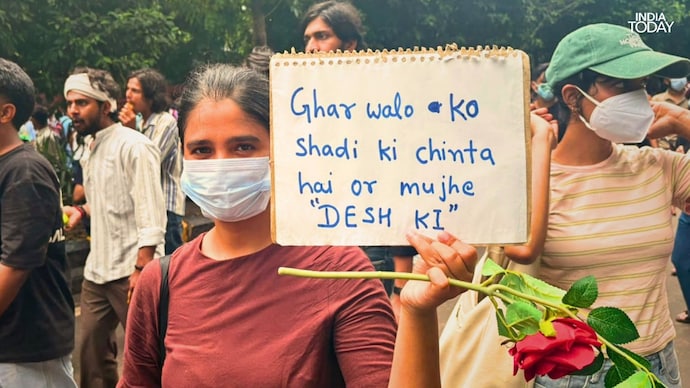
I am Gen Z. For the longest time, I thought that was the least relevant detail about me while reporting on the Cockroach Janta Party (CJP) protest at Jantar Mantar in New Delhi. After visiting the protest site multiple times over the past month, from the CJP's first gathering on June 6 to the day Union Education Minister Dharmendra Pradhan resigned, I realised that my generation is the only one that could have forced a minister of the Modi government to resign. When education minister Pradhan resigned on Saturday, the immediate debate was about credit. The Opposition parties claimed victory. The CJP celebrated. The government maintained its own position.
Watching those arguments unfold, I found myself returning not to the speeches delivered from the stage but to something I had witnessed at Jantar Mantar over the weeks.
Another voice captured this sentiment. Soon after Pradhan's resignation, Gitanjali J Angmo, the wife of social activist Sonam Wangchuk, posted on X and said that "If anyone has shown what it means for India to be a Vishwaguru, it is our Gen Z. They have lived Sanatan Dharma, not preached it."
While supporters of the movement celebrated the youth's role, the message also reflected how the protest had increasingly come to be identified with a generation rather than merely an outfit born as an online satire in Boston, the US.
MOBILE PHONES DEFINED THE NEET PROTEST
The defining feature of the movement were phones. Lakhs of them.
If there is one thing my generation understands better than those before, it is communication. And every successful protest, ultimately, is a communication exercise. That is why I believe this movement carried the unmistakable imprint of Gen Z.
Not because this generation is more ideological than earlier generations. They are not. Many students I met had never attended a protest before, and this was their first agitation. Many admitted they barely followed politics, and they were protesting for "a better education system" and "accountability". Simple messages. Easy to understand.
This is also not the largest student mobilisation India has witnessed. What made it different was how it travelled.
Every generation has struggled to be understood. People of the older generation describe today's youth with the same mocking phrases and keep complaining that Gen Z youth are always making videos, always on Instagram and always turning everything into content.
As someone who belongs to that generation, I kept thinking they were only half right. Yes, Gen Z makes everything into content. Because content is how they communicate.
No protest in India, be it the Anna movement or the farmers' agitation, saw such a scale of use of mobile phones and social media platforms for communication of ideas and messages.
GEN Z HAS REDEFINED THE LANGUAGE OF PROTEST
It wasn't just the platforms that were different. Even the language sounded unfamiliar to many outside the generation. Conversations at Jantar Mantar rarely stayed in one language.
Students switched effortlessly between Hindi and English, often within the same sentence. Their slogans, jokes, captions and conversations were written in a hybrid language that belonged entirely to Gen Z. It wasn't Hindi. It wasn't English. It was the internet's language, understood instinctively by those who grew up with it and often dismissed as gibberish by those who didn't.
I realised that most clearly after the July 20 Parliament march. The Delhi Police lathi-charge was expected to empty the streets. Instead, it flooded the internet.
Within hours, videos from New Delhi had travelled far beyond. They appeared on Instagram Reels, YouTube Shorts, and X timelines. Friends who had never heard of the Cockroach Janta Party (CJP) suddenly knew exactly what had happened.
SUCH A GENZ THING! REMIXING VIDOES, USING MEMES TO MOCK
The next morning, I noticed something that I don't think many outside Gen Z immediately understood. The videos weren't just being shared. They were being remixed.
Students added dramatic background music. They inserted sarcastic captions. They made memes. They mocked the police.
Twenty-four hours earlier, many of those same students had been crying after the lathi-charge. Now they were laughing and mocking the police. Not because the violence had become funny.
Because humour is how Gen Z refuses to surrender a narrative. People often say a picture is worth a thousand words. Standing at Jantar Mantar, I realised a meme is worth lakhs.
THE FOMO GENERATION THAT FORCED A MINISTER TO RESIGN
Every meme reached someone who had never attended the protest, and every Reel became an invitation. Every Story quietly asked another student, "Why aren't you here?"
That is where another defining trait of my generation entered the story. The FOMO, Fear of Missing Out. Older generations joke about it and dismiss it as a social media obsession.
At Jantar Mantar, I watched it become real and political.
Friends watched friends upload Instagram Stories from the protest site. College WhatsApp groups filled with videos from Delhi. Instagram feeds became a constant stream of slogans, speeches and police action.
For many, staying home no longer meant missing a protest. It meant missing history.
I met students from Bihar, Uttar Pradesh, Karnataka and Assam who admitted they hadn't planned to travel until the July 20 videos appeared on their phones. That was the day when Rapid Action Force and Delhi Police personnel came down on the protesters with brutal force.
THE BURGER BACHCHAS WHO STOOD IN SUN AND RAIN
Another stereotype quietly collapsed at Jantar Mantar. Gen Z is often mocked as "burger bachchas", a generation supposedly too comfortable to survive discomfort, too dependent on air-conditioning and too impatient for hardship.
The protest challenged that caricature. Students sat through Delhi's harsh afternoon sun, endured sudden spells of rain, slept on pavements and returned the next morning. Many had travelled hundreds of kilometres with little certainty about when they would return home. The same generation often accused of seeking comfort appeared willing to trade it for a cause they believed in.
One of them was Aminul Hoque. "They attacked students who were protesting peacefully. They messed with the wrong generation," Hoque, who had travelled from Assam, told me.
Hoque's journey made sense to me because I recognised the language through which he had been mobilised. Not through a speech or by a newspaper editorial. It was through an algorithm.
TWO PROTESTS FOR PRADHAN'S RESIGNATION: ONE THAT DIDN'T SLEEP AT ALL
There were moments during my reporting when I realised I was watching two protests unfold simultaneously. One existed at Jantar Mantar. The other existed on millions of screens.
The physical protest ended every night, but the digital protest never slept.
Perhaps that also explains why so many young protesters first had to convince their families before convincing anyone else.
I met students who left home despite strong opposition from parents. Some wore masks because they feared relatives would recognise them in videos. Others argued with family members before boarding trains to Delhi.
For many of the Gen Z, the first protest wasn't against the government. It was at the dining table.
AT JANTAR MANTAR, GEN Z REINVENTED HOW DISSENT TRAVELS
Looking back, I think older generations often ask the wrong question about Gen Z. They ask why Gen Z is always on phones.
Technology has shortened not just attention spans but generations themselves. The platforms through which my generation understands politics barely resemble those that shaped even young Millennials. The language has changed. The humour has changed. The speed has changed. Overall, the protest has changed.
Governments still know how to disperse crowds. I am not sure they yet know how to disperse content.
The July 20 crackdown scattered protesters, and it also created millions of new witnesses.
Whether Dharmendra Pradhan resigned because of the movement alone will remain a matter of political debate.
But after weeks of walking through Jantar Mantar, talking to students and watching a protest evolve in real time, one conclusion stays with me.
Gen Z did not reinvent dissent. It just reinvented how dissent travels. Not through pamphlets. Not through prime-time television. But through a screen small enough to fit into a pocket and powerful enough to turn one confrontation on a Delhi street into a national conversation.
I am Gen Z. For the longest time, I thought that was the least relevant detail about me while reporting on the Cockroach Janta Party (CJP) protest at Jantar Mantar in New Delhi. After visiting the protest site multiple times over the past month, from the CJP's first gathering on June 6 to the day Union Education Minister Dharmendra Pradhan resigned, I realised that my generation is the only one that could have forced a minister of the Modi government to resign. When education minister Pradhan resigned on Saturday, the immediate debate was about credit. The Opposition parties claimed victory. The CJP celebrated. The government maintained its own position.
Watching those arguments unfold, I found myself returning not to the speeches delivered from the stage but to something I had witnessed at Jantar Mantar over the weeks.
Another voice captured this sentiment. Soon after Pradhan's resignation, Gitanjali J Angmo, the wife of social activist Sonam Wangchuk, posted on X and said that "If anyone has shown what it means for India to be a Vishwaguru, it is our Gen Z. They have lived Sanatan Dharma, not preached it."
While supporters of the movement celebrated the youth's role, the message also reflected how the protest had increasingly come to be identified with a generation rather than merely an outfit born as an online satire in Boston, the US.
MOBILE PHONES DEFINED THE NEET PROTEST
The defining feature of the movement were phones. Lakhs of them.
If there is one thing my generation understands better than those before, it is communication. And every successful protest, ultimately, is a communication exercise. That is why I believe this movement carried the unmistakable imprint of Gen Z.
Not because this generation is more ideological than earlier generations. They are not. Many students I met had never attended a protest before, and this was their first agitation. Many admitted they barely followed politics, and they were protesting for "a better education system" and "accountability". Simple messages. Easy to understand.
This is also not the largest student mobilisation India has witnessed. What made it different was how it travelled.
Every generation has struggled to be understood. People of the older generation describe today's youth with the same mocking phrases and keep complaining that Gen Z youth are always making videos, always on Instagram and always turning everything into content.
As someone who belongs to that generation, I kept thinking they were only half right. Yes, Gen Z makes everything into content. Because content is how they communicate.
No protest in India, be it the Anna movement or the farmers' agitation, saw such a scale of use of mobile phones and social media platforms for communication of ideas and messages.
GEN Z HAS REDEFINED THE LANGUAGE OF PROTEST
It wasn't just the platforms that were different. Even the language sounded unfamiliar to many outside the generation. Conversations at Jantar Mantar rarely stayed in one language.
Students switched effortlessly between Hindi and English, often within the same sentence. Their slogans, jokes, captions and conversations were written in a hybrid language that belonged entirely to Gen Z. It wasn't Hindi. It wasn't English. It was the internet's language, understood instinctively by those who grew up with it and often dismissed as gibberish by those who didn't.
I realised that most clearly after the July 20 Parliament march. The Delhi Police lathi-charge was expected to empty the streets. Instead, it flooded the internet.
Within hours, videos from New Delhi had travelled far beyond. They appeared on Instagram Reels, YouTube Shorts, and X timelines. Friends who had never heard of the Cockroach Janta Party (CJP) suddenly knew exactly what had happened.
SUCH A GENZ THING! REMIXING VIDOES, USING MEMES TO MOCK
The next morning, I noticed something that I don't think many outside Gen Z immediately understood. The videos weren't just being shared. They were being remixed.
Students added dramatic background music. They inserted sarcastic captions. They made memes. They mocked the police.
Twenty-four hours earlier, many of those same students had been crying after the lathi-charge. Now they were laughing and mocking the police. Not because the violence had become funny.
Because humour is how Gen Z refuses to surrender a narrative. People often say a picture is worth a thousand words. Standing at Jantar Mantar, I realised a meme is worth lakhs.
THE FOMO GENERATION THAT FORCED A MINISTER TO RESIGN
Every meme reached someone who had never attended the protest, and every Reel became an invitation. Every Story quietly asked another student, "Why aren't you here?"
That is where another defining trait of my generation entered the story. The FOMO, Fear of Missing Out. Older generations joke about it and dismiss it as a social media obsession.
At Jantar Mantar, I watched it become real and political.
Friends watched friends upload Instagram Stories from the protest site. College WhatsApp groups filled with videos from Delhi. Instagram feeds became a constant stream of slogans, speeches and police action.
For many, staying home no longer meant missing a protest. It meant missing history.
I met students from Bihar, Uttar Pradesh, Karnataka and Assam who admitted they hadn't planned to travel until the July 20 videos appeared on their phones. That was the day when Rapid Action Force and Delhi Police personnel came down on the protesters with brutal force.
THE BURGER BACHCHAS WHO STOOD IN SUN AND RAIN
Another stereotype quietly collapsed at Jantar Mantar. Gen Z is often mocked as "burger bachchas", a generation supposedly too comfortable to survive discomfort, too dependent on air-conditioning and too impatient for hardship.
The protest challenged that caricature. Students sat through Delhi's harsh afternoon sun, endured sudden spells of rain, slept on pavements and returned the next morning. Many had travelled hundreds of kilometres with little certainty about when they would return home. The same generation often accused of seeking comfort appeared willing to trade it for a cause they believed in.
One of them was Aminul Hoque. "They attacked students who were protesting peacefully. They messed with the wrong generation," Hoque, who had travelled from Assam, told me.
Hoque's journey made sense to me because I recognised the language through which he had been mobilised. Not through a speech or by a newspaper editorial. It was through an algorithm.
TWO PROTESTS FOR PRADHAN'S RESIGNATION: ONE THAT DIDN'T SLEEP AT ALL
There were moments during my reporting when I realised I was watching two protests unfold simultaneously. One existed at Jantar Mantar. The other existed on millions of screens.
The physical protest ended every night, but the digital protest never slept.
Perhaps that also explains why so many young protesters first had to convince their families before convincing anyone else.
I met students who left home despite strong opposition from parents. Some wore masks because they feared relatives would recognise them in videos. Others argued with family members before boarding trains to Delhi.
For many of the Gen Z, the first protest wasn't against the government. It was at the dining table.
AT JANTAR MANTAR, GEN Z REINVENTED HOW DISSENT TRAVELS
Looking back, I think older generations often ask the wrong question about Gen Z. They ask why Gen Z is always on phones.
Technology has shortened not just attention spans but generations themselves. The platforms through which my generation understands politics barely resemble those that shaped even young Millennials. The language has changed. The humour has changed. The speed has changed. Overall, the protest has changed.
Governments still know how to disperse crowds. I am not sure they yet know how to disperse content.
The July 20 crackdown scattered protesters, and it also created millions of new witnesses.
Whether Dharmendra Pradhan resigned because of the movement alone will remain a matter of political debate.
But after weeks of walking through Jantar Mantar, talking to students and watching a protest evolve in real time, one conclusion stays with me.
Gen Z did not reinvent dissent. It just reinvented how dissent travels. Not through pamphlets. Not through prime-time television. But through a screen small enough to fit into a pocket and powerful enough to turn one confrontation on a Delhi street into a national conversation.
I am Gen Z. For the longest time, I thought that was the least relevant detail about me while reporting on the Cockroach Janta Party (CJP) protest at Jantar Mantar in New Delhi. After visiting the protest site multiple times over the past month, from the CJP's first gathering on June 6 to the day Union Education Minister Dharmendra Pradhan resigned, I realised that my generation is the only one that could have forced a minister of the Modi government to resign. When education minister Pradhan resigned on Saturday, the immediate debate was about credit. The Opposition parties claimed victory. The CJP celebrated. The government maintained its own position.
Watching those arguments unfold, I found myself returning not to the speeches delivered from the stage but to something I had witnessed at Jantar Mantar over the weeks.
Another voice captured this sentiment. Soon after Pradhan's resignation, Gitanjali J Angmo, the wife of social activist Sonam Wangchuk, posted on X and said that "If anyone has shown what it means for India to be a Vishwaguru, it is our Gen Z. They have lived Sanatan Dharma, not preached it."
While supporters of the movement celebrated the youth's role, the message also reflected how the protest had increasingly come to be identified with a generation rather than merely an outfit born as an online satire in Boston, the US.
MOBILE PHONES DEFINED THE NEET PROTEST
The defining feature of the movement were phones. Lakhs of them.
If there is one thing my generation understands better than those before, it is communication. And every successful protest, ultimately, is a communication exercise. That is why I believe this movement carried the unmistakable imprint of Gen Z.
Not because this generation is more ideological than earlier generations. They are not. Many students I met had never attended a protest before, and this was their first agitation. Many admitted they barely followed politics, and they were protesting for "a better education system" and "accountability". Simple messages. Easy to understand.
This is also not the largest student mobilisation India has witnessed. What made it different was how it travelled.
Every generation has struggled to be understood. People of the older generation describe today's youth with the same mocking phrases and keep complaining that Gen Z youth are always making videos, always on Instagram and always turning everything into content.
As someone who belongs to that generation, I kept thinking they were only half right. Yes, Gen Z makes everything into content. Because content is how they communicate.
No protest in India, be it the Anna movement or the farmers' agitation, saw such a scale of use of mobile phones and social media platforms for communication of ideas and messages.
GEN Z HAS REDEFINED THE LANGUAGE OF PROTEST
It wasn't just the platforms that were different. Even the language sounded unfamiliar to many outside the generation. Conversations at Jantar Mantar rarely stayed in one language.
Students switched effortlessly between Hindi and English, often within the same sentence. Their slogans, jokes, captions and conversations were written in a hybrid language that belonged entirely to Gen Z. It wasn't Hindi. It wasn't English. It was the internet's language, understood instinctively by those who grew up with it and often dismissed as gibberish by those who didn't.
I realised that most clearly after the July 20 Parliament march. The Delhi Police lathi-charge was expected to empty the streets. Instead, it flooded the internet.
Within hours, videos from New Delhi had travelled far beyond. They appeared on Instagram Reels, YouTube Shorts, and X timelines. Friends who had never heard of the Cockroach Janta Party (CJP) suddenly knew exactly what had happened.
SUCH A GENZ THING! REMIXING VIDOES, USING MEMES TO MOCK
The next morning, I noticed something that I don't think many outside Gen Z immediately understood. The videos weren't just being shared. They were being remixed.
Students added dramatic background music. They inserted sarcastic captions. They made memes. They mocked the police.
Twenty-four hours earlier, many of those same students had been crying after the lathi-charge. Now they were laughing and mocking the police. Not because the violence had become funny.
Because humour is how Gen Z refuses to surrender a narrative. People often say a picture is worth a thousand words. Standing at Jantar Mantar, I realised a meme is worth lakhs.
THE FOMO GENERATION THAT FORCED A MINISTER TO RESIGN
Every meme reached someone who had never attended the protest, and every Reel became an invitation. Every Story quietly asked another student, "Why aren't you here?"
That is where another defining trait of my generation entered the story. The FOMO, Fear of Missing Out. Older generations joke about it and dismiss it as a social media obsession.
At Jantar Mantar, I watched it become real and political.
Friends watched friends upload Instagram Stories from the protest site. College WhatsApp groups filled with videos from Delhi. Instagram feeds became a constant stream of slogans, speeches and police action.
For many, staying home no longer meant missing a protest. It meant missing history.
I met students from Bihar, Uttar Pradesh, Karnataka and Assam who admitted they hadn't planned to travel until the July 20 videos appeared on their phones. That was the day when Rapid Action Force and Delhi Police personnel came down on the protesters with brutal force.
THE BURGER BACHCHAS WHO STOOD IN SUN AND RAIN
Another stereotype quietly collapsed at Jantar Mantar. Gen Z is often mocked as "burger bachchas", a generation supposedly too comfortable to survive discomfort, too dependent on air-conditioning and too impatient for hardship.
The protest challenged that caricature. Students sat through Delhi's harsh afternoon sun, endured sudden spells of rain, slept on pavements and returned the next morning. Many had travelled hundreds of kilometres with little certainty about when they would return home. The same generation often accused of seeking comfort appeared willing to trade it for a cause they believed in.
One of them was Aminul Hoque. "They attacked students who were protesting peacefully. They messed with the wrong generation," Hoque, who had travelled from Assam, told me.
Hoque's journey made sense to me because I recognised the language through which he had been mobilised. Not through a speech or by a newspaper editorial. It was through an algorithm.
TWO PROTESTS FOR PRADHAN'S RESIGNATION: ONE THAT DIDN'T SLEEP AT ALL
There were moments during my reporting when I realised I was watching two protests unfold simultaneously. One existed at Jantar Mantar. The other existed on millions of screens.
The physical protest ended every night, but the digital protest never slept.
Perhaps that also explains why so many young protesters first had to convince their families before convincing anyone else.
I met students who left home despite strong opposition from parents. Some wore masks because they feared relatives would recognise them in videos. Others argued with family members before boarding trains to Delhi.
For many of the Gen Z, the first protest wasn't against the government. It was at the dining table.
AT JANTAR MANTAR, GEN Z REINVENTED HOW DISSENT TRAVELS
Looking back, I think older generations often ask the wrong question about Gen Z. They ask why Gen Z is always on phones.
Technology has shortened not just attention spans but generations themselves. The platforms through which my generation understands politics barely resemble those that shaped even young Millennials. The language has changed. The humour has changed. The speed has changed. Overall, the protest has changed.
Governments still know how to disperse crowds. I am not sure they yet know how to disperse content.
The July 20 crackdown scattered protesters, and it also created millions of new witnesses.
Whether Dharmendra Pradhan resigned because of the movement alone will remain a matter of political debate.
But after weeks of walking through Jantar Mantar, talking to students and watching a protest evolve in real time, one conclusion stays with me.
Gen Z did not reinvent dissent. It just reinvented how dissent travels. Not through pamphlets. Not through prime-time television. But through a screen small enough to fit into a pocket and powerful enough to turn one confrontation on a Delhi street into a national conversation.

