Days after July 20 crackdown, Delhi Police keeps low profile at Jantar Mantar
Even as Delhi Police tightened security across the capital, its presence inside Jantar Mantar remained minimal, with protesters volunteering and managing the crowd at the protest site.
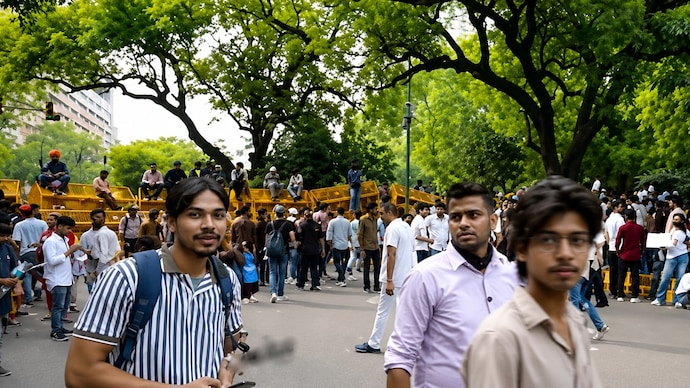
Days after Delhi Police's forceful crackdown on the July 20 'Chalo Sansad' march, security personnel appeared to adopt a markedly different strategy at Jantar Mantar on Thursday, keeping a low profile inside the main protest venue even as thousands of students continued their agitation over the NEET-UG paper leak.
A ground report by India Today's sister platform Lallantop found that while the protest site remained packed with demonstrators, police presence inside the barricaded area was minimal, almost non-existent.
Most security personnel remained stationed outside the barricades, leaving crowd management largely to volunteers and the protesting students themselves, observed Lallantop’s Kuldeep Mishra.
The shift comes after police and Rapid Action Force (RAF) personnel used lathis to disperse protesters during the July 20 march towards Parliament, drawing criticism over the use of force against students.
Some protesters also claimed that pellet guns were used during the CJP's 'Chalo Parliament' march in New Delhi. India Today Digital spoke to one protester whose medico-legal report records pellet injuries sustained during the police action.
Despite the sparse police deployment within the protest venue, the area remained heavily barricaded from both ends, creating narrow entry and exit points that resulted in bottlenecks as thousands of protesters moved through the site.
Lallantop’s Rajat Pandey said that the movement was now functioning on "auto-pilot", with volunteers managing queues, regulating entry and exit and even assisting journalists and visitors in navigating the crowded venue. Members of the volunteer team were also seen helping Lallantop’s team in carrying their equipment through the barricaded passages.
The video report also highlighted the lack of basic amenities at the protest site. It pointed out that two ambulances were parked inside the barricaded area, but there was no clear passage for emergency vehicles to move quickly if required.
The washrooms near the protest site also remained non-functional due to the absence of running water. Interestingly, despite the absence of visible policing inside the protest zone, the arrangements appeared largely orderly, with volunteers ensuring discipline and preventing overcrowding.
The apparent reduction in visible policing at Jantar Mantar comes even as Delhi Police has simultaneously tightened its overall security posture across the national capital. Delhi Police on Friday cancelled the leave of all personnel until further orders, with leave to be granted only in emergency situations.
The development follows the violence during the July 20 'Chalo Sansad' march, when protesters attempting to reach Parliament despite prohibitory orders were met with brutal force of Delhi Police. Security has since been intensified around Parliament Street, Jantar Mantar and other high-security zones during the Monsoon Session of Parliament.
The student-led agitation, spearheaded by the CJP, has been demanding accountability over irregularities in competitive examinations, including the NEET-UG paper leak, examination reforms and the resignation of Union Education Minister Dharmendra Pradhan.
Days after Delhi Police's forceful crackdown on the July 20 'Chalo Sansad' march, security personnel appeared to adopt a markedly different strategy at Jantar Mantar on Thursday, keeping a low profile inside the main protest venue even as thousands of students continued their agitation over the NEET-UG paper leak.
A ground report by India Today's sister platform Lallantop found that while the protest site remained packed with demonstrators, police presence inside the barricaded area was minimal, almost non-existent.
Most security personnel remained stationed outside the barricades, leaving crowd management largely to volunteers and the protesting students themselves, observed Lallantop’s Kuldeep Mishra.
The shift comes after police and Rapid Action Force (RAF) personnel used lathis to disperse protesters during the July 20 march towards Parliament, drawing criticism over the use of force against students.
Some protesters also claimed that pellet guns were used during the CJP's 'Chalo Parliament' march in New Delhi. India Today Digital spoke to one protester whose medico-legal report records pellet injuries sustained during the police action.
Despite the sparse police deployment within the protest venue, the area remained heavily barricaded from both ends, creating narrow entry and exit points that resulted in bottlenecks as thousands of protesters moved through the site.
Lallantop’s Rajat Pandey said that the movement was now functioning on "auto-pilot", with volunteers managing queues, regulating entry and exit and even assisting journalists and visitors in navigating the crowded venue. Members of the volunteer team were also seen helping Lallantop’s team in carrying their equipment through the barricaded passages.
The video report also highlighted the lack of basic amenities at the protest site. It pointed out that two ambulances were parked inside the barricaded area, but there was no clear passage for emergency vehicles to move quickly if required.
The washrooms near the protest site also remained non-functional due to the absence of running water. Interestingly, despite the absence of visible policing inside the protest zone, the arrangements appeared largely orderly, with volunteers ensuring discipline and preventing overcrowding.
The apparent reduction in visible policing at Jantar Mantar comes even as Delhi Police has simultaneously tightened its overall security posture across the national capital. Delhi Police on Friday cancelled the leave of all personnel until further orders, with leave to be granted only in emergency situations.
The development follows the violence during the July 20 'Chalo Sansad' march, when protesters attempting to reach Parliament despite prohibitory orders were met with brutal force of Delhi Police. Security has since been intensified around Parliament Street, Jantar Mantar and other high-security zones during the Monsoon Session of Parliament.
The student-led agitation, spearheaded by the CJP, has been demanding accountability over irregularities in competitive examinations, including the NEET-UG paper leak, examination reforms and the resignation of Union Education Minister Dharmendra Pradhan.
Days after Delhi Police's forceful crackdown on the July 20 'Chalo Sansad' march, security personnel appeared to adopt a markedly different strategy at Jantar Mantar on Thursday, keeping a low profile inside the main protest venue even as thousands of students continued their agitation over the NEET-UG paper leak.
A ground report by India Today's sister platform Lallantop found that while the protest site remained packed with demonstrators, police presence inside the barricaded area was minimal, almost non-existent.
Most security personnel remained stationed outside the barricades, leaving crowd management largely to volunteers and the protesting students themselves, observed Lallantop’s Kuldeep Mishra.
The shift comes after police and Rapid Action Force (RAF) personnel used lathis to disperse protesters during the July 20 march towards Parliament, drawing criticism over the use of force against students.
Some protesters also claimed that pellet guns were used during the CJP's 'Chalo Parliament' march in New Delhi. India Today Digital spoke to one protester whose medico-legal report records pellet injuries sustained during the police action.
Despite the sparse police deployment within the protest venue, the area remained heavily barricaded from both ends, creating narrow entry and exit points that resulted in bottlenecks as thousands of protesters moved through the site.
Lallantop’s Rajat Pandey said that the movement was now functioning on "auto-pilot", with volunteers managing queues, regulating entry and exit and even assisting journalists and visitors in navigating the crowded venue. Members of the volunteer team were also seen helping Lallantop’s team in carrying their equipment through the barricaded passages.
The video report also highlighted the lack of basic amenities at the protest site. It pointed out that two ambulances were parked inside the barricaded area, but there was no clear passage for emergency vehicles to move quickly if required.
The washrooms near the protest site also remained non-functional due to the absence of running water. Interestingly, despite the absence of visible policing inside the protest zone, the arrangements appeared largely orderly, with volunteers ensuring discipline and preventing overcrowding.
The apparent reduction in visible policing at Jantar Mantar comes even as Delhi Police has simultaneously tightened its overall security posture across the national capital. Delhi Police on Friday cancelled the leave of all personnel until further orders, with leave to be granted only in emergency situations.
The development follows the violence during the July 20 'Chalo Sansad' march, when protesters attempting to reach Parliament despite prohibitory orders were met with brutal force of Delhi Police. Security has since been intensified around Parliament Street, Jantar Mantar and other high-security zones during the Monsoon Session of Parliament.
The student-led agitation, spearheaded by the CJP, has been demanding accountability over irregularities in competitive examinations, including the NEET-UG paper leak, examination reforms and the resignation of Union Education Minister Dharmendra Pradhan.

