Honda ZR-V review, first drive: Does this brand-new hybrid SUV make a strong statement?
Can a few laps around a racetrack reveal the true character of Honda's newest flagship SUV? Our first encounter with the ZR-V offers a promising glimpse, but not the whole picture just yet.
Honda has taken its own sweet time expanding its SUV portfolio in India. While the Elevate has helped the brand establish a footing in one of the country’s most competitive segments, there has always been room for something more premium. Enter the Honda ZR-V, a strong hybrid SUV positioned above the Elevate and aimed at buyers who prioritise refinement, efficiency and technology over outright extravagance. Our first experience with the ZR-V came at the Buddh International Circuit, but it’s important to set expectations right from the outset. This wasn’t a conventional road test or first drive review. Track time was limited, driving conditions were controlled, and a ractrack can’t simulate the happenings of daily traffic conditions. I’d arge our valued readers to treat this as more of an initial drive impression rather than a definitive first drive review.
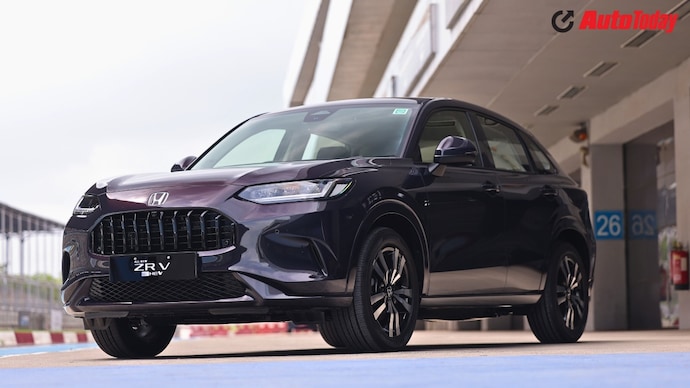
From the very first glance, the ZR-V doesn’t try to overwhelm with dramatic styling. Instead, it follows Honda’s familiar philosophy of restrained elegance. The front fascia is dominated by a vertical slat grille flanked by sleek full-LED headlamps with L-shaped integrated daytime running lights and sequential turn indicators, giving the SUV a sharp yet sophisticated appearance.
The side profile is perhaps its strongest angle, with clean body lines, a gently tapering roofline and 18-inch diamond-cut alloy wheels lending it a planted stance. At the rear, slim LED tail lamps, a subtle roof spoiler and neatly integrated dual exhaust tips complete a design that’s more mature than flashy. On the whole, very much in keeping with Honda’s signature design language.
On the inside, the dashboard layout is refreshingly clean, avoiding excessive visual clutter while retaining physical controls for frequently used functions.
Material quality immediately stands out, with soft-touch surfaces, leather upholstery, ambient lighting and a sculpted centre console helping elevate the overall ambience. The seating position is comfortable, visibility appears good, and the fit and finish are exactly what one expects from a Honda.
Equipment levels are equally impressive. There’s a 10.2-inch fully digital instrument cluster, a nine-inch touchscreen with wireless Apple CarPlay and Android Auto, wireless charging, eight-way-powered front seats with memory function, a powered tailgate, dual-zone climate control and a 12-speaker Bose audio system, which Honda tells us has been specifically tuned for this car. On paper, the ZR-V certainly ticks all the boxes expected of a premium SUV in this segment.
Moreover, Honda’s SENSING suite, which is the brand’s speak for Level 2 ADAS, brings adaptive cruise control with low-speed follow, collision mitigation braking, lane keeping assist, road departure mitigation, lead car departure notification and automatic high beam. There are also eight airbags as standard, a 360-degree surround-view camera as well as Honda’s ACE body structure on offer. As far as warranty is concerned the ZR-V comes with three years, unlimited kilometres as standard, three years of roadside assistance, five years or one lakh kilometres of warranty for the hybrid components and eight years or one lakh sixty thousand kilometres of warranty for the lithium-ion battery. There are a total of four colour options, out of which the purple and white clearly stand out.
Under the bonnet sits Honda’s 2.0-litre, four-cylinder, Atkinson-cycle petrol engine working alongside an e:HEV strong hybrid system. Combined output stands at 184bhp and 315Nm, delivered through a two-motor-integrated CVT, while the claimed fuel efficiency is an impressive 22.8kmpl. The ZR-V is capable of doing the 0-100kmph run in 7.9 seconds, which is respectable. Also, the aforementioned transmission isn’t like a usual planetary gearbox, which means it doesn’t get a CVT belt and is an electronic transmission with a traction motor, which is only said to smoothen the driving experience. Moreover, this engine is said to have a thermal efficiency of 41 per cent, which is higher than the usual figure for petrol engines, which hovers around the 30 per cent mark. That’s not all, unlike the parallel hybrid developed by Toyota and Maruti Suzuki, this doesn’t come with a power-split mechanism, which means the generator is connected directly to the engine. All of this points to Honda’s engineering-first approach, which is always a plus for a buyer.
Although a racetrack isn’t the natural habitat for a product of this kind, it did provide some useful insights. Initial throttle response feels immediate thanks to the electric motor’s instant torque delivery, making acceleration smooth and effortless. Honda has also incorporated an interesting system which synchronises engine sound with acceleration to create a more natural driving experience than traditional CVTs often deliver. Through the circuit’s sweeping corners, the ZR-V remained composed, exhibiting controlled body movements and confidence-inspiring straight-line stability. The steering carries adequate weight, and the regenerative braking paddles add another layer of interaction by allowing drivers to vary the level of energy recuperation.
Given the controlled environment, it would be unfair to conclude ride quality over broken roads, suspension compliance, cabin refinement in urban traffic, real-world fuel efficiency or how the hybrid system behaves during daily commuting. These are aspects that often define ownership far more than outright performance on a racetrack, and they’re questions that will only be answered once we spend considerably more time with the ZR-V on public roads.
For now, the Honda ZR-V leaves a positive first impression. It feels well-engineered, thoughtfully equipped and reasonably premium without pushing the envelope. That said, the inclusion of a two-tone trim would’ve added to the sense of space; just a sunroof would’ve added to the premium factor even further. Furthermore, the rear seat experience may not be class-leading, but it does check the basic boxes except for the exclusion of rear blinds. Whether those strengths translate into everyday excellence or negatives becoming glaringly unavoidable remains to be seen. This brief encounter certainly suggests Honda has introduced a flagship SUV that’s worth looking forward to exploring in much greater depth.
Verdict
Sadly, we don’t have a price point right now. I guess that it will hover around the Rs 50 lakh mark, which will mean stiff competition from other brands. However, it’s best to treat this as a flex, commitment and showcase of Honda’s true engineering prowess. This is a brand that for years has served as the perfect middle ground for enthusiasts who didn’t want to compromise on everyday practicality or performance, for that matter. However, things in India have been slow. There are plans for new products, including an EV as well as a sub-4m SUV, but today the ZR-V stands as a promise of Honda’s future in India. It feels like a bright light at the end of a long tunnel. That said, we hope to spend more time with the ZR-V soon and bring you a comprehensive review of Honda’s newest product for India.
Subscribe to Auto Today Magazine
Honda has taken its own sweet time expanding its SUV portfolio in India. While the Elevate has helped the brand establish a footing in one of the country’s most competitive segments, there has always been room for something more premium. Enter the Honda ZR-V, a strong hybrid SUV positioned above the Elevate and aimed at buyers who prioritise refinement, efficiency and technology over outright extravagance. Our first experience with the ZR-V came at the Buddh International Circuit, but it’s important to set expectations right from the outset. This wasn’t a conventional road test or first drive review. Track time was limited, driving conditions were controlled, and a ractrack can’t simulate the happenings of daily traffic conditions. I’d arge our valued readers to treat this as more of an initial drive impression rather than a definitive first drive review.
From the very first glance, the ZR-V doesn’t try to overwhelm with dramatic styling. Instead, it follows Honda’s familiar philosophy of restrained elegance. The front fascia is dominated by a vertical slat grille flanked by sleek full-LED headlamps with L-shaped integrated daytime running lights and sequential turn indicators, giving the SUV a sharp yet sophisticated appearance.
The side profile is perhaps its strongest angle, with clean body lines, a gently tapering roofline and 18-inch diamond-cut alloy wheels lending it a planted stance. At the rear, slim LED tail lamps, a subtle roof spoiler and neatly integrated dual exhaust tips complete a design that’s more mature than flashy. On the whole, very much in keeping with Honda’s signature design language.
On the inside, the dashboard layout is refreshingly clean, avoiding excessive visual clutter while retaining physical controls for frequently used functions.
Material quality immediately stands out, with soft-touch surfaces, leather upholstery, ambient lighting and a sculpted centre console helping elevate the overall ambience. The seating position is comfortable, visibility appears good, and the fit and finish are exactly what one expects from a Honda.
Equipment levels are equally impressive. There’s a 10.2-inch fully digital instrument cluster, a nine-inch touchscreen with wireless Apple CarPlay and Android Auto, wireless charging, eight-way-powered front seats with memory function, a powered tailgate, dual-zone climate control and a 12-speaker Bose audio system, which Honda tells us has been specifically tuned for this car. On paper, the ZR-V certainly ticks all the boxes expected of a premium SUV in this segment.
Moreover, Honda’s SENSING suite, which is the brand’s speak for Level 2 ADAS, brings adaptive cruise control with low-speed follow, collision mitigation braking, lane keeping assist, road departure mitigation, lead car departure notification and automatic high beam. There are also eight airbags as standard, a 360-degree surround-view camera as well as Honda’s ACE body structure on offer. As far as warranty is concerned the ZR-V comes with three years, unlimited kilometres as standard, three years of roadside assistance, five years or one lakh kilometres of warranty for the hybrid components and eight years or one lakh sixty thousand kilometres of warranty for the lithium-ion battery. There are a total of four colour options, out of which the purple and white clearly stand out.
Under the bonnet sits Honda’s 2.0-litre, four-cylinder, Atkinson-cycle petrol engine working alongside an e:HEV strong hybrid system. Combined output stands at 184bhp and 315Nm, delivered through a two-motor-integrated CVT, while the claimed fuel efficiency is an impressive 22.8kmpl. The ZR-V is capable of doing the 0-100kmph run in 7.9 seconds, which is respectable. Also, the aforementioned transmission isn’t like a usual planetary gearbox, which means it doesn’t get a CVT belt and is an electronic transmission with a traction motor, which is only said to smoothen the driving experience. Moreover, this engine is said to have a thermal efficiency of 41 per cent, which is higher than the usual figure for petrol engines, which hovers around the 30 per cent mark. That’s not all, unlike the parallel hybrid developed by Toyota and Maruti Suzuki, this doesn’t come with a power-split mechanism, which means the generator is connected directly to the engine. All of this points to Honda’s engineering-first approach, which is always a plus for a buyer.
Although a racetrack isn’t the natural habitat for a product of this kind, it did provide some useful insights. Initial throttle response feels immediate thanks to the electric motor’s instant torque delivery, making acceleration smooth and effortless. Honda has also incorporated an interesting system which synchronises engine sound with acceleration to create a more natural driving experience than traditional CVTs often deliver. Through the circuit’s sweeping corners, the ZR-V remained composed, exhibiting controlled body movements and confidence-inspiring straight-line stability. The steering carries adequate weight, and the regenerative braking paddles add another layer of interaction by allowing drivers to vary the level of energy recuperation.
Given the controlled environment, it would be unfair to conclude ride quality over broken roads, suspension compliance, cabin refinement in urban traffic, real-world fuel efficiency or how the hybrid system behaves during daily commuting. These are aspects that often define ownership far more than outright performance on a racetrack, and they’re questions that will only be answered once we spend considerably more time with the ZR-V on public roads.
For now, the Honda ZR-V leaves a positive first impression. It feels well-engineered, thoughtfully equipped and reasonably premium without pushing the envelope. That said, the inclusion of a two-tone trim would’ve added to the sense of space; just a sunroof would’ve added to the premium factor even further. Furthermore, the rear seat experience may not be class-leading, but it does check the basic boxes except for the exclusion of rear blinds. Whether those strengths translate into everyday excellence or negatives becoming glaringly unavoidable remains to be seen. This brief encounter certainly suggests Honda has introduced a flagship SUV that’s worth looking forward to exploring in much greater depth.
Verdict
Sadly, we don’t have a price point right now. I guess that it will hover around the Rs 50 lakh mark, which will mean stiff competition from other brands. However, it’s best to treat this as a flex, commitment and showcase of Honda’s true engineering prowess. This is a brand that for years has served as the perfect middle ground for enthusiasts who didn’t want to compromise on everyday practicality or performance, for that matter. However, things in India have been slow. There are plans for new products, including an EV as well as a sub-4m SUV, but today the ZR-V stands as a promise of Honda’s future in India. It feels like a bright light at the end of a long tunnel. That said, we hope to spend more time with the ZR-V soon and bring you a comprehensive review of Honda’s newest product for India.
Subscribe to Auto Today Magazine
Honda has taken its own sweet time expanding its SUV portfolio in India. While the Elevate has helped the brand establish a footing in one of the country’s most competitive segments, there has always been room for something more premium. Enter the Honda ZR-V, a strong hybrid SUV positioned above the Elevate and aimed at buyers who prioritise refinement, efficiency and technology over outright extravagance. Our first experience with the ZR-V came at the Buddh International Circuit, but it’s important to set expectations right from the outset. This wasn’t a conventional road test or first drive review. Track time was limited, driving conditions were controlled, and a ractrack can’t simulate the happenings of daily traffic conditions. I’d arge our valued readers to treat this as more of an initial drive impression rather than a definitive first drive review.
From the very first glance, the ZR-V doesn’t try to overwhelm with dramatic styling. Instead, it follows Honda’s familiar philosophy of restrained elegance. The front fascia is dominated by a vertical slat grille flanked by sleek full-LED headlamps with L-shaped integrated daytime running lights and sequential turn indicators, giving the SUV a sharp yet sophisticated appearance.
The side profile is perhaps its strongest angle, with clean body lines, a gently tapering roofline and 18-inch diamond-cut alloy wheels lending it a planted stance. At the rear, slim LED tail lamps, a subtle roof spoiler and neatly integrated dual exhaust tips complete a design that’s more mature than flashy. On the whole, very much in keeping with Honda’s signature design language.
On the inside, the dashboard layout is refreshingly clean, avoiding excessive visual clutter while retaining physical controls for frequently used functions.
Material quality immediately stands out, with soft-touch surfaces, leather upholstery, ambient lighting and a sculpted centre console helping elevate the overall ambience. The seating position is comfortable, visibility appears good, and the fit and finish are exactly what one expects from a Honda.
Equipment levels are equally impressive. There’s a 10.2-inch fully digital instrument cluster, a nine-inch touchscreen with wireless Apple CarPlay and Android Auto, wireless charging, eight-way-powered front seats with memory function, a powered tailgate, dual-zone climate control and a 12-speaker Bose audio system, which Honda tells us has been specifically tuned for this car. On paper, the ZR-V certainly ticks all the boxes expected of a premium SUV in this segment.
Moreover, Honda’s SENSING suite, which is the brand’s speak for Level 2 ADAS, brings adaptive cruise control with low-speed follow, collision mitigation braking, lane keeping assist, road departure mitigation, lead car departure notification and automatic high beam. There are also eight airbags as standard, a 360-degree surround-view camera as well as Honda’s ACE body structure on offer. As far as warranty is concerned the ZR-V comes with three years, unlimited kilometres as standard, three years of roadside assistance, five years or one lakh kilometres of warranty for the hybrid components and eight years or one lakh sixty thousand kilometres of warranty for the lithium-ion battery. There are a total of four colour options, out of which the purple and white clearly stand out.
Under the bonnet sits Honda’s 2.0-litre, four-cylinder, Atkinson-cycle petrol engine working alongside an e:HEV strong hybrid system. Combined output stands at 184bhp and 315Nm, delivered through a two-motor-integrated CVT, while the claimed fuel efficiency is an impressive 22.8kmpl. The ZR-V is capable of doing the 0-100kmph run in 7.9 seconds, which is respectable. Also, the aforementioned transmission isn’t like a usual planetary gearbox, which means it doesn’t get a CVT belt and is an electronic transmission with a traction motor, which is only said to smoothen the driving experience. Moreover, this engine is said to have a thermal efficiency of 41 per cent, which is higher than the usual figure for petrol engines, which hovers around the 30 per cent mark. That’s not all, unlike the parallel hybrid developed by Toyota and Maruti Suzuki, this doesn’t come with a power-split mechanism, which means the generator is connected directly to the engine. All of this points to Honda’s engineering-first approach, which is always a plus for a buyer.
Although a racetrack isn’t the natural habitat for a product of this kind, it did provide some useful insights. Initial throttle response feels immediate thanks to the electric motor’s instant torque delivery, making acceleration smooth and effortless. Honda has also incorporated an interesting system which synchronises engine sound with acceleration to create a more natural driving experience than traditional CVTs often deliver. Through the circuit’s sweeping corners, the ZR-V remained composed, exhibiting controlled body movements and confidence-inspiring straight-line stability. The steering carries adequate weight, and the regenerative braking paddles add another layer of interaction by allowing drivers to vary the level of energy recuperation.
Given the controlled environment, it would be unfair to conclude ride quality over broken roads, suspension compliance, cabin refinement in urban traffic, real-world fuel efficiency or how the hybrid system behaves during daily commuting. These are aspects that often define ownership far more than outright performance on a racetrack, and they’re questions that will only be answered once we spend considerably more time with the ZR-V on public roads.
For now, the Honda ZR-V leaves a positive first impression. It feels well-engineered, thoughtfully equipped and reasonably premium without pushing the envelope. That said, the inclusion of a two-tone trim would’ve added to the sense of space; just a sunroof would’ve added to the premium factor even further. Furthermore, the rear seat experience may not be class-leading, but it does check the basic boxes except for the exclusion of rear blinds. Whether those strengths translate into everyday excellence or negatives becoming glaringly unavoidable remains to be seen. This brief encounter certainly suggests Honda has introduced a flagship SUV that’s worth looking forward to exploring in much greater depth.
Verdict
Sadly, we don’t have a price point right now. I guess that it will hover around the Rs 50 lakh mark, which will mean stiff competition from other brands. However, it’s best to treat this as a flex, commitment and showcase of Honda’s true engineering prowess. This is a brand that for years has served as the perfect middle ground for enthusiasts who didn’t want to compromise on everyday practicality or performance, for that matter. However, things in India have been slow. There are plans for new products, including an EV as well as a sub-4m SUV, but today the ZR-V stands as a promise of Honda’s future in India. It feels like a bright light at the end of a long tunnel. That said, we hope to spend more time with the ZR-V soon and bring you a comprehensive review of Honda’s newest product for India.
Subscribe to Auto Today Magazine

