I went to cover CJP protest. I left wondering why it felt like a festival
I arrived expecting slogans, barricades and chaos. Instead, I found samosas, biryani, hand fans, grandparents checking on strangers and a protest that somehow felt more like India's biggest family function.
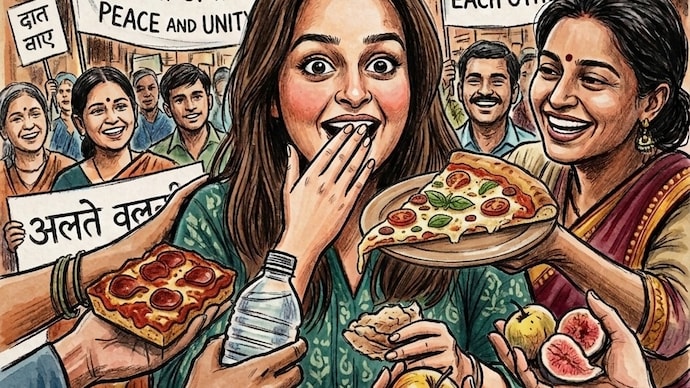
The first thing that came out of my mouth while leaving the CJP student protest wasn't a political observation or a reporter's note. It was simply, "I'm going to miss these people."
Before I entered the venue, I watched a water cannon push away the barricades outside, a reminder that this was, after all, a protest. But the moment I crossed onto the site, the atmosphere changed so dramatically that I couldn't help but laugh to myself. I genuinely felt like a newly married bahu entering her sasural for the first time.
The only things missing were a pooja ki thali, someone applying a tilak on my forehead and Kabhi Khushi Kabhie Gham's title track playing in the background.
Before I had even figured out where I wanted to begin reporting, a stranger handed me a bottle of water. There was no awkward introduction, no curiosity about who I was or where I was from. It was simply an instinctive act of kindness.
I thanked him, walked a little further, and stopped to read one of the many handwritten placards being carried through the protest. While I stood there, another person quietly placed a packet of samosas in my hand.
I politely refused, explaining that I didn’t need it, but he smiled and insisted. Only then did I notice that he wasn’t offering food just to me; he was carrying dozens of packets, making sure everyone entering the protest had something to eat.
Then, two different people handed me mini packets of biscuits, each with a different flavour. All this happened within barely two minutes of entering the protest.
I’ll admit it, I love free food as much as the next person. But somehow, accepting it that day felt different. It almost felt like cheating. The food somehow felt more theirs than mine, as though every samosa, every biscuit packet, and every meal had been bought with someone’s sacrifice or affection.
It wasn’t hospitality in the traditional sense. It was people trying to take care of strangers because they believed everyone present was sharing the same journey.
The only thing I accepted without hesitation was the water, because Delhi’s humidity had already declared war on all of us.
And speaking of the weather, one small gesture stayed with me throughout the day. Everywhere I looked, people carried hand fans, not for themselves, but to cool strangers sitting beside them.
Students noticed people sweating and quietly fanned them. Volunteers did the same. Nobody asked them to, and nobody expected praise. They simply saw someone struggling and tried to make the day a little easier.
It was a small act, but it reflected the spirit of the protest more than any slogan from the stage.
As I walked deeper inside, I noticed something else that seemed almost unbelievable. Delivery executives were constantly entering and leaving the venue. Food bags arrived one after another without a break.
Curious, I stopped one rider and asked how many trips he had made that day. He laughed before answering, “This is my fifteenth round.”
Fifteen deliveries to a protest by one delivery executive. That was when it truly dawned on me that this place had become its own little ecosystem, fuelled almost entirely by strangers looking after one another.
The food itself deserved a separate story. One corner served proper North Indian meals, while another had burgers and fries stacked neatly. There was Italian food somewhere in between. Lucknowi and Hyderabadi biryanis attracted long queues, and there were plenty of vegetarian as well as non-vegetarian options.
What amazed me wasn’t just the variety, but where it had all come from. Many of these meals had been ordered by people sitting hundreds of kilometres away, in Maharashtra, Chhattisgarh, and several other states. They couldn’t physically join the protest, so they found another way to participate.
They simply opened a food delivery app and fed strangers.
Further inside, I came across a young corporate employee who had created a small corner offering free sanitary pads and stationery. Protesters dropped by to pick up sketch pens, chart papers, and markers before sitting down to make fresh placards. I stood there quietly watching her help one person after another.
When she finally looked up, she smiled and thanked me for being there. It felt almost backwards. She had spent her day making life easier for everyone else, yet she was thanking me.
By then, the Delhi heat had completely defeated me. I must have looked as exhausted as I felt because a young volunteer walked over, handed me some biodegradable tissues, and asked if I needed water. The funny part was that he didn’t even have any water with him. He had simply noticed that I looked tired and wanted to help in whatever way he could.
That brief interaction stayed with me because it perfectly captured the mood of the protest. These students weren’t just fighting for a cause anymore. Somewhere along the way, they had started treating everyone who entered the venue like family.
The warmth extended far beyond the students themselves. Parents wandered through the crowd asking unfamiliar children whether they had eaten or needed anything. Elderly people, some easily in their seventies and eighties, guided youngsters towards food counters, checked if they were drinking enough water and made sure nobody looked lost.
Watching them felt less like covering a protest and more like attending a massive family function where everyone's parents had collectively adopted everyone else's children for the day.
Then came perhaps the most surprising sight of all: people voluntarily picking up garbage. As someone from Delhi, I feel fully entitled to joke that this alone deserved headline treatment. Volunteers wearing gloves quietly walked around collecting litter wherever they found it. Nobody instructed them to do it, and nobody stopped to appreciate them. They simply wanted the place to remain clean.
Not every corner carried the same mood either. Some students danced together as music played from a speaker. Others challenged each other to push-up competitions.
Many simply sat on the ground, physically exhausted after days of uncertainty but still smiling whenever someone walked over to ask if they had eaten. There was fatigue, there was anxiety, but there was also hope.
Somewhere between all those little moments, the protest stopped feeling like just another assignment. It became a reminder that sometimes movements aren't remembered only for the demands they make, but for the communities they create. And that is why, as I walked out of the venue, the only thought that stayed with me was one I never imagined I'd have after covering a protest: "I'm going to miss these people."
The first thing that came out of my mouth while leaving the CJP student protest wasn't a political observation or a reporter's note. It was simply, "I'm going to miss these people."
Before I entered the venue, I watched a water cannon push away the barricades outside, a reminder that this was, after all, a protest. But the moment I crossed onto the site, the atmosphere changed so dramatically that I couldn't help but laugh to myself. I genuinely felt like a newly married bahu entering her sasural for the first time.
The only things missing were a pooja ki thali, someone applying a tilak on my forehead and Kabhi Khushi Kabhie Gham's title track playing in the background.
Before I had even figured out where I wanted to begin reporting, a stranger handed me a bottle of water. There was no awkward introduction, no curiosity about who I was or where I was from. It was simply an instinctive act of kindness.
I thanked him, walked a little further, and stopped to read one of the many handwritten placards being carried through the protest. While I stood there, another person quietly placed a packet of samosas in my hand.
I politely refused, explaining that I didn’t need it, but he smiled and insisted. Only then did I notice that he wasn’t offering food just to me; he was carrying dozens of packets, making sure everyone entering the protest had something to eat.
Then, two different people handed me mini packets of biscuits, each with a different flavour. All this happened within barely two minutes of entering the protest.
I’ll admit it, I love free food as much as the next person. But somehow, accepting it that day felt different. It almost felt like cheating. The food somehow felt more theirs than mine, as though every samosa, every biscuit packet, and every meal had been bought with someone’s sacrifice or affection.
It wasn’t hospitality in the traditional sense. It was people trying to take care of strangers because they believed everyone present was sharing the same journey.
The only thing I accepted without hesitation was the water, because Delhi’s humidity had already declared war on all of us.
And speaking of the weather, one small gesture stayed with me throughout the day. Everywhere I looked, people carried hand fans, not for themselves, but to cool strangers sitting beside them.
Students noticed people sweating and quietly fanned them. Volunteers did the same. Nobody asked them to, and nobody expected praise. They simply saw someone struggling and tried to make the day a little easier.
It was a small act, but it reflected the spirit of the protest more than any slogan from the stage.
As I walked deeper inside, I noticed something else that seemed almost unbelievable. Delivery executives were constantly entering and leaving the venue. Food bags arrived one after another without a break.
Curious, I stopped one rider and asked how many trips he had made that day. He laughed before answering, “This is my fifteenth round.”
Fifteen deliveries to a protest by one delivery executive. That was when it truly dawned on me that this place had become its own little ecosystem, fuelled almost entirely by strangers looking after one another.
The food itself deserved a separate story. One corner served proper North Indian meals, while another had burgers and fries stacked neatly. There was Italian food somewhere in between. Lucknowi and Hyderabadi biryanis attracted long queues, and there were plenty of vegetarian as well as non-vegetarian options.
What amazed me wasn’t just the variety, but where it had all come from. Many of these meals had been ordered by people sitting hundreds of kilometres away, in Maharashtra, Chhattisgarh, and several other states. They couldn’t physically join the protest, so they found another way to participate.
They simply opened a food delivery app and fed strangers.
Further inside, I came across a young corporate employee who had created a small corner offering free sanitary pads and stationery. Protesters dropped by to pick up sketch pens, chart papers, and markers before sitting down to make fresh placards. I stood there quietly watching her help one person after another.
When she finally looked up, she smiled and thanked me for being there. It felt almost backwards. She had spent her day making life easier for everyone else, yet she was thanking me.
By then, the Delhi heat had completely defeated me. I must have looked as exhausted as I felt because a young volunteer walked over, handed me some biodegradable tissues, and asked if I needed water. The funny part was that he didn’t even have any water with him. He had simply noticed that I looked tired and wanted to help in whatever way he could.
That brief interaction stayed with me because it perfectly captured the mood of the protest. These students weren’t just fighting for a cause anymore. Somewhere along the way, they had started treating everyone who entered the venue like family.
The warmth extended far beyond the students themselves. Parents wandered through the crowd asking unfamiliar children whether they had eaten or needed anything. Elderly people, some easily in their seventies and eighties, guided youngsters towards food counters, checked if they were drinking enough water and made sure nobody looked lost.
Watching them felt less like covering a protest and more like attending a massive family function where everyone's parents had collectively adopted everyone else's children for the day.
Then came perhaps the most surprising sight of all: people voluntarily picking up garbage. As someone from Delhi, I feel fully entitled to joke that this alone deserved headline treatment. Volunteers wearing gloves quietly walked around collecting litter wherever they found it. Nobody instructed them to do it, and nobody stopped to appreciate them. They simply wanted the place to remain clean.
Not every corner carried the same mood either. Some students danced together as music played from a speaker. Others challenged each other to push-up competitions.
Many simply sat on the ground, physically exhausted after days of uncertainty but still smiling whenever someone walked over to ask if they had eaten. There was fatigue, there was anxiety, but there was also hope.
Somewhere between all those little moments, the protest stopped feeling like just another assignment. It became a reminder that sometimes movements aren't remembered only for the demands they make, but for the communities they create. And that is why, as I walked out of the venue, the only thought that stayed with me was one I never imagined I'd have after covering a protest: "I'm going to miss these people."
The first thing that came out of my mouth while leaving the CJP student protest wasn't a political observation or a reporter's note. It was simply, "I'm going to miss these people."
Before I entered the venue, I watched a water cannon push away the barricades outside, a reminder that this was, after all, a protest. But the moment I crossed onto the site, the atmosphere changed so dramatically that I couldn't help but laugh to myself. I genuinely felt like a newly married bahu entering her sasural for the first time.
The only things missing were a pooja ki thali, someone applying a tilak on my forehead and Kabhi Khushi Kabhie Gham's title track playing in the background.
Before I had even figured out where I wanted to begin reporting, a stranger handed me a bottle of water. There was no awkward introduction, no curiosity about who I was or where I was from. It was simply an instinctive act of kindness.
I thanked him, walked a little further, and stopped to read one of the many handwritten placards being carried through the protest. While I stood there, another person quietly placed a packet of samosas in my hand.
I politely refused, explaining that I didn’t need it, but he smiled and insisted. Only then did I notice that he wasn’t offering food just to me; he was carrying dozens of packets, making sure everyone entering the protest had something to eat.
Then, two different people handed me mini packets of biscuits, each with a different flavour. All this happened within barely two minutes of entering the protest.
I’ll admit it, I love free food as much as the next person. But somehow, accepting it that day felt different. It almost felt like cheating. The food somehow felt more theirs than mine, as though every samosa, every biscuit packet, and every meal had been bought with someone’s sacrifice or affection.
It wasn’t hospitality in the traditional sense. It was people trying to take care of strangers because they believed everyone present was sharing the same journey.
The only thing I accepted without hesitation was the water, because Delhi’s humidity had already declared war on all of us.
And speaking of the weather, one small gesture stayed with me throughout the day. Everywhere I looked, people carried hand fans, not for themselves, but to cool strangers sitting beside them.
Students noticed people sweating and quietly fanned them. Volunteers did the same. Nobody asked them to, and nobody expected praise. They simply saw someone struggling and tried to make the day a little easier.
It was a small act, but it reflected the spirit of the protest more than any slogan from the stage.
As I walked deeper inside, I noticed something else that seemed almost unbelievable. Delivery executives were constantly entering and leaving the venue. Food bags arrived one after another without a break.
Curious, I stopped one rider and asked how many trips he had made that day. He laughed before answering, “This is my fifteenth round.”
Fifteen deliveries to a protest by one delivery executive. That was when it truly dawned on me that this place had become its own little ecosystem, fuelled almost entirely by strangers looking after one another.
The food itself deserved a separate story. One corner served proper North Indian meals, while another had burgers and fries stacked neatly. There was Italian food somewhere in between. Lucknowi and Hyderabadi biryanis attracted long queues, and there were plenty of vegetarian as well as non-vegetarian options.
What amazed me wasn’t just the variety, but where it had all come from. Many of these meals had been ordered by people sitting hundreds of kilometres away, in Maharashtra, Chhattisgarh, and several other states. They couldn’t physically join the protest, so they found another way to participate.
They simply opened a food delivery app and fed strangers.
Further inside, I came across a young corporate employee who had created a small corner offering free sanitary pads and stationery. Protesters dropped by to pick up sketch pens, chart papers, and markers before sitting down to make fresh placards. I stood there quietly watching her help one person after another.
When she finally looked up, she smiled and thanked me for being there. It felt almost backwards. She had spent her day making life easier for everyone else, yet she was thanking me.
By then, the Delhi heat had completely defeated me. I must have looked as exhausted as I felt because a young volunteer walked over, handed me some biodegradable tissues, and asked if I needed water. The funny part was that he didn’t even have any water with him. He had simply noticed that I looked tired and wanted to help in whatever way he could.
That brief interaction stayed with me because it perfectly captured the mood of the protest. These students weren’t just fighting for a cause anymore. Somewhere along the way, they had started treating everyone who entered the venue like family.
The warmth extended far beyond the students themselves. Parents wandered through the crowd asking unfamiliar children whether they had eaten or needed anything. Elderly people, some easily in their seventies and eighties, guided youngsters towards food counters, checked if they were drinking enough water and made sure nobody looked lost.
Watching them felt less like covering a protest and more like attending a massive family function where everyone's parents had collectively adopted everyone else's children for the day.
Then came perhaps the most surprising sight of all: people voluntarily picking up garbage. As someone from Delhi, I feel fully entitled to joke that this alone deserved headline treatment. Volunteers wearing gloves quietly walked around collecting litter wherever they found it. Nobody instructed them to do it, and nobody stopped to appreciate them. They simply wanted the place to remain clean.
Not every corner carried the same mood either. Some students danced together as music played from a speaker. Others challenged each other to push-up competitions.
Many simply sat on the ground, physically exhausted after days of uncertainty but still smiling whenever someone walked over to ask if they had eaten. There was fatigue, there was anxiety, but there was also hope.
Somewhere between all those little moments, the protest stopped feeling like just another assignment. It became a reminder that sometimes movements aren't remembered only for the demands they make, but for the communities they create. And that is why, as I walked out of the venue, the only thought that stayed with me was one I never imagined I'd have after covering a protest: "I'm going to miss these people."

