The mountain gave warning signs: How the Teesta tunnel disaster unfolded
What triggered the deadly explosion inside NHPC's Teesta Stage VI project? A reconstruction of the tunnel network, geological risks, and the chain of events that turned a construction site into a disaster.

Twenty-two workers are now confirmed dead. Three others are still feared trapped beneath a Himalayan mountain. Days after a suspected methane gas explosion ripped through an under-construction tunnel at NHPC's Teesta Stage VI Hydroelectric Project in South Sikkim's Namchi district, rescue teams continue to battle toxic gases, water ingress and unstable conditions deep underground. But project documents suggest the mountain may have offered warning signs long before the explosion.
So, what exactly is the Teesta Stage Six project? And what happened inside the tunnel that turned an ordinary construction shift into a catastrophe?
To understand what went wrong, India Today's Open Source Intelligence (OSINT) team analysed official project documents, engineering layouts and satellite imagery. In our visual reconstruction below, we break down the project, the tunnel network, Adit 3 and what led to the explosion. India Today found that while methane can remain trapped within rock formations and fuel underground explosions, NHPC had documented earlier releases just 2 km from the blast site, raising an important question: were the known risks adequately contained?
Teesta Stage Six is NHPC's 500 MW run-of-the-river hydroelectric project, located on the Teesta River in South Sikkim's Namchi district. The project's 26.5-metre-high barrage is being built near Sirwani village, close to Singtam, while the underground powerhouse is located downstream near Tarkhola village. It is the final project in the six-project Teesta cascade planned across the river in Sikkim.
Unlike conventional dams that create vast reservoirs, a run-of-the-river project diverts part of a river's natural flow through tunnels to generate electricity before releasing the water back into the river downstream. The project consists of four 125 MW generating units, with water carried through two parallel headrace tunnels, each nearly 13.8 kilometres long, to an underground powerhouse. Electricity generated at the project is stepped up to 220 kV before being transmitted to the national power grid through Rangpo.
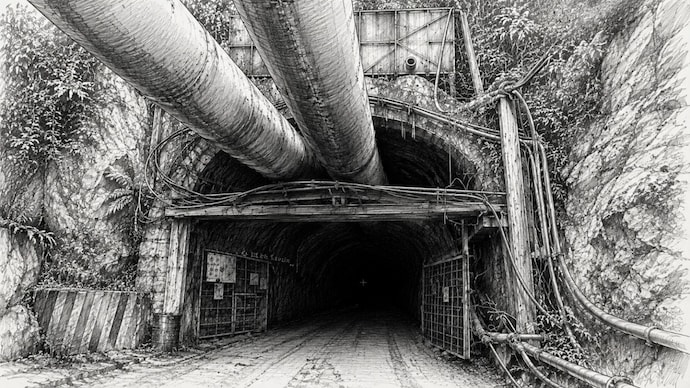
The July 20 accident occurred inside Adit 3, a 347-metre-long access tunnel located between the barrage and the underground powerhouse. The tunnel serves as one of four access passages used by engineers and workers to excavate the main headrace tunnels.
Unlike the finished tunnels that will eventually carry water, Adits are temporary construction passages used to transport workers, heavy machinery and construction material deep inside the mountain. The project layout identifies four such Adits, with Adit 3 providing access to one of the most critical excavation faces.
According to NHPC, at 1:04 pm on July 20, workers encountered a suspected methane gas pocket trapped within the surrounding rock. Seconds later, the gas ignited. Smoke, toxic gases, and rapidly falling oxygen transformed the confined tunnel into a deadly underground chamber, trapping workers deep inside the mountain.
"A second Eastern Coalfields rescue team has joined operations at the NHPC tunnel collapse site as efforts continue to locate the remaining victims," said Siddhant Maurya, District Informatics Officer (DIO) Namchi.
The danger was not entirely unexpected. Just 10 days before the accident, NHPC issued an Expression of Interest (EOI) seeking experts to speed up excavation in the same stretch. The document said work was "being adversely affected by poor to very poor geological conditions, including seepage, ingress of water/slush, cavity formation, face collapses, and the presence of methane gas."
The accompanying geological map also marks several previous incidences of methane gas release along the critical tunnel section. One of the marked locations lies roughly 2 kilometres from the access tunnel where the July 20 explosion occurred.
NHPC also cited a study by the CSIR-Central Institute of Mining and Fuel Research (CIMFR), Dhanbad, which concluded that "unpressurized methane releasing from pockets in the phyllitic formation can be safely managed" if proper protocols are followed, including keeping methane concentrations below 1%. Phyllite, a soft, layered metamorphic rock common in the young Himalayas, contains natural fractures that can trap methane beneath the surface. The study recommended “continuous methane monitoring, adequate ventilation, and a mandatory one-hour gas dilution period after every excavation cycle.”
Whether these safety protocols were followed remains a matter of investigation. The tragedy has also raised broader questions. Did help reach the workers in time? Were the known methane risks adequately monitored and managed? And despite prior geological warnings, could more have been done to prevent the disaster? Those answers are likely to emerge only once the official investigation is complete.
The project itself has had a long and difficult journey. Originally targeted for commissioning in 2012, construction was repeatedly delayed by funding constraints, forest clearances, the 2011 Sikkim earthquake, and what project documents describe as "geological surprises." The latest tragedy has now added another grim chapter to that history.
The Teesta River, meanwhile, is no stranger to headlines. For decades, it has been at the centre of one of South Asia's most sensitive water-sharing disputes between India and Bangladesh. This time, however, the focus has shifted from diplomacy to disaster, with one of the deadliest industrial accidents in Sikkim's recent history unfolding deep beneath the Himalayan mountains.
Twenty-two workers are now confirmed dead. Three others are still feared trapped beneath a Himalayan mountain. Days after a suspected methane gas explosion ripped through an under-construction tunnel at NHPC's Teesta Stage VI Hydroelectric Project in South Sikkim's Namchi district, rescue teams continue to battle toxic gases, water ingress and unstable conditions deep underground. But project documents suggest the mountain may have offered warning signs long before the explosion.
So, what exactly is the Teesta Stage Six project? And what happened inside the tunnel that turned an ordinary construction shift into a catastrophe?
To understand what went wrong, India Today's Open Source Intelligence (OSINT) team analysed official project documents, engineering layouts and satellite imagery. In our visual reconstruction below, we break down the project, the tunnel network, Adit 3 and what led to the explosion. India Today found that while methane can remain trapped within rock formations and fuel underground explosions, NHPC had documented earlier releases just 2 km from the blast site, raising an important question: were the known risks adequately contained?
Teesta Stage Six is NHPC's 500 MW run-of-the-river hydroelectric project, located on the Teesta River in South Sikkim's Namchi district. The project's 26.5-metre-high barrage is being built near Sirwani village, close to Singtam, while the underground powerhouse is located downstream near Tarkhola village. It is the final project in the six-project Teesta cascade planned across the river in Sikkim.
Unlike conventional dams that create vast reservoirs, a run-of-the-river project diverts part of a river's natural flow through tunnels to generate electricity before releasing the water back into the river downstream. The project consists of four 125 MW generating units, with water carried through two parallel headrace tunnels, each nearly 13.8 kilometres long, to an underground powerhouse. Electricity generated at the project is stepped up to 220 kV before being transmitted to the national power grid through Rangpo.
The July 20 accident occurred inside Adit 3, a 347-metre-long access tunnel located between the barrage and the underground powerhouse. The tunnel serves as one of four access passages used by engineers and workers to excavate the main headrace tunnels.
Unlike the finished tunnels that will eventually carry water, Adits are temporary construction passages used to transport workers, heavy machinery and construction material deep inside the mountain. The project layout identifies four such Adits, with Adit 3 providing access to one of the most critical excavation faces.
According to NHPC, at 1:04 pm on July 20, workers encountered a suspected methane gas pocket trapped within the surrounding rock. Seconds later, the gas ignited. Smoke, toxic gases, and rapidly falling oxygen transformed the confined tunnel into a deadly underground chamber, trapping workers deep inside the mountain.
"A second Eastern Coalfields rescue team has joined operations at the NHPC tunnel collapse site as efforts continue to locate the remaining victims," said Siddhant Maurya, District Informatics Officer (DIO) Namchi.
The danger was not entirely unexpected. Just 10 days before the accident, NHPC issued an Expression of Interest (EOI) seeking experts to speed up excavation in the same stretch. The document said work was "being adversely affected by poor to very poor geological conditions, including seepage, ingress of water/slush, cavity formation, face collapses, and the presence of methane gas."
The accompanying geological map also marks several previous incidences of methane gas release along the critical tunnel section. One of the marked locations lies roughly 2 kilometres from the access tunnel where the July 20 explosion occurred.
NHPC also cited a study by the CSIR-Central Institute of Mining and Fuel Research (CIMFR), Dhanbad, which concluded that "unpressurized methane releasing from pockets in the phyllitic formation can be safely managed" if proper protocols are followed, including keeping methane concentrations below 1%. Phyllite, a soft, layered metamorphic rock common in the young Himalayas, contains natural fractures that can trap methane beneath the surface. The study recommended “continuous methane monitoring, adequate ventilation, and a mandatory one-hour gas dilution period after every excavation cycle.”
Whether these safety protocols were followed remains a matter of investigation. The tragedy has also raised broader questions. Did help reach the workers in time? Were the known methane risks adequately monitored and managed? And despite prior geological warnings, could more have been done to prevent the disaster? Those answers are likely to emerge only once the official investigation is complete.
The project itself has had a long and difficult journey. Originally targeted for commissioning in 2012, construction was repeatedly delayed by funding constraints, forest clearances, the 2011 Sikkim earthquake, and what project documents describe as "geological surprises." The latest tragedy has now added another grim chapter to that history.
The Teesta River, meanwhile, is no stranger to headlines. For decades, it has been at the centre of one of South Asia's most sensitive water-sharing disputes between India and Bangladesh. This time, however, the focus has shifted from diplomacy to disaster, with one of the deadliest industrial accidents in Sikkim's recent history unfolding deep beneath the Himalayan mountains.
Twenty-two workers are now confirmed dead. Three others are still feared trapped beneath a Himalayan mountain. Days after a suspected methane gas explosion ripped through an under-construction tunnel at NHPC's Teesta Stage VI Hydroelectric Project in South Sikkim's Namchi district, rescue teams continue to battle toxic gases, water ingress and unstable conditions deep underground. But project documents suggest the mountain may have offered warning signs long before the explosion.
So, what exactly is the Teesta Stage Six project? And what happened inside the tunnel that turned an ordinary construction shift into a catastrophe?
To understand what went wrong, India Today's Open Source Intelligence (OSINT) team analysed official project documents, engineering layouts and satellite imagery. In our visual reconstruction below, we break down the project, the tunnel network, Adit 3 and what led to the explosion. India Today found that while methane can remain trapped within rock formations and fuel underground explosions, NHPC had documented earlier releases just 2 km from the blast site, raising an important question: were the known risks adequately contained?
Teesta Stage Six is NHPC's 500 MW run-of-the-river hydroelectric project, located on the Teesta River in South Sikkim's Namchi district. The project's 26.5-metre-high barrage is being built near Sirwani village, close to Singtam, while the underground powerhouse is located downstream near Tarkhola village. It is the final project in the six-project Teesta cascade planned across the river in Sikkim.
Unlike conventional dams that create vast reservoirs, a run-of-the-river project diverts part of a river's natural flow through tunnels to generate electricity before releasing the water back into the river downstream. The project consists of four 125 MW generating units, with water carried through two parallel headrace tunnels, each nearly 13.8 kilometres long, to an underground powerhouse. Electricity generated at the project is stepped up to 220 kV before being transmitted to the national power grid through Rangpo.
The July 20 accident occurred inside Adit 3, a 347-metre-long access tunnel located between the barrage and the underground powerhouse. The tunnel serves as one of four access passages used by engineers and workers to excavate the main headrace tunnels.
Unlike the finished tunnels that will eventually carry water, Adits are temporary construction passages used to transport workers, heavy machinery and construction material deep inside the mountain. The project layout identifies four such Adits, with Adit 3 providing access to one of the most critical excavation faces.
According to NHPC, at 1:04 pm on July 20, workers encountered a suspected methane gas pocket trapped within the surrounding rock. Seconds later, the gas ignited. Smoke, toxic gases, and rapidly falling oxygen transformed the confined tunnel into a deadly underground chamber, trapping workers deep inside the mountain.
"A second Eastern Coalfields rescue team has joined operations at the NHPC tunnel collapse site as efforts continue to locate the remaining victims," said Siddhant Maurya, District Informatics Officer (DIO) Namchi.
The danger was not entirely unexpected. Just 10 days before the accident, NHPC issued an Expression of Interest (EOI) seeking experts to speed up excavation in the same stretch. The document said work was "being adversely affected by poor to very poor geological conditions, including seepage, ingress of water/slush, cavity formation, face collapses, and the presence of methane gas."
The accompanying geological map also marks several previous incidences of methane gas release along the critical tunnel section. One of the marked locations lies roughly 2 kilometres from the access tunnel where the July 20 explosion occurred.
NHPC also cited a study by the CSIR-Central Institute of Mining and Fuel Research (CIMFR), Dhanbad, which concluded that "unpressurized methane releasing from pockets in the phyllitic formation can be safely managed" if proper protocols are followed, including keeping methane concentrations below 1%. Phyllite, a soft, layered metamorphic rock common in the young Himalayas, contains natural fractures that can trap methane beneath the surface. The study recommended “continuous methane monitoring, adequate ventilation, and a mandatory one-hour gas dilution period after every excavation cycle.”
Whether these safety protocols were followed remains a matter of investigation. The tragedy has also raised broader questions. Did help reach the workers in time? Were the known methane risks adequately monitored and managed? And despite prior geological warnings, could more have been done to prevent the disaster? Those answers are likely to emerge only once the official investigation is complete.
The project itself has had a long and difficult journey. Originally targeted for commissioning in 2012, construction was repeatedly delayed by funding constraints, forest clearances, the 2011 Sikkim earthquake, and what project documents describe as "geological surprises." The latest tragedy has now added another grim chapter to that history.
The Teesta River, meanwhile, is no stranger to headlines. For decades, it has been at the centre of one of South Asia's most sensitive water-sharing disputes between India and Bangladesh. This time, however, the focus has shifted from diplomacy to disaster, with one of the deadliest industrial accidents in Sikkim's recent history unfolding deep beneath the Himalayan mountains.

