House of Rohit Bal turns the spotlight on the hands behind the legend through Dastkar
House of Rohit Bal unveiled Dastkar at Hyundai India Couture Week 2026 as a tribute to its artisans.
What does dastkar mean? Chances are, most of you already know - but for those who don't, it's Urdu for a craftsman, artisan, or skilled handworker: someone who makes things with their hands and small tools, not machines.
Wondering why the impromptu Urdu lesson? Because that's exactly what the House of Rohit Bal named its latest couture collection, unveiled at Hyundai India Couture Week 2026 on Friday. And true to its name, the collection was a tribute — to the hands, minds, and quiet mastery of the karigars who've shaped the brand into what it is today.
Staged at the Taj Palace in New Delhi, Dastkar was like a thank-you note of sorts, one addressed to the embroiderers, weavers, dyers, pattern-makers and karigars who've spent three decades translating Rohit Bal's imagination into garments without ever quite stepping into the light themselves. This time, the House built the entire collection around them.
The clothes did the talking, and what they said was fairly simple: behind every "iconic" fashion moment is someone's hands, and it's about time they got credit.
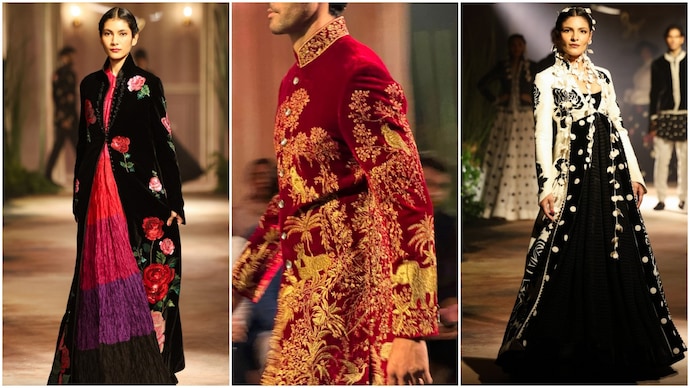
There was no single showstopper look, and who really needs one when the collection itself does all the heavy lifting. Sheer black and white shirts, embroidered were a common feature. High, ruffled or pleated stand collars turned up again and again across the show, on men's jackets and women's peplums alike, almost like a signature punctuation mark.
One black velvet peplum jacket, dotted in white and finished with a lace choker-collar, sat atop a skirt that mixed black-and-white damask swirls — closer to a vintage wallpaper or a Toile de Jouy print than anything typically seen on an Indian couture runway — with a single, defiantly red rose. Another standout feature was pearl tassels and dimensional lace floral applique — the kind of embellishment that takes weeks of handwork, not a print run, to get right.
Fraze Tasnim, creative director at Rohit Bal Couture, said, “Dastkar is our deepest expression of gratitude. It is dedicated to the artisans who have remained an integral part of the Rohit Bal House for over thirty years. Their skill, patience and unwavering commitment have shaped every embroidery, every silhouette and every collection that has emerged from our atelier.
Drawing on French tapestries, vintage wallpapers, and what the House describes as "the rhythmic interplay of lines and dots," the collection ran rich silks, velvets and heritage textiles through hand embroidery and layered texture.
Also, what you couldn’t miss was the runway. Walking the models through an almost overgrown, garden/forest-like space made the connection literal — as if the collection had simply grown out of the same soil his design philosophy always drew from. The motifs, the embroidery everything complemented the theme.
As the House put it: the strength of a great fashion house lies not only in creative vision, but in the collective excellence of the people who bring that vision to life, the collection brilliantly justified that.
What does dastkar mean? Chances are, most of you already know - but for those who don't, it's Urdu for a craftsman, artisan, or skilled handworker: someone who makes things with their hands and small tools, not machines.
Wondering why the impromptu Urdu lesson? Because that's exactly what the House of Rohit Bal named its latest couture collection, unveiled at Hyundai India Couture Week 2026 on Friday. And true to its name, the collection was a tribute — to the hands, minds, and quiet mastery of the karigars who've shaped the brand into what it is today.
Staged at the Taj Palace in New Delhi, Dastkar was like a thank-you note of sorts, one addressed to the embroiderers, weavers, dyers, pattern-makers and karigars who've spent three decades translating Rohit Bal's imagination into garments without ever quite stepping into the light themselves. This time, the House built the entire collection around them.
The clothes did the talking, and what they said was fairly simple: behind every "iconic" fashion moment is someone's hands, and it's about time they got credit.
There was no single showstopper look, and who really needs one when the collection itself does all the heavy lifting. Sheer black and white shirts, embroidered were a common feature. High, ruffled or pleated stand collars turned up again and again across the show, on men's jackets and women's peplums alike, almost like a signature punctuation mark.
One black velvet peplum jacket, dotted in white and finished with a lace choker-collar, sat atop a skirt that mixed black-and-white damask swirls — closer to a vintage wallpaper or a Toile de Jouy print than anything typically seen on an Indian couture runway — with a single, defiantly red rose. Another standout feature was pearl tassels and dimensional lace floral applique — the kind of embellishment that takes weeks of handwork, not a print run, to get right.
Fraze Tasnim, creative director at Rohit Bal Couture, said, “Dastkar is our deepest expression of gratitude. It is dedicated to the artisans who have remained an integral part of the Rohit Bal House for over thirty years. Their skill, patience and unwavering commitment have shaped every embroidery, every silhouette and every collection that has emerged from our atelier.
Drawing on French tapestries, vintage wallpapers, and what the House describes as "the rhythmic interplay of lines and dots," the collection ran rich silks, velvets and heritage textiles through hand embroidery and layered texture.
Also, what you couldn’t miss was the runway. Walking the models through an almost overgrown, garden/forest-like space made the connection literal — as if the collection had simply grown out of the same soil his design philosophy always drew from. The motifs, the embroidery everything complemented the theme.
As the House put it: the strength of a great fashion house lies not only in creative vision, but in the collective excellence of the people who bring that vision to life, the collection brilliantly justified that.
What does dastkar mean? Chances are, most of you already know - but for those who don't, it's Urdu for a craftsman, artisan, or skilled handworker: someone who makes things with their hands and small tools, not machines.
Wondering why the impromptu Urdu lesson? Because that's exactly what the House of Rohit Bal named its latest couture collection, unveiled at Hyundai India Couture Week 2026 on Friday. And true to its name, the collection was a tribute — to the hands, minds, and quiet mastery of the karigars who've shaped the brand into what it is today.
Staged at the Taj Palace in New Delhi, Dastkar was like a thank-you note of sorts, one addressed to the embroiderers, weavers, dyers, pattern-makers and karigars who've spent three decades translating Rohit Bal's imagination into garments without ever quite stepping into the light themselves. This time, the House built the entire collection around them.
The clothes did the talking, and what they said was fairly simple: behind every "iconic" fashion moment is someone's hands, and it's about time they got credit.
There was no single showstopper look, and who really needs one when the collection itself does all the heavy lifting. Sheer black and white shirts, embroidered were a common feature. High, ruffled or pleated stand collars turned up again and again across the show, on men's jackets and women's peplums alike, almost like a signature punctuation mark.
One black velvet peplum jacket, dotted in white and finished with a lace choker-collar, sat atop a skirt that mixed black-and-white damask swirls — closer to a vintage wallpaper or a Toile de Jouy print than anything typically seen on an Indian couture runway — with a single, defiantly red rose. Another standout feature was pearl tassels and dimensional lace floral applique — the kind of embellishment that takes weeks of handwork, not a print run, to get right.
Fraze Tasnim, creative director at Rohit Bal Couture, said, “Dastkar is our deepest expression of gratitude. It is dedicated to the artisans who have remained an integral part of the Rohit Bal House for over thirty years. Their skill, patience and unwavering commitment have shaped every embroidery, every silhouette and every collection that has emerged from our atelier.
Drawing on French tapestries, vintage wallpapers, and what the House describes as "the rhythmic interplay of lines and dots," the collection ran rich silks, velvets and heritage textiles through hand embroidery and layered texture.
Also, what you couldn’t miss was the runway. Walking the models through an almost overgrown, garden/forest-like space made the connection literal — as if the collection had simply grown out of the same soil his design philosophy always drew from. The motifs, the embroidery everything complemented the theme.
As the House put it: the strength of a great fashion house lies not only in creative vision, but in the collective excellence of the people who bring that vision to life, the collection brilliantly justified that.

