Madhya Pradesh | The big fat Metro party
White elephants? The Bhopal and Indore Metros see paltry footfalls, get rented out for shaadis and dos
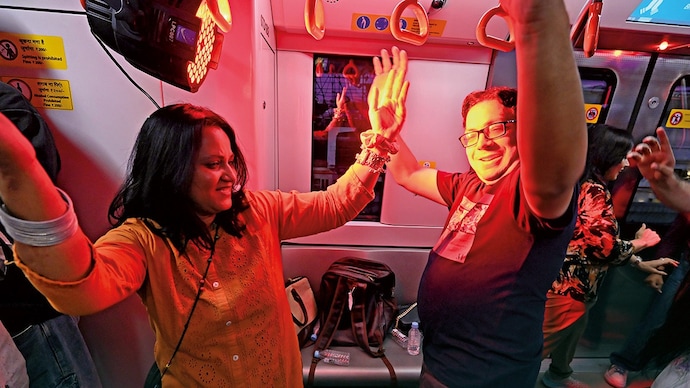
If it’s a metro, it should be a metropolis. Chew on that inverted logic, and you see the ambition that got a string of Tier-2 Indian cities buying a ticket in the past decade. But check what’s happening in Bhopal and Indore. As summer rolled in, the MP Metro Rail Corporation Ltd (MPMRCL) put out word that it would rent out its metro coaches in the two cities for photo shoots for birthday parties, weddings, kitty parties and other dos.
If it’s a metro, it should be a metropolis. Chew on that inverted logic, and you see the ambition that got a string of Tier-2 Indian cities buying a ticket in the past decade. But check what’s happening in Bhopal and Indore. As summer rolled in, the MP Metro Rail Corporation Ltd (MPMRCL) put out word that it would rent out its metro coaches in the two cities for photo shoots for birthday parties, weddings, kitty parties and other dos.
It’s not a bad offer. A stationary coach at Rs 5,000 for an hour’s photo shoot. A moving one at Rs 7,000 a pop. Officials say this is aimed at familiarising the citizenry with the metro. That doesn’t entirely wash—a metro ride is not bungee jumping, it’s just a short train ride with air-conditioning. Just a tad costlier than usual public transport. Point is, that has proved prohibitive here—the telltale evening squeeze of humanity is nowhere in sight.
RUNNING ON EMPTY
In fact, the two metros, which began operations in the past year, have not been finding even average ridership. In Bhopal, average ridership stands at 250-300 per day; in Indore, it’s even lower at 100 per day. At a time when plain-vanilla civic issues struggle for funds, people naturally wonder at the viability of mounting a white elephant.
Civic agencies say it’s too early to judge, reasoning that financial viability in mass transport projects is seldom achieved soon—or ever—even in the best-run systems across the world. But the tonality has clearly been shifting: from the early days of fanfare when the BJP and Congress were both claiming credit, to defensive posturing.
The first 6 km section of the 31.2 km Indore Metro project was inaugurated on May 31, 2025. Bhopal Metro’s first 7 km stretch, in a 30.8 km plan, got rocking on December 20, 2025. But post-launch, the response has been lukewarm, to say the least. Bhopal thought it wise to trim its AIIMS-to-Subhash Nagar metro frequency from nine to five. Likewise, the first free ‘Joyride’ week in Indore saw 150,000 denizens hop on; a graded scaling back to 75 per cent and half-rate discounts in subsequent weeks saw the enthusiasm of Indoris dip proportionately. These got only 35,000 and 15,000 takers. The trickle that the full rates attracted saw the first 15-minute inaugural frequency go down to hourly, then two-hourly, to just two round trips a day. In both cities, three 250-capacity coaches ply on each trip.
The cost overruns are nothing to sniff at. The 2018 DPR for the Bhopal Metro pegged costs at Rs 6,941 crore; that’s been revised upwards to Rs 10,000 crore. Indore’s Rs 7,500 crore plan has zoomed to Rs 12,800 crore. Officials ascribe this mostly to a GST hike from 12 to 18 per cent on materials. The routes also mutated, with the underground sections increasing. At grade, construction costs around Rs 100 crore per km; elevated makes it around Rs 300 crore per km; tunnelling ups that to Rs 800 per km.
Both projects are funded 60 per cent by foreign lenders: the Asian Development Bank and New Development Bank for Indore, the European Investment Bank for Bhopal. Of the remaining 40 per cent, half is picked up by the Centre, the remaining by the state government.
Krishna Chaitanya, MD, MPMRCL, reasons that reading it this way is flawed: “Even the Delhi Metro took 20 years to get the 40 lakh ridership it presently has. The Indore and Bhopal Metros are barely a year old and have very little coverage for them to attract ridership.” He says unless at least 17-18 km of the projects become functional, connecting major workplaces in the cities and peripheral areas where working populations live, the ridership will remain low. The crux, according to planners, is that a critical part of the project needs to get going for the metro to get ridership.
Meanwhile, in both Bhopal and Indore, the local bus network has also considerably weakened. The fleets in both cities are depleted and new investment is not coming in. This has led to an increase in congestion. Thanks partly to a sudden increase in battery-operated rickshaws—filling the gap between demand and supply but proving to be a traffic nightmare in themselves.
The viability of the proj-ects, officials say, was vetted at multiple levels. Passenger traffic projections were studied by six central departments before being approved—since Peak Hour Peak Direction Traffic should be at least 20,000 for a city to get a metro. “Ridership for Bhopal will stand at 4 lakh per day upon completion by 2035-36; for Indore, it will be 5 lakh, as per the DPR,” says Chaitanya. “Success should be judged then.” Just that it seems a rather long wait in unmoving traffic.

