FIFA World Cup 2026 | Why India is missing
As smaller nations light up the World Cup, Indian football languishes in neglect and indecision
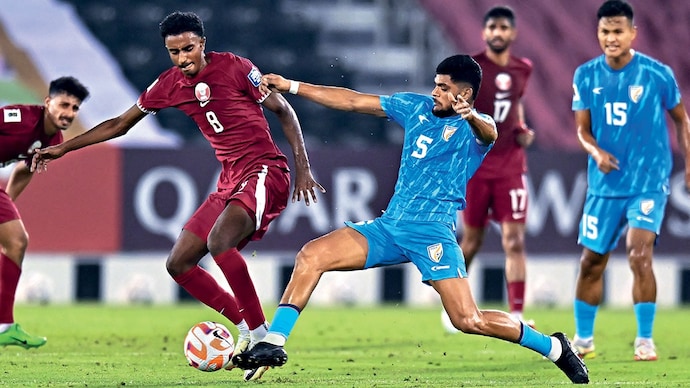


As millions stayed awake through the night in early July to watch Cabo Verde’s spirited performance against defending champions Argentina at the 2026 FIFA World Cup, football fans in India wondered how a tiny archipelago off the coast of Africa, only slightly bigger than Goa, is squaring up against footballing giants, while even qualifying for the tournament remains a distant dream for India. The sorry state of Indian football showed when India was forced to withdraw from the 2026 Asian Games because the men’s team failed to satisfy the Union sports ministry’s criterion of being among Asia’s top eight. India ranks 24 among the 46 members of the Asian Football Confederation (AFC) and the team failed to qualify yet again for the AFC Asian Cup 2027, the foremost competition in the continent. India’s quest to make history collapsed in 2024 itself in the second round of the AFC qualifiers. Competing in Group A alongside Qatar, Kuwait and Afghanistan, it failed to secure a top two finish needed to progress in the World Cup qualifiers. The Blue Tigers managed just one win—against Kuwait—their first away win in 22 years.
As millions stayed awake through the night in early July to watch Cabo Verde’s spirited performance against defending champions Argentina at the 2026 FIFA World Cup, football fans in India wondered how a tiny archipelago off the coast of Africa, only slightly bigger than Goa, is squaring up against footballing giants, while even qualifying for the tournament remains a distant dream for India. The sorry state of Indian football showed when India was forced to withdraw from the 2026 Asian Games because the men’s team failed to satisfy the Union sports ministry’s criterion of being among Asia’s top eight. India ranks 24 among the 46 members of the Asian Football Confederation (AFC) and the team failed to qualify yet again for the AFC Asian Cup 2027, the foremost competition in the continent. India’s quest to make history collapsed in 2024 itself in the second round of the AFC qualifiers. Competing in Group A alongside Qatar, Kuwait and Afghanistan, it failed to secure a top two finish needed to progress in the World Cup qualifiers. The Blue Tigers managed just one win—against Kuwait—their first away win in 22 years.
The picture is even more dismal when it comes to world football rankings. India has been on a downward spiral—from 102 in 2023 to 139 in 2026. Its highest FIFA ranking remains 94, achieved in 1996 under Bhaichung Bhutia’s captaincy, while its second-best ranking of 96 came in 2017—the year India hosted the FIFA Under-17 World Cup, the biggest-ever FIFA event it hosted. It was hailed as the beginning of a footballing renaissance, as stadiums were modernised, crowds turned up in unprecedented numbers and the All India Football Federation (AIFF) spoke of creating a lasting legacy. At least 18 players from 10 countries that participated in it are playing in the 2026 World Cup. India, which hoped to ride the momentum into a new era, appears to have drifted further away, even as tiny Curacao, a Caribbean island with a population of 158,000, and the small nation of Cabo Verde, with half a million people, have taken advantage of the expanded, 48-team version of the 2026 World Cup and qualified. Not only did they improve infrastructure at home, they also drew heavily on their football-playing diasporas from across the leagues in Europe.
IMPERFECT STRUCTURE
Indian football is governed by the AIFF, the apex body affiliated to FIFA and the AFC. The AIFF oversees the national teams, youth development and domestic competitions, but unlike the Board of Control for Cricket in India (BCCI), it does not exercise complete authority over the sport. Football clubs are independent entities that own player contracts and decide when to release players for national duty. National football coaches frequently struggle to assemble a settled squad and secure adequate preparation time before international tournaments.
The domestic football pyramid is headed by the Indian Super League (ISL), followed by the I-League, I-League 2 and I-League 3, with state leagues forming the base. A few top ISL stars can earn between Rs 2 crore and Rs 8 crore a season, but most Indian footballers make between Rs 8 lakh and Rs 60 lakh annually, while players in the I-League often earn Rs 3 lakh to Rs 15 lakh a year. In contrast, even an uncapped player in the Indian Premier League can command a base auction price of Rs 30 lakh, with many established cricketers earning in crores.
Compared with Europe’s elite competitions like the Premier League (England), La Liga (Spain), Bundesliga (Germany) and Serie A (Italy), Indian football is in a developmental phase. These leagues are backed by rich clubs, world-class academies and scouting systems, multi-billion-dollar broadcast deals and deep talent pools, enabling them to attract the world’s best players and coaches. Indian football, by contrast, is still stuck at building its grassroots ecosystem and infrastructure.
CATCH THEM YOUNG
Those involved in Indian football insist that the country’s biggest failure begins long before players wear the blue jersey. “Kids do not have access to sport...there’s a shortage of grounds for football,” says Pradhyum Reddy, former head coach of Shillong Lajong FC and erstwhile CEO of Dempo FC. “It’s not just about training at academies; you need to have leagues that run all year around for youth.”
India depends on youngsters presenting themselves for selection trials instead of building a nationwide scouting network. In a country where football largely remains a working-class sport, experts argue that expecting a daily wage earner from the rural areas to send his child to a metropolis in the hope of being spotted is unrealistic. “Scouting must be spread across districts and villages, where youngsters are constantly assessed and monitored,” argues Anirban Dutta, secretary of the Indian Football Association—the apex football body in West Bengal.
Indeed, the years between childhood and late adolescence determine whether a footballer acquires the technical ability, tactical intelligence and physical conditioning required for the modern game. Yet India has only a handful of noteworthy residential football academies, like Minerva in Chandigarh, where such skills are best honed. In nations like Spain and the UK, promising players grow up in academies that integrate schooling with sports science, psychology, recovery—even position-specific coaching.
If India aspires to be at the World Cup in the next decade, it needs to focus hard on youth development. Many believe foreign expertise would deliver greater returns if deployed at the youth level, where coaches can shape muscle memory and tactical awareness. “Our youth structure is the foundation, and that is where we have failed,” says Bengal football team coach Sanjoy Sen.
However, even the best coaching cannot compensate for the absence of competitive football. Indian professionals play only around 30 competitive matches in a season, with few overseas matches. Most foreign players play over 50 matches in domestic leagues and international tournaments.
The countries now racing ahead of India have spent decades correcting precisely these structural weaknesses. Japan laid the foundations of its modern football ecosystem three decades ago through the J-League, linking every professional club to a robust academy system. Uzbekistan, too, invested systematically in school football.
A BROKEN SYSTEM
If India’s talent pipeline is weak, its apex football institutions have been no less fragile. The AIFF has spent the past few years in legal disputes and disagreements with stakeholders. The prolonged uncertainty over the ISL in 2025-26 was the epitome of that dysfunction. With the commercial agreement governing the country’s premier competition expiring and no resolution in sight, players publicly appealed for the league to continue. The possibility of India’s top-tier tournament not taking place exposed how vulnerable the domestic calendar was. Running a professional football club in India costs an estimated Rs 60 crore annually. Without a stable competition calendar, clubs struggle to retain sponsors and ticket revenues plummet.
The fractured relationship between the AIFF and state football associations has adversely affected development. It was most evident when Mohun Bagan refused to release seven players for national duty in the Unity Cup—a tournament in London featuring Jamaica, Nigeria, Zimbabwe and India—as it is not part of FIFA’s international window and also due to valid injury concerns, since AIFF doesn’t take financial responsibility for injured players in training camps.
Inevitably, administrative uncertainty has affected onfield performance. Croatian Igor timac’s five-year tenure (2019-2024) as India’s head coach produced mixed results. He guided India to three titles in 2023—the SAFF Championship, the Tri-Nation Series and the Intercontinental Cup—and briefly restored India’s ranking to the FIFA top 100. But timac was dismissed in June 2024 after India crashed out of the 2023 AFC Asian Cup without a point and after the disappointment of the 2026 FIFA World Cup qualifiers. When Khalid Jamil took over in August 2025, some within the AIFF believed he should initially have been appointed on a short-term basis. His two-year contract renewed the debate over the need for appointments to be guided by long-term strategy.
Former AIFF president Praful Patel rejects the suggestion that Indian football lacks direction. While acknowledging the shortcomings of his administration (2009-2022), he insists that there was a long-term vision. “Our plan was to qualify for the World Cup by 2030. So we were taking one step at a time and things were improving,” he says.
But even if India succeeds in identifying better talent and fixing its administration, one question remains: is football an attractive profession? For most young Indians, the answer is no.
Unlike cricket, the returns in football are neither immediate nor guaranteed. Still, for decades, the game offered financial security through government employment under sports quotas. Those opportunities have diminished greatly and many promising players struggle to justify pursuing football professionally.
There is another worrying trend—the absence of new footballing icons who can captivate a generation and generate public interest. For nearly two decades, Indian football rode on the shoulders of Bhaichung Bhutia and later Sunil Chhetri. Their charisma kept fans interested and convinced sponsors that football had a market in India. But the pipeline expected to produce their successors failed to deliver. The shortage compelled Chhetri to reverse his international retirement at the age of 40 to bolster India’s campaign in the AFC Asian Cup 2027 qualifiers.
Pradyumna Tembhekar, a team doctor for ISL team Jamshedpur FC and India’s FIFA ambassador, has heard his share of jibes about Indian football. “A Canadian ambassador told me that even if there are 128 teams in the World Cup, India [still] won’t make it,” he says.
IN FOOTBALL WE TRUST
Ironic though it may sound, several populous swathes of India nurse a passion for the game. Football fills stadiums in Kolkata, unites villages in Kerala, dominates evenings in Goa and is deeply embedded in the Northeast’s sporting culture, especially in Mizoram and Manipur. Every year, thousands of children dream of wearing the national jersey.
Indian football is also seeing some positive change. Residential academies like Tata Football Academy in Jamshedpur, Minerva, Bengaluru FC soccer schools supported by JSW Sports and the Reliance Foundation Young Champs in Navi Mumbai are ensuring the next generation of players get technical knowledge, appropriate nutrition, fitness and education. Talented young players from these academies are recruited by ISL teams.
AIFF is drawing inspiration from the Cabo Verde’s diaspora model and allowing clubs to field one Overseas Citizen of India (OCI) player in their squad. However, not everyone is convinced. “We don’t have as many players in the diaspora,” notes Reddy, adding that FIFA rules about national team representation are stringent.
Reversing the decline in Indian football will mean rebuilding it from the ground up—year-round scouting, integrated football schools, a predictable competition calendar and sticking to a long-term roadmap. For too long, Indian football has searched for shortcuts to success. The countries overtaking it offer a lesson: in football, there are none. n
FIRST-PERSON
‘The national team must come first’
Khalid Jamil, coach of the national men’s football team, talks about what he thinks are the problems plaguing Indian football
The biggest challenge I am facing is the unavailability of players. Clubs are either not releasing players or recalling players after releasing them for national duty, or releasing them so late that I barely get any meaningful training time with the squad. What I need is continuity—a fixed group of players and sufficient time to work with them. Since taking charge, I have conducted four camps. Every time, I had a different set of players. How can anyone realistically expect consistent results? The national team must come first. Players also have a responsibility. They should speak to their clubs and say that they want to be available for the national team once the domestic season is over.
For example, Bengaluru FC initially did not release a player I wanted. I called their CEO, Parth Jindal, and he made arrangements, saying that serving the nation was paramount. I believe every club owner would support the national team if approached. Then, one night, I called footballer Vikram Pratap Singh and asked him to join the camp, and he complied. We need that commitment. People often point to problems such as inadequate scouting, weak grassroots structures and the lack of school football. They are right. We need better scouting systems and a stronger grassroots ecosystem. At the same time, our players need more international matches.That exposure is equally important for their development. As for the next World Cup, we have to improve. But immediate problems need to be resolved.
I am starting another national camp soon. I have spoken to some players and will work with them. I hope a solution can be found so that I have a stable pool of players and the opportunity to build a settled team.
As far as the AIFF is concerned, I have faced no interference. Everyone, including president Kalyan Chaubey, has been supportive. Whatever recent results have been, the responsibility is mine.
— As told to Arkamoy Datta Majumdar

