Punjab's warring factions
Raja Warring was always seen as a compromise king. Now Channi raises the banner of revolt in the Congress
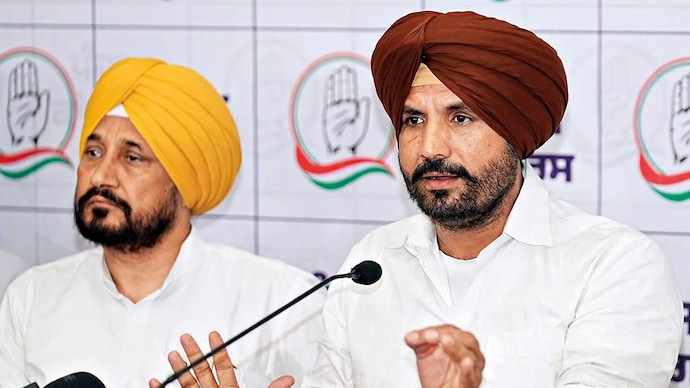
On July 6, all eyes in Punjab were on the prize fight between the Akal Takht and the Bhagwant Mann regime. But no one missed former Chhattisgarh chief minister Bhupesh Baghel deboarding quietly in Chandigarh. Officially, it was all ho-hum: the Congress state in-charge was in town to review preparations for the 2027 assembly election. But everyone saw it for what it was, shorn of euphemism. It was the fire engine rushing in, without sirens blaring—there was a full-blown inferno down the block. The high command had reappointed Rahul Gandhi loyalist Amrinder Singh Raja Warring as state unit president, and the state unit was warring against the firman.
On July 6, all eyes in Punjab were on the prize fight between the Akal Takht and the Bhagwant Mann regime. But no one missed former Chhattisgarh chief minister Bhupesh Baghel deboarding quietly in Chandigarh. Officially, it was all ho-hum: the Congress state in-charge was in town to review preparations for the 2027 assembly election. But everyone saw it for what it was, shorn of euphemism. It was the fire engine rushing in, without sirens blaring—there was a full-blown inferno down the block. The high command had reappointed Rahul Gandhi loyalist Amrinder Singh Raja Warring as state unit president, and the state unit was warring against the firman.
Days before Baghel’s arrival, the mutineers had gathered in Mohali. Their rallying point: former CM Charanjit Singh Channi. Also present was Sukhjinder Randhawa, Gurdaspur MP and AICC general secretary, six of the party’s 14 MLAs and a host of biggies. So as to not leave anyone in doubt, they posted pictures from the huddle. A defiant missive to the high command was drafted, seeking a change in leadership, arguing that Warring’s face would hurt the party in 2027. Their choice? Channi.
The group has resolved to boycott Warring’s official engagements, pending a seven-day ‘ultimatum’ to the Centre. A foretaste of that came as several of these leaders skipped Baghel’s official sessions, choosing instead to huddle with Channi at his residence in Morinda. They have authorised Channi to meet party chief Mallikarjun Kharge, general secretary K.C. Venugopal and former president Rahul Gandhi and convey their sentiments.
For students of Punjab politics, the moment carried a sense of dj vu. In 2015, the party’s MLAs had similarly rallied behind Captain Amarinder Singh, defying the high command. Only Amarinder had the stature to unite the Congress and take on the Akali Dal-BJP regime, they argued. New Delhi relented. Today, the chief insurrectionist has changed. Another element, too, seems to be departing from the 2015 script: the high command has refused to blink.
Instead, there came an elaborate balancing act. Channi was made chairman of the campaign committee, former deputy CM Sukhjinder Singh Randhawa, Vijay Inder Singla and MP Dr Amar Singh were given charge of three other committees. Dalit leaders Sukhwinder Singh Danny, Raj Kumar Verka as well as OBC face Sangat Singh Gilzian were made working presidents. On paper, every major faction and social group had been accommodated. In reality, the critics saw committee chairs as a poor consolation prize that could not substitute for re-solving the leadership question.
CHANGING SOCIAL MOOD
At its core, the battle reflects changing social dynamics. Warring, a Jat Sikh, upholds the traditional pyramid—the community has long held the sceptre despite being just a fifth of the population. Channi is a different proposition. As Punjab’s first Dalit CM, he is the party’s tallest Scheduled Caste leader. Punjab has India’s highest Dalit ratio at 32 per cent, so this is hardly trivial. Channi is a Ramdassia Sikh; with the Hindu Ravidasias and Addharmis, the sub-group weighs in at 16 per cent, the second biggest bloc after Jat Sikhs. His camp says returning to a Jat Sikh leadership will confound the party’s messaging.
If Warring has survived sustained leadership challenges since he took charge in 2022, that’s a function of the party’s deep divisions. Seniors have openly questioned his style, criticised his decisions and lobbied Delhi for a change. Recent assembly bypolls became proxy factional battles. In Ludhiana West, where Warring is the sitting MP, Bharat Bhushan Ashu’s campaign saw him get a limited role. At Tarn Taran, Warring was blamed for failing to connect with voters. Fair or not, the perception that Warring had become a liability had taken hold.
Yet, when the high command finally had the chance to replace him, it chose status quo. That may prove costly in one of the few major states where the Congress believes it has a realistic chance.

