If Diljit Dosanjh's Satluj unsettled you, watch top 7 films on police brutality
Diljit Dosanjh's Satluj revisits Jaswant Singh Khalra's probe into illegal cremations and custodial killings in Punjab. A seven-film watchlist places it alongside Indian titles examining police violence, caste and institutional power.
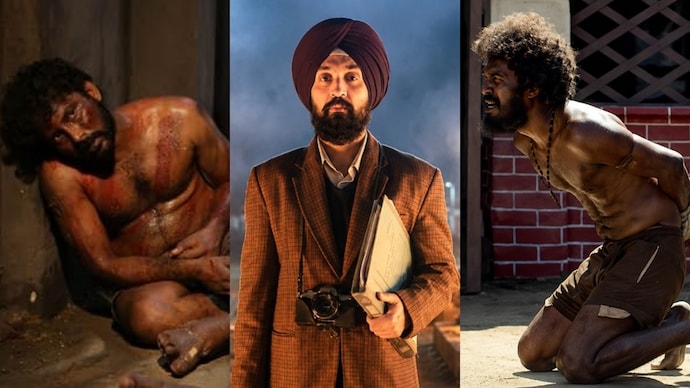
"Kitne baaki hai? (How many are left?)" asks a police officer to his colleague in the chilling opening scene of Diljit Dosanjh's Satluj. A number comes back. Three? Five? It barely registers. Moments earlier, bullets had been fired indiscriminately at unarmed civilians. The count is no longer about people; it is about how many targets remain before the magazine runs empty.
Satluj refuses to turn its policemen into moustache-twirling villains. That is precisely what makes them terrifying. Their brutality is systemic. Disappearances, custodial torture, extrajudicial killings and illegal cremations are treated as routine police work. Human lives are reduced to files, statistics and problems to be erased.
There is no anger, no frenzy, not even hatred. Only an unsettling absence of conscience. Innocent men beg for mercy, but their pleas dissolve into gunfire. The officers do not flinch. They do not hesitate. The camera lingers on expressionless faces carrying out executions as though they were routine administrative tasks. The violence is relentless, but the film's greatest horror lies in showing brutality not as an aberration, but as an institution functioning exactly as intended.
Director Honey Trehan's Satluj, starring Diljit Dosanjh – originally titled Punjab '95 – spent nearly four years in censorship limbo before arriving on ZEE5, stripped of its theatrical release but not its power. The film follows human rights activist Jaswant Singh Khalra (Diljit Dosanjh), a bank employee who begins investigating the suspicious rise in unidentified bodies being cremated across Punjab during the militancy years.
What he uncovers is staggering – an estimated 25,000 people were cremated as "unclaimed" while their families were still searching for them, the result of alleged fake encounters and custodial killings carried out under the cover of anti-insurgency operations.
While Satluj is among the latest films to confront the brutality of the state head-on, it joins a powerful lineage of Indian cinema that has exposed police excesses, custodial violence and the devastating human cost of unchecked power. Here are seven films that dared to look at police brutality in all its variations.
Visaaranai (2016) - Tamil
Director Vetri Maaran's Visaaranai was the film that set the template for unflinching custodial violence in Indian cinema. Based on M Chandrakumar's autobiographical novel Lock Up, Visaaranai follows four Tamil migrant labourers working in Guntur, Andhra Pradesh, who are picked up off the street by local police looking to close a robbery case.
For thirteen days, they are beaten with batons, boots and banana stems - the torture is relentless, documented with a procedural grimness that never tips into spectacle. The men eventually confess to a crime they did not commit, simply to make it stop. In the second half, the story shifts to Tamil Nadu, where the same men are pulled into a different and larger web of police corruption – this time with even less chance of escape. The film ends in gunshots and darkness, with the deaths covered up and repackaged for the press as a heroic encounter.
Director Vetri Maaran won three National Awards for it, and it became India's official Oscar entry in 2016. The actors underwent counselling during filming. Visaaranai's most devastating argument is that the violence is not aberrant - it is the system functioning exactly as designed.
Jai Bhim (2021) – Tamil
Based on a real 1993 case fought by advocate K Chandru (later a Madras High Court judge), Jai Bhim follows Sengeni (Lijomol Jose), an Irula tribal woman whose husband Rajakannu (Manikandan) is arrested on suspicion of theft after he is called to remove a snake from an upper-caste household. Rajakannu and his relatives are picked up, detained and tortured for days to extract a confession. He is then reported as having "escaped" custody.
Sengeni, pregnant and alone, enlists lawyer Chandru (Suriya) to file a habeas corpus petition. What the investigation reveals is that Rajakannu did not escape – he died in the lock-up from injuries sustained during torture, and the police staged his death to look like a road accident. In one of the film's most disturbing scenes, chilli powder is sprinkled into unconscious men's eyes to check if they are still alive. The violence in Jai Bhim is inseparable from caste – the police act with impunity precisely because Rajakannu's community has no political leverage, no money and no voice.
Karnan (2021) – Tamil
Inspired by the 1995 Kodiyankulam incident, in which police unleashed organised violence on a Dalit village in Tamil Nadu, Director Mari Selvaraj's Karnan, starring Dhanush, is set in the fictional village of Podiyankulam - a Dalit community denied even a bus stop, forcing its people to use the stop in a neighbouring dominant-caste village where they are routinely humiliated. When the young, hotheaded Karnan (Dhanush) rallies his village against a series of injustices, IPS officer SP Kannabiran, a man who believes the caste hierarchy is natural and correct, decides to make an example of them.
He summons the village elders to the police station under the pretence of resolving a dispute, then beats them for an hour and locks them up overnight. When the conflict escalates, police raid the village in force, beating everyone in sight, sparing no one. Most of the older village heads succumb to their injuries in the years that follow.
The police in Karnan are not rogue officers, they are instruments of a caste order that the system exists to protect, and Mari Selvaraj does not let you forget it for a single frame.
Nayattu (2021) – Malayalam
Written by civil police officer Shahi Kabir, director Martin Prakkat's Nayattu turns the police brutality narrative inside out. Three officers, CPO Praveen (Kunchacko Boban), sub-inspector Maniyan (Joju George) and constable Sunitha (Nimisha Sajayan), get into a scuffle with a local political goon connected to a Dalit organisation. The goon dies in an accident shortly after. With elections approaching and the CM needing the community's support, political pressure mounts to frame the three officers for murder.
They go on the run. What unfolds is a thriller about how the same system that produces brutality against ordinary people can just as quickly devour its own. The three officers are not innocent, they are complicit in the system they are now fleeing, and Nayattu holds that discomfort without resolving it. The most disturbing thing in the film is not the violence but the speed at which the truth of an event is buried the moment power needs a different story.
Santosh (2024) – Hindi
A British-Indian production that the Indian censor board refused to certify for theatrical release without cuts, which the makers declined to make. Director Sandhya Suri's Santosh follows a young widow (Shahana Goswami) who inherits her deceased husband's job as a police constable in rural North India under a government compassionate appointment scheme. When a low-caste girl is found raped and murdered, Santosh is drawn into the investigation under the wing of Inspector Sharma (Sunita Rajwar).
What the film reveals, quietly and without dramatic flourish, is how thoroughly casteism and Islamophobia are embedded in the police's approach to the case – who gets investigated, who gets protected, whose life is considered worth solving? In one of the film's most chilling sequences, Santosh herself, pushed beyond her limits, participates in the very brutality she has been watching. Sandhya Suri is not interested in individual bad cops, she is interested in what an entire system produces when prejudice goes all the way down.
Mai Ghat: Crime No 103/2005 (2019) – Marathi
The most quietly devastating film on this list. Based on the true story of Prabhavati Amma, a washerwoman from Thiruvananthapuram whose son Udayakumar was picked up by police from a park with a friend, accused of stealing Rs 4,200 that was, in fact, his mother's savings from doing laundry. He was tortured to death in custody.
Mai Ghat, directed by Anant Mahadevan, follows Prabhavati (Usha Jadhav) through thirteen years of legal struggle - witnesses turning hostile, cases dismissed, appeals and petitions – until a special CBI court sentenced the guilty policemen to death, a historic first in India. Mahadevan never shows the torture on screen. He lets the aftermath carry everything: a mother's silence, a lifetime of washing other people's clothes on the ghat, the cost of a fight that took thirteen years and gave her back a verdict but not her son. This is a film about what custodial violence does to the people left behind, and it lands harder for never showing you the act itself.
Article 15 (2019) – Hindi
Loosely inspired by the 2014 Badaun gang rape case, in which two Dalit girls were found raped and hanged from a tree in Uttar Pradesh, director Anubhav Sinha's Article 15 follows IPS officer Ayan Ranjan (Ayushmann Khurrana), newly posted to a small town in UP, who investigates the murder of three Dalit girls. The brutality here is not in the lock-up, it is in the institution itself. One of the perpetrators of the rape and murder turns out to be a police constable. The coroner suppresses her real autopsy findings under pressure and files a false report. Local officers work to classify the case as an honour killing and shut it down.
A factory owner casually admits to beating the girls for demanding a Rs 3 wage hike, and nobody in the station sees anything worth reporting in that. What Ayan is up against is not a few corrupt individuals but a police force that has never been asked to treat Dalit lives as worth protecting, and has arranged all its paperwork accordingly.
Anubhav Sinha names what he is going after directly: Article 15 of the Constitution, which prohibits discrimination on the grounds of caste, gets pasted on the station bulletin board as an indictment. It remains one of the few mainstream Hindi films to put caste at the absolute centre of a story this directly and this unflinchingly.
"Kitne baaki hai? (How many are left?)" asks a police officer to his colleague in the chilling opening scene of Diljit Dosanjh's Satluj. A number comes back. Three? Five? It barely registers. Moments earlier, bullets had been fired indiscriminately at unarmed civilians. The count is no longer about people; it is about how many targets remain before the magazine runs empty.
Satluj refuses to turn its policemen into moustache-twirling villains. That is precisely what makes them terrifying. Their brutality is systemic. Disappearances, custodial torture, extrajudicial killings and illegal cremations are treated as routine police work. Human lives are reduced to files, statistics and problems to be erased.
There is no anger, no frenzy, not even hatred. Only an unsettling absence of conscience. Innocent men beg for mercy, but their pleas dissolve into gunfire. The officers do not flinch. They do not hesitate. The camera lingers on expressionless faces carrying out executions as though they were routine administrative tasks. The violence is relentless, but the film's greatest horror lies in showing brutality not as an aberration, but as an institution functioning exactly as intended.
Director Honey Trehan's Satluj, starring Diljit Dosanjh – originally titled Punjab '95 – spent nearly four years in censorship limbo before arriving on ZEE5, stripped of its theatrical release but not its power. The film follows human rights activist Jaswant Singh Khalra (Diljit Dosanjh), a bank employee who begins investigating the suspicious rise in unidentified bodies being cremated across Punjab during the militancy years.
What he uncovers is staggering – an estimated 25,000 people were cremated as "unclaimed" while their families were still searching for them, the result of alleged fake encounters and custodial killings carried out under the cover of anti-insurgency operations.
While Satluj is among the latest films to confront the brutality of the state head-on, it joins a powerful lineage of Indian cinema that has exposed police excesses, custodial violence and the devastating human cost of unchecked power. Here are seven films that dared to look at police brutality in all its variations.
Visaaranai (2016) - Tamil
Director Vetri Maaran's Visaaranai was the film that set the template for unflinching custodial violence in Indian cinema. Based on M Chandrakumar's autobiographical novel Lock Up, Visaaranai follows four Tamil migrant labourers working in Guntur, Andhra Pradesh, who are picked up off the street by local police looking to close a robbery case.
For thirteen days, they are beaten with batons, boots and banana stems - the torture is relentless, documented with a procedural grimness that never tips into spectacle. The men eventually confess to a crime they did not commit, simply to make it stop. In the second half, the story shifts to Tamil Nadu, where the same men are pulled into a different and larger web of police corruption – this time with even less chance of escape. The film ends in gunshots and darkness, with the deaths covered up and repackaged for the press as a heroic encounter.
Director Vetri Maaran won three National Awards for it, and it became India's official Oscar entry in 2016. The actors underwent counselling during filming. Visaaranai's most devastating argument is that the violence is not aberrant - it is the system functioning exactly as designed.
Jai Bhim (2021) – Tamil
Based on a real 1993 case fought by advocate K Chandru (later a Madras High Court judge), Jai Bhim follows Sengeni (Lijomol Jose), an Irula tribal woman whose husband Rajakannu (Manikandan) is arrested on suspicion of theft after he is called to remove a snake from an upper-caste household. Rajakannu and his relatives are picked up, detained and tortured for days to extract a confession. He is then reported as having "escaped" custody.
Sengeni, pregnant and alone, enlists lawyer Chandru (Suriya) to file a habeas corpus petition. What the investigation reveals is that Rajakannu did not escape – he died in the lock-up from injuries sustained during torture, and the police staged his death to look like a road accident. In one of the film's most disturbing scenes, chilli powder is sprinkled into unconscious men's eyes to check if they are still alive. The violence in Jai Bhim is inseparable from caste – the police act with impunity precisely because Rajakannu's community has no political leverage, no money and no voice.
Karnan (2021) – Tamil
Inspired by the 1995 Kodiyankulam incident, in which police unleashed organised violence on a Dalit village in Tamil Nadu, Director Mari Selvaraj's Karnan, starring Dhanush, is set in the fictional village of Podiyankulam - a Dalit community denied even a bus stop, forcing its people to use the stop in a neighbouring dominant-caste village where they are routinely humiliated. When the young, hotheaded Karnan (Dhanush) rallies his village against a series of injustices, IPS officer SP Kannabiran, a man who believes the caste hierarchy is natural and correct, decides to make an example of them.
He summons the village elders to the police station under the pretence of resolving a dispute, then beats them for an hour and locks them up overnight. When the conflict escalates, police raid the village in force, beating everyone in sight, sparing no one. Most of the older village heads succumb to their injuries in the years that follow.
The police in Karnan are not rogue officers, they are instruments of a caste order that the system exists to protect, and Mari Selvaraj does not let you forget it for a single frame.
Nayattu (2021) – Malayalam
Written by civil police officer Shahi Kabir, director Martin Prakkat's Nayattu turns the police brutality narrative inside out. Three officers, CPO Praveen (Kunchacko Boban), sub-inspector Maniyan (Joju George) and constable Sunitha (Nimisha Sajayan), get into a scuffle with a local political goon connected to a Dalit organisation. The goon dies in an accident shortly after. With elections approaching and the CM needing the community's support, political pressure mounts to frame the three officers for murder.
They go on the run. What unfolds is a thriller about how the same system that produces brutality against ordinary people can just as quickly devour its own. The three officers are not innocent, they are complicit in the system they are now fleeing, and Nayattu holds that discomfort without resolving it. The most disturbing thing in the film is not the violence but the speed at which the truth of an event is buried the moment power needs a different story.
Santosh (2024) – Hindi
A British-Indian production that the Indian censor board refused to certify for theatrical release without cuts, which the makers declined to make. Director Sandhya Suri's Santosh follows a young widow (Shahana Goswami) who inherits her deceased husband's job as a police constable in rural North India under a government compassionate appointment scheme. When a low-caste girl is found raped and murdered, Santosh is drawn into the investigation under the wing of Inspector Sharma (Sunita Rajwar).
What the film reveals, quietly and without dramatic flourish, is how thoroughly casteism and Islamophobia are embedded in the police's approach to the case – who gets investigated, who gets protected, whose life is considered worth solving? In one of the film's most chilling sequences, Santosh herself, pushed beyond her limits, participates in the very brutality she has been watching. Sandhya Suri is not interested in individual bad cops, she is interested in what an entire system produces when prejudice goes all the way down.
Mai Ghat: Crime No 103/2005 (2019) – Marathi
The most quietly devastating film on this list. Based on the true story of Prabhavati Amma, a washerwoman from Thiruvananthapuram whose son Udayakumar was picked up by police from a park with a friend, accused of stealing Rs 4,200 that was, in fact, his mother's savings from doing laundry. He was tortured to death in custody.
Mai Ghat, directed by Anant Mahadevan, follows Prabhavati (Usha Jadhav) through thirteen years of legal struggle - witnesses turning hostile, cases dismissed, appeals and petitions – until a special CBI court sentenced the guilty policemen to death, a historic first in India. Mahadevan never shows the torture on screen. He lets the aftermath carry everything: a mother's silence, a lifetime of washing other people's clothes on the ghat, the cost of a fight that took thirteen years and gave her back a verdict but not her son. This is a film about what custodial violence does to the people left behind, and it lands harder for never showing you the act itself.
Article 15 (2019) – Hindi
Loosely inspired by the 2014 Badaun gang rape case, in which two Dalit girls were found raped and hanged from a tree in Uttar Pradesh, director Anubhav Sinha's Article 15 follows IPS officer Ayan Ranjan (Ayushmann Khurrana), newly posted to a small town in UP, who investigates the murder of three Dalit girls. The brutality here is not in the lock-up, it is in the institution itself. One of the perpetrators of the rape and murder turns out to be a police constable. The coroner suppresses her real autopsy findings under pressure and files a false report. Local officers work to classify the case as an honour killing and shut it down.
A factory owner casually admits to beating the girls for demanding a Rs 3 wage hike, and nobody in the station sees anything worth reporting in that. What Ayan is up against is not a few corrupt individuals but a police force that has never been asked to treat Dalit lives as worth protecting, and has arranged all its paperwork accordingly.
Anubhav Sinha names what he is going after directly: Article 15 of the Constitution, which prohibits discrimination on the grounds of caste, gets pasted on the station bulletin board as an indictment. It remains one of the few mainstream Hindi films to put caste at the absolute centre of a story this directly and this unflinchingly.

