Centre admits NavIC can't provide navigation services, next launch soon
The Centre has told Parliament that NavIC cannot currently provide standalone positioning services because only three PNT satellites are operational. ISRO is preparing NVS-03 for launch.
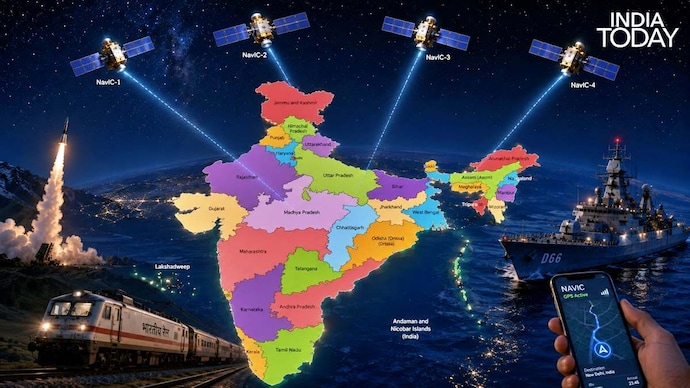
India's indigenous satellite navigation system, NavIC, is currently operating with only three satellites capable of providing Positioning, Navigation and Timing (PNT) services, falling short of the minimum four satellites required to offer standalone positioning services, the government informed Parliament on Wednesday.
Standalone positioning service means a navigation system can determine your location using only its own satellites, without relying on GPS or any other global navigation system.
In a written reply in the Lok Sabha, Union Minister of State for Space Dr. Jitendra Singh said that after the completion of the 10-year mission life of IRNSS-1F, the operational NavIC constellation now has only IRNSS-1B, IRNSS-1I and NVS-01 providing PNT services.
The minister said that while standalone positioning services are currently unavailable, NavIC's timing service continues to function normally.
"To provide basic positioning service, a minimum of four operational satellites are required in orbit. Hence, the NavIC constellation cannot provide standalone positioning service; however, timing service is functional," Singh said.
Despite the reduced constellation, the government said there is no operational vulnerability for users because NavIC is now used in a multi-constellation Global Navigation Satellite System (GNSS) environment, alongside systems such as GPS, Galileo and GLONASS.
The Armed Forces are also using multi-constellation GNSS, including NavIC, to support operational requirements.
To restore the constellation, ISRO has lined up new satellites. The minister said that NVS-03 is ready for launch, while NVS-04 and NVS-05 are in advanced stages of realisation.
The update comes as ISRO works to strengthen India's second-generation NavIC network following setbacks in recent years.
The agency successfully launched NVS-01 in 2023, but the subsequent NVS-02 mission encountered propulsion-related issues that prevented the satellite from reaching its intended operational orbit.
The upcoming launches are expected to rebuild the constellation, restore standalone navigation capability and enhance the reliability of India's homegrown satellite navigation system, which provides positioning, navigation and precise timing services across India and regions extending about 1,500 km beyond its borders.
India's indigenous satellite navigation system, NavIC, is currently operating with only three satellites capable of providing Positioning, Navigation and Timing (PNT) services, falling short of the minimum four satellites required to offer standalone positioning services, the government informed Parliament on Wednesday.
Standalone positioning service means a navigation system can determine your location using only its own satellites, without relying on GPS or any other global navigation system.
In a written reply in the Lok Sabha, Union Minister of State for Space Dr. Jitendra Singh said that after the completion of the 10-year mission life of IRNSS-1F, the operational NavIC constellation now has only IRNSS-1B, IRNSS-1I and NVS-01 providing PNT services.
The minister said that while standalone positioning services are currently unavailable, NavIC's timing service continues to function normally.
"To provide basic positioning service, a minimum of four operational satellites are required in orbit. Hence, the NavIC constellation cannot provide standalone positioning service; however, timing service is functional," Singh said.
Despite the reduced constellation, the government said there is no operational vulnerability for users because NavIC is now used in a multi-constellation Global Navigation Satellite System (GNSS) environment, alongside systems such as GPS, Galileo and GLONASS.
The Armed Forces are also using multi-constellation GNSS, including NavIC, to support operational requirements.
To restore the constellation, ISRO has lined up new satellites. The minister said that NVS-03 is ready for launch, while NVS-04 and NVS-05 are in advanced stages of realisation.
The update comes as ISRO works to strengthen India's second-generation NavIC network following setbacks in recent years.
The agency successfully launched NVS-01 in 2023, but the subsequent NVS-02 mission encountered propulsion-related issues that prevented the satellite from reaching its intended operational orbit.
The upcoming launches are expected to rebuild the constellation, restore standalone navigation capability and enhance the reliability of India's homegrown satellite navigation system, which provides positioning, navigation and precise timing services across India and regions extending about 1,500 km beyond its borders.
India's indigenous satellite navigation system, NavIC, is currently operating with only three satellites capable of providing Positioning, Navigation and Timing (PNT) services, falling short of the minimum four satellites required to offer standalone positioning services, the government informed Parliament on Wednesday.
Standalone positioning service means a navigation system can determine your location using only its own satellites, without relying on GPS or any other global navigation system.
In a written reply in the Lok Sabha, Union Minister of State for Space Dr. Jitendra Singh said that after the completion of the 10-year mission life of IRNSS-1F, the operational NavIC constellation now has only IRNSS-1B, IRNSS-1I and NVS-01 providing PNT services.
The minister said that while standalone positioning services are currently unavailable, NavIC's timing service continues to function normally.
"To provide basic positioning service, a minimum of four operational satellites are required in orbit. Hence, the NavIC constellation cannot provide standalone positioning service; however, timing service is functional," Singh said.
Despite the reduced constellation, the government said there is no operational vulnerability for users because NavIC is now used in a multi-constellation Global Navigation Satellite System (GNSS) environment, alongside systems such as GPS, Galileo and GLONASS.
The Armed Forces are also using multi-constellation GNSS, including NavIC, to support operational requirements.
To restore the constellation, ISRO has lined up new satellites. The minister said that NVS-03 is ready for launch, while NVS-04 and NVS-05 are in advanced stages of realisation.
The update comes as ISRO works to strengthen India's second-generation NavIC network following setbacks in recent years.
The agency successfully launched NVS-01 in 2023, but the subsequent NVS-02 mission encountered propulsion-related issues that prevented the satellite from reaching its intended operational orbit.
The upcoming launches are expected to rebuild the constellation, restore standalone navigation capability and enhance the reliability of India's homegrown satellite navigation system, which provides positioning, navigation and precise timing services across India and regions extending about 1,500 km beyond its borders.

