Uneven monsoon takes a toll: India's reservoirs have 63% less water than 2025
India's major reservoirs are only 32.38% full despite the monsoon covering the entire country. Here's what experts have to say about India's worsening water crisis, and whether something can be done.
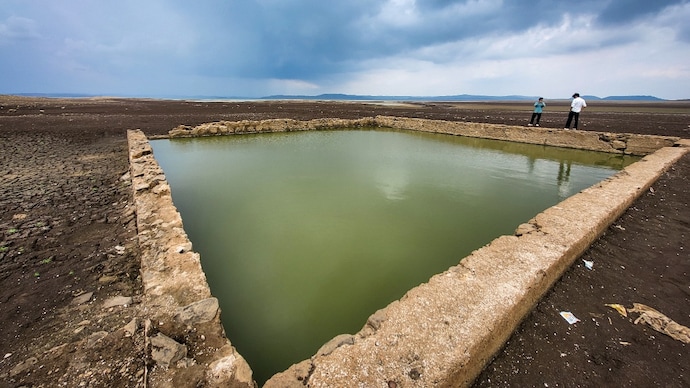
Even as the southwest monsoon has covered the entirety of India, the country's water reserves remain worryingly low.
The monsoon downpours, though intense in various regions, have been vastly uneven.
According to the Central Water Commission (CWC), 166 major reservoirs across the country are currently filled to just 32.38% of their total capacity, as compared to last year.
While this is an improvement from 26% a week ago, experts said that it is far from reassuring as climate change makes rainfall increasingly erratic and intensifies pressure on drinking water, agriculture, industry and groundwater.
Assessing the situation, experts have warned that the real challenge is no longer just storing more water but also learning to use it wisely.
DEMAND OUTPACING SUPPLY
Speaking to PTI, Syamal Sarkar, former secretary in the Ministry of Water Resources and now an advisor with TERI's water division, said India's water demand has already outstripped available supply across domestic, industrial and agricultural sectors.
"On supply, storage is key. Major dams currently hold about 250 billion cubic metres, and this can rise substantially through ongoing government initiatives," he said. "On demand, the question is how to manage needs when supply falls short, something India, like most countries, has historically neglected in favour of supply-side fixes."
Sarkar noted that India's per capita water availability has plunged from around 5,000 cubic metres in 1950 to nearly 1,500 cubic metres today.
Since any figure below 1,700 cubic metres is internationally considered water-stressed, he said India has already crossed that threshold and is steadily moving towards the 1,000-cubic-metre mark that translates to water scarcity.
Highlighting the scale of wastage, Sarkar said a person needs only 2-3 litres of drinking water daily, yet Delhi supplies around 165 litres per person every day, most of which is used for bathing, washing and other purposes without being reused.
In contrast, Israel recycles 60-70% of its water for agriculture.
"NITI Aayog projects that by 2050, India's water demand will be double the available supply," Sarkar said, stressing that better demand management must go hand in hand with expanding storage.
CLIMATE CHANGE HITS INDIA'S WATER
Climate change has made the monsoon increasingly unpredictable, with no fixed pattern in either rainfall timing or intensity, Sarkar said.
Excess rainfall triggers floods, while weak monsoons lead to droughts and falling groundwater levels.
Initiatives such as Mission Amrit Sarovar, rainwater harvesting, the Krishi Sanchay Yojana have improved irrigation efficiency to boost water security.
At present, only about 8% of India's rainwater is stored, while irrigation systems use just 30-40% of the water they draw effectively.
Sushmita Sengupta of the Centre for Science and Environment (CSE) told PTI that cities also need to revive lakes, ponds, local water bodies and decentralised water systems instead of depending almost entirely on long-distance piped supply.
"India depended on rainfall since ancient times, but the British arrival marked a shift toward piped taps," she said.
She added that as local water bodies deteriorated and groundwater was over-extracted, cities increasingly began sourcing water from over 90-150 kilometres away.
Climate change has further worsened the situation by leaving reservoirs depleted, while long-distance pipelines lose 40-50% of water through leakage.
"The result is empty reservoirs with no easy alternative," Sengupta said.
Experts said India's growing water challenge now requires a two-pronged strategy.
A strategy that explores expanding storage while simultaneously reducing waste through rainwater harvesting, wastewater reuse, efficient irrigation and the restoration of local water systems.
Even as the southwest monsoon has covered the entirety of India, the country's water reserves remain worryingly low.
The monsoon downpours, though intense in various regions, have been vastly uneven.
According to the Central Water Commission (CWC), 166 major reservoirs across the country are currently filled to just 32.38% of their total capacity, as compared to last year.
While this is an improvement from 26% a week ago, experts said that it is far from reassuring as climate change makes rainfall increasingly erratic and intensifies pressure on drinking water, agriculture, industry and groundwater.
Assessing the situation, experts have warned that the real challenge is no longer just storing more water but also learning to use it wisely.
DEMAND OUTPACING SUPPLY
Speaking to PTI, Syamal Sarkar, former secretary in the Ministry of Water Resources and now an advisor with TERI's water division, said India's water demand has already outstripped available supply across domestic, industrial and agricultural sectors.
"On supply, storage is key. Major dams currently hold about 250 billion cubic metres, and this can rise substantially through ongoing government initiatives," he said. "On demand, the question is how to manage needs when supply falls short, something India, like most countries, has historically neglected in favour of supply-side fixes."
Sarkar noted that India's per capita water availability has plunged from around 5,000 cubic metres in 1950 to nearly 1,500 cubic metres today.
Since any figure below 1,700 cubic metres is internationally considered water-stressed, he said India has already crossed that threshold and is steadily moving towards the 1,000-cubic-metre mark that translates to water scarcity.
Highlighting the scale of wastage, Sarkar said a person needs only 2-3 litres of drinking water daily, yet Delhi supplies around 165 litres per person every day, most of which is used for bathing, washing and other purposes without being reused.
In contrast, Israel recycles 60-70% of its water for agriculture.
"NITI Aayog projects that by 2050, India's water demand will be double the available supply," Sarkar said, stressing that better demand management must go hand in hand with expanding storage.
CLIMATE CHANGE HITS INDIA'S WATER
Climate change has made the monsoon increasingly unpredictable, with no fixed pattern in either rainfall timing or intensity, Sarkar said.
Excess rainfall triggers floods, while weak monsoons lead to droughts and falling groundwater levels.
Initiatives such as Mission Amrit Sarovar, rainwater harvesting, the Krishi Sanchay Yojana have improved irrigation efficiency to boost water security.
At present, only about 8% of India's rainwater is stored, while irrigation systems use just 30-40% of the water they draw effectively.
Sushmita Sengupta of the Centre for Science and Environment (CSE) told PTI that cities also need to revive lakes, ponds, local water bodies and decentralised water systems instead of depending almost entirely on long-distance piped supply.
"India depended on rainfall since ancient times, but the British arrival marked a shift toward piped taps," she said.
She added that as local water bodies deteriorated and groundwater was over-extracted, cities increasingly began sourcing water from over 90-150 kilometres away.
Climate change has further worsened the situation by leaving reservoirs depleted, while long-distance pipelines lose 40-50% of water through leakage.
"The result is empty reservoirs with no easy alternative," Sengupta said.
Experts said India's growing water challenge now requires a two-pronged strategy.
A strategy that explores expanding storage while simultaneously reducing waste through rainwater harvesting, wastewater reuse, efficient irrigation and the restoration of local water systems.

