Satellite spots ships towing Starship floating in middle of Indian Ocean. See pics
Satellite images show recovery vessels towing SpaceX's floating Starship prototype in the Indian Ocean. The rare retrieval of Ship 40 could offer crucial data on re-entry survival and reuse.
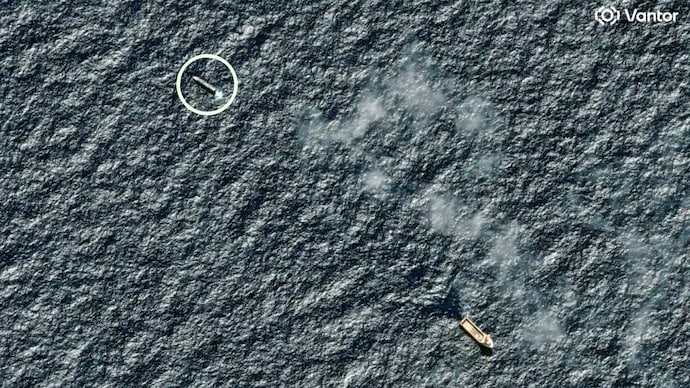
Satellite images have captured an extraordinary scene in the middle of the Indian Ocean, where multiple recovery vessels are working to tow SpaceX's Starship prototype after it achieved its most successful ocean landing to date.
The spacecraft, known as Ship 40, flew during SpaceX's 13th fully integrated Starship test flight on July 24.
While the company had not planned to recover the upper-stage vehicle, the mission ended with an unexpectedly gentle splashdown that left the spacecraft floating on the ocean instead of sinking, marking a major milestone for the reusable rocket program.
Fresh satellite imagery captured on August 2 and 3 by Colorado-based geospatial intelligence company Vantor shows recovery vessels surrounding the spacecraft. Images reveal Norwegian tugboats Normand Ranger and Skimmer Tide positioned alongside SpaceX's support ship Go Australis, with what appears to be a tow line attached to Starship's nose.
The recovery effort gained momentum after SpaceX CEO Elon Musk confirmed on July 28 that the company would attempt to retrieve the vehicle.
Ship tracking data indicated that the tugboats were moving at roughly one knot while broadcasting restricted manoeuvrability, suggesting towing operations had begun. Go Australis has since departed the recovery site and is returning to Australia.
The successful recovery attempt follows what SpaceX described as the "softest" Starship splashdown yet. Unlike previous prototypes that sank shortly after landing, Ship 40 remained airtight and buoyant, allowing engineers a rare opportunity to inspect a spacecraft that survived atmospheric re-entry and ocean landing largely intact.
Recovering Ship 40 could provide invaluable data on the performance of Starship's heat shield, which protects the vehicle from temperatures generated during re-entry at speeds exceeding 28,000 km/h.
Engineers are particularly interested in assessing the ceramic heat shield tiles and overall structural condition after flight.
The mission represents another step toward SpaceX's long-term goal of making Starship a rapidly reusable launch system capable of supporting future Moon and Mars missions while dramatically reducing the cost of access to space.
Satellite images have captured an extraordinary scene in the middle of the Indian Ocean, where multiple recovery vessels are working to tow SpaceX's Starship prototype after it achieved its most successful ocean landing to date.
The spacecraft, known as Ship 40, flew during SpaceX's 13th fully integrated Starship test flight on July 24.
While the company had not planned to recover the upper-stage vehicle, the mission ended with an unexpectedly gentle splashdown that left the spacecraft floating on the ocean instead of sinking, marking a major milestone for the reusable rocket program.
Fresh satellite imagery captured on August 2 and 3 by Colorado-based geospatial intelligence company Vantor shows recovery vessels surrounding the spacecraft. Images reveal Norwegian tugboats Normand Ranger and Skimmer Tide positioned alongside SpaceX's support ship Go Australis, with what appears to be a tow line attached to Starship's nose.
The recovery effort gained momentum after SpaceX CEO Elon Musk confirmed on July 28 that the company would attempt to retrieve the vehicle.
Ship tracking data indicated that the tugboats were moving at roughly one knot while broadcasting restricted manoeuvrability, suggesting towing operations had begun. Go Australis has since departed the recovery site and is returning to Australia.
The successful recovery attempt follows what SpaceX described as the "softest" Starship splashdown yet. Unlike previous prototypes that sank shortly after landing, Ship 40 remained airtight and buoyant, allowing engineers a rare opportunity to inspect a spacecraft that survived atmospheric re-entry and ocean landing largely intact.
Recovering Ship 40 could provide invaluable data on the performance of Starship's heat shield, which protects the vehicle from temperatures generated during re-entry at speeds exceeding 28,000 km/h.
Engineers are particularly interested in assessing the ceramic heat shield tiles and overall structural condition after flight.
The mission represents another step toward SpaceX's long-term goal of making Starship a rapidly reusable launch system capable of supporting future Moon and Mars missions while dramatically reducing the cost of access to space.
Satellite images have captured an extraordinary scene in the middle of the Indian Ocean, where multiple recovery vessels are working to tow SpaceX's Starship prototype after it achieved its most successful ocean landing to date.
The spacecraft, known as Ship 40, flew during SpaceX's 13th fully integrated Starship test flight on July 24.
While the company had not planned to recover the upper-stage vehicle, the mission ended with an unexpectedly gentle splashdown that left the spacecraft floating on the ocean instead of sinking, marking a major milestone for the reusable rocket program.
Fresh satellite imagery captured on August 2 and 3 by Colorado-based geospatial intelligence company Vantor shows recovery vessels surrounding the spacecraft. Images reveal Norwegian tugboats Normand Ranger and Skimmer Tide positioned alongside SpaceX's support ship Go Australis, with what appears to be a tow line attached to Starship's nose.
The recovery effort gained momentum after SpaceX CEO Elon Musk confirmed on July 28 that the company would attempt to retrieve the vehicle.
Ship tracking data indicated that the tugboats were moving at roughly one knot while broadcasting restricted manoeuvrability, suggesting towing operations had begun. Go Australis has since departed the recovery site and is returning to Australia.
The successful recovery attempt follows what SpaceX described as the "softest" Starship splashdown yet. Unlike previous prototypes that sank shortly after landing, Ship 40 remained airtight and buoyant, allowing engineers a rare opportunity to inspect a spacecraft that survived atmospheric re-entry and ocean landing largely intact.
Recovering Ship 40 could provide invaluable data on the performance of Starship's heat shield, which protects the vehicle from temperatures generated during re-entry at speeds exceeding 28,000 km/h.
Engineers are particularly interested in assessing the ceramic heat shield tiles and overall structural condition after flight.
The mission represents another step toward SpaceX's long-term goal of making Starship a rapidly reusable launch system capable of supporting future Moon and Mars missions while dramatically reducing the cost of access to space.

