What happens behind the scenes at military wives' parties?
For many civilians, military wives are synonymous with officers' mess parties and Ladies' Nights. Their lives, however, revolve just as much around repeated relocations, rebuilding careers, raising families, welfare work and creating support systems wherever the next posting takes them.
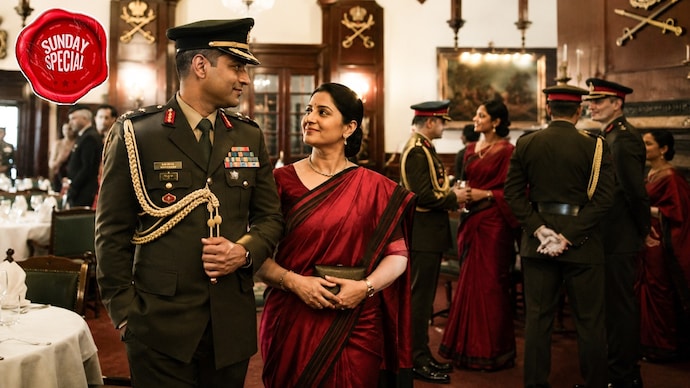


"People think we are these butterflies who are just doing parties and attending the Ladies' Club. But it is not that," said Parveen Brar, wife of a retired Brigadier in the Indian Army. She paused for a moment, sighed, and added, "There is a lot of hard work that goes into being a military spouse."
Few images of military life are as enduring as the officers' mess party. Crisp ceremonial uniforms. Sarees. Champagne and wine toasts. Formal dinners. The occasional themed evening. Regimental insignias hanging from the roofs, and the wooden ballroom that accommodates it all. In films and TV shows, scenes highlighting these aspects have long created an impression for the civilians — that while officers defend the country's borders, their spouses socialise, organise events, party, and wait for their husbands to return home.
It is an image that military spouses say captures only a fraction of their lives.
Beyond that is a life that frequently sees transfers, has the challenge of starting over every few years, and long stretches apart from their spouses. Unlike the trope presented in films, military wives are professionals, entrepreneurs, teachers, lawyers, consultants, and women who work remotely. While some choose to be homemakers as they move from one posting to another, they are still deeply involved in welfare work, while others balance those responsibilities with careers of their own.
Popular culture has long romanticised the idea of being married to a man or a woman in uniform. Service in the Armed Forces carries a certain admiration. But the narrative often stops there, especially reducing military spouses to an extension of their husbands instead of recognising that they have identities, aspirations and accomplishments of their own.
India Today Digital spoke to the wives of a retired Brigadier, a Lt Colonel, an Air Vice Marshal and a Lt Commander in the Navy to understand what lies behind the familiar image of military spouses.
Their stories are different, but they all make the same point. "We are complete individuals in our own right," Brar said, adding, "Being an Army wife is just another feather in your cap. It doesn't become your entire identity."
That distinction often disappears in popular culture.
If you're wondering why this story focusses on women as military spouses, here's why. While the number of women officers in the Indian Armed Forces has grown to around 11,000 with expanding opportunities and greater institutional inclusion, men continue to make up the overwhelming majority of the officer cadre. As a result, this story primarily focusses on the experiences of military wives.
Parveen Brar, who also runs a defence matrimony platform, said that in her experience, marriages between women officers and civilian men remain extremely uncommon. "I've seen plenty of officers marrying fellow officers, but I can't recall coming across a woman officer marrying a civilian man," she told India Today Digital.
BEYOND THE OFFICER'S MESS
The social life of military stations is among the most visible aspects of life in uniform. Annual dinners, regimental functions, cultural evenings and themed gatherings happen time to time, and that somewhat reinforces the idea that military spouses spend much of their time attending events.
In all fairness, these events do exist. But they are only one piece of a much larger ecosystem.
"The Ladies' Club is not just pretty women in neatly draped sarees having coffee and brunch together," Brar said. "There is a lot of actual work that goes on there," she added.
Much of that work revolves around welfare.
For decades, spouses' organisations across the Army, Air Force and Navy, have functioned as support networks for military families. While each service has its own structure — the Army Women's Welfare Association (AWWA), the Air Force Wives Welfare Association (AFWWA) and the Navy Welfare and Wellness Association (NWWA) — their activities are centred around welfare.
Each of these organisations, all of them non-profit, help families settle into new stations, organise educational programmes, support widows of soldiers killed in the line of duty (Veer Naris), run vocational initiatives, assist children with special needs and create community networks that become particularly important during long field postings.
The social gatherings that attract public attention also double up as platforms for a slew of things.
"Contrary to the popular perception, these gatherings are not simply social parties or 'kitty parties'," said Anahita Mehta [name changed], wife of an Air Vice Marshal.
"A typical event includes welcoming newly posted families, farewells for outgoing members, cultural performances, charity fundraisers, exhibitions run by spouses, talks on health, parenting, financial planning or wellness, and celebrations of national festivals," Mehta told India Today Digital.
"You don't have Nari Shiksha anymore, but when I got married in the 1980s, we used to teach jawans's wives basic English, how to sign documents and how to manage everyday tasks like banking. That was one of the ways military spouses contributed to welfare at the time," Brar explained.
The welfare work extends beyond all this. At many military stations, spouses also contribute through handicraft initiatives that help raise funds for welfare activities.
"The unit provides the material, and the women make handcrafted items such as tablecloths and handkerchiefs. These are then sold at exhibitions or AWWA counters in military canteens, and the proceeds go back into welfare activities for families and children. It's one way of ensuring that something made by the community benefits the community," Brar explained.
The events, she says, serve another purpose that is less visible to outsiders. "They help build support networks among military families," Mehta also said.
Several military spouses, speaking on the condition of anonymity, told India Today Digital that while joining welfare associations is not mandatory, participation in the social life of a unit is often seen as an important part of military life. Remaining visibly disengaged or openly dismissive of these conventions, they said, can be viewed unfavourably and is widely believed to reflect not just on the spouse, but on the officer as well.
That expectation is reinforced by a well-established social hierarchy. At official gatherings, protocol often mirrors military rank, with seating arrangements, receiving lines and interactions reflecting seniority. Younger spouses are expected to learn these conventions over time, treating senior officers' spouses with the same deference accorded to rank within the service.
STARTING OVER EVERY FEW YEARS
If there is one part of military life that nearly every spouse mentions first, it is moving. Every posting means another city, another home, another school, another neighbourhood and another set of friendships.
"Moving every three years is very hard," Brar said. "The children are more or less brought up single-handedly by the wife because the husband is so busy. There are exercises, field postings and long periods when you're living alone with the children," she added.
The relocation itself rarely ends with one move.
Families often shift first into temporary accommodation before moving again into permanent housing once it becomes available. "Technically, we're doing this every six or seven months," Brar said.
Beginning again is perhaps the greatest skill military spouses learn.
Starting over doesn't just mean setting up a new home; it often means rebuilding a career as well.
Teaching has long been a common profession among military wives. Vacancies in government and Army Public Schools are regularly shared through welfare associations such as AWWA, NWWA, and AFWWA. For many, teaching offers a degree of continuity in a life of frequent transfers, with a broadly similar curriculum and nature of work across postings.
Packing and unpacking become routine. Often, when the officer has already moved to the next posting or is away on duty, it falls on the spouses to oversee the entire move and set up the household in a new city. If the family is moving to a peace station, the transition is relatively easier. But when the posting is in a remote or operationally sensitive area such as Kashmir or parts of the Northeast, the challenges are much more.
Even with the logistical support that the military provides, relocations are rarely seamless.
"Things get lost in transit all the time, from beds to dining table to and entire set of chairs. It's frustrating, but you learn to deal with it," said the wife of a Lieutenant Commander in the Indian Navy, who has seen two postings along the eastern coast of India within a year. The bigger adjustment, she says, is settling into an entirely new environment.
"One posting could be in Srinagar in Jammu and Kashmir, and the next in Wellington in Tamil Nadu," explained Brar. More often than not, the responsibility of setting up a new home, helping the family settle in and adapting to an unfamiliar environment falls on the spouse while the officer is busy with the new assignment.
"Sometimes you throw things away because you don't know whether it's worth packing them," Brar said, adding, "It's like spring-cleaning every few years."
Yet, the rhythm of military life creates communities that are close-knit. "Though I am not a part of NWWA yet, I know that social gatherings like Ladies' Night and the parties are less about socialising for their own sake and more about building relationships that often become a family's support system during long separations," the wife of the Lt Commander said.
"When you've moved enough times, you know exactly what a newly arrived family is going through," the Navy officer's wife explained. "It's at these parties and ladies' night where people reach out. Someone tells you where the good schools are, another helps you settle in, someone else invites you over for dinner. That support becomes invaluable."
THE INVISIBLE WORK OF MAKING A HOUSE A HOME
Those support networks rarely end when the evening does. These networks make all the difference between arriving at a new station and feeling at home there.
There is a rhythm to these moves. As one family prepares to leave, another arrives. "Before the moving truck has even been unloaded, neighbours often drop by with tea, water or snacks for the workers. Within days, newly arrived spouses are introduced to others in the station and handed an informal guidebook to the place — where to shop, which schools are good, where to find the best tailor, even the local chaat shop," a serving Lt Colonel's wife told India Today Digital.
"You never really arrive in a cantonment alone," said the wife of the Lt Colonel, who has a master's degree in women's studies. "Somebody has already lived that life before you, and hands it over with all the instructions you need to find your way around," she added.
She recalled overseeing two house moves almost entirely on her own while caring for her toddler son. "The ladies would come and say, 'Send him over to us for a while.' My son was practically outsourced," she laughed. "People would force me to take a break because they knew how exhausting it was," she explained.
The emotional burden, she says, changes with time. Leaving the first home she had built after marriage was difficult. So was leaving the house where her son was born. Today, after nearly nine moves, she has developed rituals that make every new house feel familiar. The same table occupies the same corner. The same photographs go up on the same wall. "That's how we cope," she said.
The harder part now is helping her son begin again. At seven, he has already attended six schools. "Earlier, it was my husband helping me through the emotions of moving," she said. "Now, I'm the one helping my son settle into a new routine, a new school and a new life."
It is also the kind of practical advice that gets exchanged over welcome dinners, Ladies' Nights and officers' mess.
THE TRADITIONS, PARTIES HAVE EVOLVED OVER THE YEARS
Brar explained that military social life has become noticeably less formal than it was when she entered the AWWA in the 1980s, but certain traditions continue.
"The newer generation of spouses and officers has brought about that change," said Brar. Brar said that in the 1980s, it was common to see second- and third-generation military officers, but that is far less common today.
One of the traditions that is less talked about is the Bada Khana — a ceremonial meal that brings officers, soldiers and their families together on special occasions. "It is for both officers and jawans," she says. "People meet, interact and share a meal. The officers also spend time with the soldiers and their families," Brar said.
Many stations also organise themed evenings. "You'll have a Goa theme, a Hawaiian theme or even a Texas theme," Brar says. "Those continue even today because they are a good break from the regular ceremonial events," said Brar.
There isn't just Ladies' Night, there is also "Husbands' Night", where spouses organise an evening dedicated to the officers. "There's usually some extra entertainment, like games and small surprises," she says. "It's simply a way of making the evening special," explained Brar.
In the Air Force, cultural evenings often include qawwali, classical music, folk performances and regional showcases.
"At training establishments that host officers from friendly foreign countries, these programmes also become opportunities for informal cultural exchange," Mehta explained. "They help foster goodwill alongside professional military cooperation," she added.
Much of what keeps military communities together happens behind the scenes, and military wives are often at the centre of it. "Reducing military spouses to a single stereotype overlooks the diversity within the community itself," said the wife of a Lieutenant Commander in the Indian Navy.
The officers' mess parties might be the most visible part of military life, but behind every welcome dinner and themed evening is a world that is rarely talked about.
Perhaps that is why Brar's first response lingered throughout the conversation.
"People think we are these butterflies who are just doing parties," she had said.
By the end of the conversation, the butterflies had all but disappeared.
"People think we are these butterflies who are just doing parties and attending the Ladies' Club. But it is not that," said Parveen Brar, wife of a retired Brigadier in the Indian Army. She paused for a moment, sighed, and added, "There is a lot of hard work that goes into being a military spouse."
Few images of military life are as enduring as the officers' mess party. Crisp ceremonial uniforms. Sarees. Champagne and wine toasts. Formal dinners. The occasional themed evening. Regimental insignias hanging from the roofs, and the wooden ballroom that accommodates it all. In films and TV shows, scenes highlighting these aspects have long created an impression for the civilians — that while officers defend the country's borders, their spouses socialise, organise events, party, and wait for their husbands to return home.
It is an image that military spouses say captures only a fraction of their lives.
Beyond that is a life that frequently sees transfers, has the challenge of starting over every few years, and long stretches apart from their spouses. Unlike the trope presented in films, military wives are professionals, entrepreneurs, teachers, lawyers, consultants, and women who work remotely. While some choose to be homemakers as they move from one posting to another, they are still deeply involved in welfare work, while others balance those responsibilities with careers of their own.
Popular culture has long romanticised the idea of being married to a man or a woman in uniform. Service in the Armed Forces carries a certain admiration. But the narrative often stops there, especially reducing military spouses to an extension of their husbands instead of recognising that they have identities, aspirations and accomplishments of their own.
India Today Digital spoke to the wives of a retired Brigadier, a Lt Colonel, an Air Vice Marshal and a Lt Commander in the Navy to understand what lies behind the familiar image of military spouses.
Their stories are different, but they all make the same point. "We are complete individuals in our own right," Brar said, adding, "Being an Army wife is just another feather in your cap. It doesn't become your entire identity."
That distinction often disappears in popular culture.
If you're wondering why this story focusses on women as military spouses, here's why. While the number of women officers in the Indian Armed Forces has grown to around 11,000 with expanding opportunities and greater institutional inclusion, men continue to make up the overwhelming majority of the officer cadre. As a result, this story primarily focusses on the experiences of military wives.
Parveen Brar, who also runs a defence matrimony platform, said that in her experience, marriages between women officers and civilian men remain extremely uncommon. "I've seen plenty of officers marrying fellow officers, but I can't recall coming across a woman officer marrying a civilian man," she told India Today Digital.
BEYOND THE OFFICER'S MESS
The social life of military stations is among the most visible aspects of life in uniform. Annual dinners, regimental functions, cultural evenings and themed gatherings happen time to time, and that somewhat reinforces the idea that military spouses spend much of their time attending events.
In all fairness, these events do exist. But they are only one piece of a much larger ecosystem.
"The Ladies' Club is not just pretty women in neatly draped sarees having coffee and brunch together," Brar said. "There is a lot of actual work that goes on there," she added.
Much of that work revolves around welfare.
For decades, spouses' organisations across the Army, Air Force and Navy, have functioned as support networks for military families. While each service has its own structure — the Army Women's Welfare Association (AWWA), the Air Force Wives Welfare Association (AFWWA) and the Navy Welfare and Wellness Association (NWWA) — their activities are centred around welfare.
Each of these organisations, all of them non-profit, help families settle into new stations, organise educational programmes, support widows of soldiers killed in the line of duty (Veer Naris), run vocational initiatives, assist children with special needs and create community networks that become particularly important during long field postings.
The social gatherings that attract public attention also double up as platforms for a slew of things.
"Contrary to the popular perception, these gatherings are not simply social parties or 'kitty parties'," said Anahita Mehta [name changed], wife of an Air Vice Marshal.
"A typical event includes welcoming newly posted families, farewells for outgoing members, cultural performances, charity fundraisers, exhibitions run by spouses, talks on health, parenting, financial planning or wellness, and celebrations of national festivals," Mehta told India Today Digital.
"You don't have Nari Shiksha anymore, but when I got married in the 1980s, we used to teach jawans's wives basic English, how to sign documents and how to manage everyday tasks like banking. That was one of the ways military spouses contributed to welfare at the time," Brar explained.
The welfare work extends beyond all this. At many military stations, spouses also contribute through handicraft initiatives that help raise funds for welfare activities.
"The unit provides the material, and the women make handcrafted items such as tablecloths and handkerchiefs. These are then sold at exhibitions or AWWA counters in military canteens, and the proceeds go back into welfare activities for families and children. It's one way of ensuring that something made by the community benefits the community," Brar explained.
The events, she says, serve another purpose that is less visible to outsiders. "They help build support networks among military families," Mehta also said.
Several military spouses, speaking on the condition of anonymity, told India Today Digital that while joining welfare associations is not mandatory, participation in the social life of a unit is often seen as an important part of military life. Remaining visibly disengaged or openly dismissive of these conventions, they said, can be viewed unfavourably and is widely believed to reflect not just on the spouse, but on the officer as well.
That expectation is reinforced by a well-established social hierarchy. At official gatherings, protocol often mirrors military rank, with seating arrangements, receiving lines and interactions reflecting seniority. Younger spouses are expected to learn these conventions over time, treating senior officers' spouses with the same deference accorded to rank within the service.
STARTING OVER EVERY FEW YEARS
If there is one part of military life that nearly every spouse mentions first, it is moving. Every posting means another city, another home, another school, another neighbourhood and another set of friendships.
"Moving every three years is very hard," Brar said. "The children are more or less brought up single-handedly by the wife because the husband is so busy. There are exercises, field postings and long periods when you're living alone with the children," she added.
The relocation itself rarely ends with one move.
Families often shift first into temporary accommodation before moving again into permanent housing once it becomes available. "Technically, we're doing this every six or seven months," Brar said.
Beginning again is perhaps the greatest skill military spouses learn.
Starting over doesn't just mean setting up a new home; it often means rebuilding a career as well.
Teaching has long been a common profession among military wives. Vacancies in government and Army Public Schools are regularly shared through welfare associations such as AWWA, NWWA, and AFWWA. For many, teaching offers a degree of continuity in a life of frequent transfers, with a broadly similar curriculum and nature of work across postings.
Packing and unpacking become routine. Often, when the officer has already moved to the next posting or is away on duty, it falls on the spouses to oversee the entire move and set up the household in a new city. If the family is moving to a peace station, the transition is relatively easier. But when the posting is in a remote or operationally sensitive area such as Kashmir or parts of the Northeast, the challenges are much more.
Even with the logistical support that the military provides, relocations are rarely seamless.
"Things get lost in transit all the time, from beds to dining table to and entire set of chairs. It's frustrating, but you learn to deal with it," said the wife of a Lieutenant Commander in the Indian Navy, who has seen two postings along the eastern coast of India within a year. The bigger adjustment, she says, is settling into an entirely new environment.
"One posting could be in Srinagar in Jammu and Kashmir, and the next in Wellington in Tamil Nadu," explained Brar. More often than not, the responsibility of setting up a new home, helping the family settle in and adapting to an unfamiliar environment falls on the spouse while the officer is busy with the new assignment.
"Sometimes you throw things away because you don't know whether it's worth packing them," Brar said, adding, "It's like spring-cleaning every few years."
Yet, the rhythm of military life creates communities that are close-knit. "Though I am not a part of NWWA yet, I know that social gatherings like Ladies' Night and the parties are less about socialising for their own sake and more about building relationships that often become a family's support system during long separations," the wife of the Lt Commander said.
"When you've moved enough times, you know exactly what a newly arrived family is going through," the Navy officer's wife explained. "It's at these parties and ladies' night where people reach out. Someone tells you where the good schools are, another helps you settle in, someone else invites you over for dinner. That support becomes invaluable."
THE INVISIBLE WORK OF MAKING A HOUSE A HOME
Those support networks rarely end when the evening does. These networks make all the difference between arriving at a new station and feeling at home there.
There is a rhythm to these moves. As one family prepares to leave, another arrives. "Before the moving truck has even been unloaded, neighbours often drop by with tea, water or snacks for the workers. Within days, newly arrived spouses are introduced to others in the station and handed an informal guidebook to the place — where to shop, which schools are good, where to find the best tailor, even the local chaat shop," a serving Lt Colonel's wife told India Today Digital.
"You never really arrive in a cantonment alone," said the wife of the Lt Colonel, who has a master's degree in women's studies. "Somebody has already lived that life before you, and hands it over with all the instructions you need to find your way around," she added.
She recalled overseeing two house moves almost entirely on her own while caring for her toddler son. "The ladies would come and say, 'Send him over to us for a while.' My son was practically outsourced," she laughed. "People would force me to take a break because they knew how exhausting it was," she explained.
The emotional burden, she says, changes with time. Leaving the first home she had built after marriage was difficult. So was leaving the house where her son was born. Today, after nearly nine moves, she has developed rituals that make every new house feel familiar. The same table occupies the same corner. The same photographs go up on the same wall. "That's how we cope," she said.
The harder part now is helping her son begin again. At seven, he has already attended six schools. "Earlier, it was my husband helping me through the emotions of moving," she said. "Now, I'm the one helping my son settle into a new routine, a new school and a new life."
It is also the kind of practical advice that gets exchanged over welcome dinners, Ladies' Nights and officers' mess.
THE TRADITIONS, PARTIES HAVE EVOLVED OVER THE YEARS
Brar explained that military social life has become noticeably less formal than it was when she entered the AWWA in the 1980s, but certain traditions continue.
"The newer generation of spouses and officers has brought about that change," said Brar. Brar said that in the 1980s, it was common to see second- and third-generation military officers, but that is far less common today.
One of the traditions that is less talked about is the Bada Khana — a ceremonial meal that brings officers, soldiers and their families together on special occasions. "It is for both officers and jawans," she says. "People meet, interact and share a meal. The officers also spend time with the soldiers and their families," Brar said.
Many stations also organise themed evenings. "You'll have a Goa theme, a Hawaiian theme or even a Texas theme," Brar says. "Those continue even today because they are a good break from the regular ceremonial events," said Brar.
There isn't just Ladies' Night, there is also "Husbands' Night", where spouses organise an evening dedicated to the officers. "There's usually some extra entertainment, like games and small surprises," she says. "It's simply a way of making the evening special," explained Brar.
In the Air Force, cultural evenings often include qawwali, classical music, folk performances and regional showcases.
"At training establishments that host officers from friendly foreign countries, these programmes also become opportunities for informal cultural exchange," Mehta explained. "They help foster goodwill alongside professional military cooperation," she added.
Much of what keeps military communities together happens behind the scenes, and military wives are often at the centre of it. "Reducing military spouses to a single stereotype overlooks the diversity within the community itself," said the wife of a Lieutenant Commander in the Indian Navy.
The officers' mess parties might be the most visible part of military life, but behind every welcome dinner and themed evening is a world that is rarely talked about.
Perhaps that is why Brar's first response lingered throughout the conversation.
"People think we are these butterflies who are just doing parties," she had said.
By the end of the conversation, the butterflies had all but disappeared.

