China's Unitree shows a robot that will be terrifying in war if deployed
Unitree has launched the Super Athlete AS2-W, a rugged AI-powered quadruped robot that can sprint across rocks, climb steep slopes and carry cargo. While built for civilian use, its capabilities hint at what future battlefield robots could one day become.
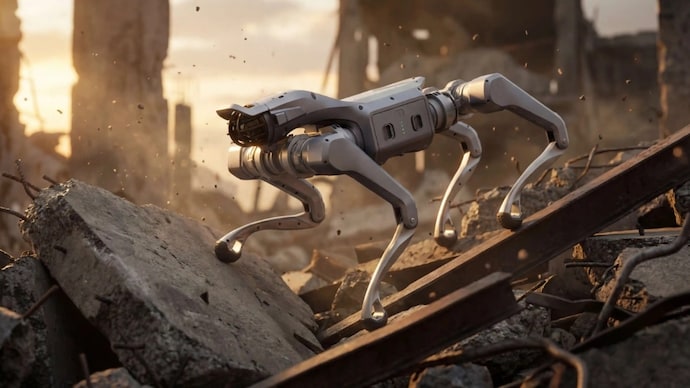
China's robotics company Unitree has unveiled what may be its most capable quadruped robot yet. Called the Unitree Super Athlete AS2-W, the new compact four-legged machine is designed to move across tough terrain that would be difficult for both conventional wheeled vehicles and humans to access.
Introducing the robot in a video posted on X, Unitree shows the AS2-W effortlessly climbing steep rocky trails, splashing through shallow streams, performing quick turns and even flips, all while carrying a backpack. The company says much of its movement is powered by reinforcement learning, allowing the robot to adapt to difficult environments in real time.
Unitree AS2-W specifications
At first glance, the AS2-W looks like another robotic dog which the company has unveiled earlier. But look closer and it is quite different from earlier models. Instead of relying only on feet, the robot combines articulated legs with wheels, giving it the speed of a wheeled vehicle and the terrain-handling ability of a legged robot. According to Unitreee, this hybrid design allows it to roll quickly over flat surfaces before stepping over rocks, climbing slopes and tackling obstacles.
The AS2-W can also carry a continuous payload of up to 16kg and travel more than 30km. The robot weighs around 18kg with its battery and is capable of reaching speeds of more than 5 metres per second. It can climb 25cm stairs, tackle 40-degree slopes, and even negotiate 50cm vertical platforms. It is powered by 12 high-power-density motors, an 8-core high-performance processor, and supports Wi-Fi 6 and Bluetooth 5.2.
The company has also equipped it with a suite of sensors and AI-focused hardware. There is also the option to configure it with LiDAR, a high-definition front camera, microphones, speakers and Unitree's ISS 3.0 intelligent follow system, which the company says enables centimetre-level positioning. There are also developer tools for embodied AI, autonomous decision-making and large AI models, suggesting the platform is meant to be more than just a remote-controlled robot.
Could it have military uses?
Officially, Unitree is pitching the AS2-W as a machine for industrial inspections, logistics, search and rescue, outdoor exploration, research and cargo transport. Its rugged design and ability to traverse terrain that is inaccessible to conventional vehicles could make it useful after natural disasters, in mines, forests and construction sites where humans face greater risks.
However, looking at what the AS2-W is capable of, it is easy to see why a robot like this could become a formidable tool on the battlefield if ever adapted for military use. Its ability to move across rugged terrain, carry payloads and navigate autonomously gives it capabilities that extend well beyond civilian applications.
While Unitree has not announced any defence deployment or military role for the AS2-W, robots with similar mobility could theoretically transport supplies, scout dangerous areas, carry sensors or communications equipment, or assist soldiers in places where conventional vehicles cannot easily operate.
At the very least, the AS2-W shows how far robotics has come. Just a few years ago, most robots were designed for repetitive jobs like joining lego pieces in a controlled environment. Today, machines like the AS2-W show how robots have become faster, smarter and agile enough to work in places that were once too difficult or dangerous for robots. It also offers a glimpse of a future where robots could become everyday companions in industries ranging from logistics and disaster response to exploration and, potentially, even warfare.
They can also potentially carry explosives and run into entrenched positions or vehicles at high speed, almost acting like autonomous missiles or bombs that have ability to smartly and quickly navigate tough terrains.
China's robotics company Unitree has unveiled what may be its most capable quadruped robot yet. Called the Unitree Super Athlete AS2-W, the new compact four-legged machine is designed to move across tough terrain that would be difficult for both conventional wheeled vehicles and humans to access.
Introducing the robot in a video posted on X, Unitree shows the AS2-W effortlessly climbing steep rocky trails, splashing through shallow streams, performing quick turns and even flips, all while carrying a backpack. The company says much of its movement is powered by reinforcement learning, allowing the robot to adapt to difficult environments in real time.
Unitree AS2-W specifications
At first glance, the AS2-W looks like another robotic dog which the company has unveiled earlier. But look closer and it is quite different from earlier models. Instead of relying only on feet, the robot combines articulated legs with wheels, giving it the speed of a wheeled vehicle and the terrain-handling ability of a legged robot. According to Unitreee, this hybrid design allows it to roll quickly over flat surfaces before stepping over rocks, climbing slopes and tackling obstacles.
The AS2-W can also carry a continuous payload of up to 16kg and travel more than 30km. The robot weighs around 18kg with its battery and is capable of reaching speeds of more than 5 metres per second. It can climb 25cm stairs, tackle 40-degree slopes, and even negotiate 50cm vertical platforms. It is powered by 12 high-power-density motors, an 8-core high-performance processor, and supports Wi-Fi 6 and Bluetooth 5.2.
The company has also equipped it with a suite of sensors and AI-focused hardware. There is also the option to configure it with LiDAR, a high-definition front camera, microphones, speakers and Unitree's ISS 3.0 intelligent follow system, which the company says enables centimetre-level positioning. There are also developer tools for embodied AI, autonomous decision-making and large AI models, suggesting the platform is meant to be more than just a remote-controlled robot.
Could it have military uses?
Officially, Unitree is pitching the AS2-W as a machine for industrial inspections, logistics, search and rescue, outdoor exploration, research and cargo transport. Its rugged design and ability to traverse terrain that is inaccessible to conventional vehicles could make it useful after natural disasters, in mines, forests and construction sites where humans face greater risks.
However, looking at what the AS2-W is capable of, it is easy to see why a robot like this could become a formidable tool on the battlefield if ever adapted for military use. Its ability to move across rugged terrain, carry payloads and navigate autonomously gives it capabilities that extend well beyond civilian applications.
While Unitree has not announced any defence deployment or military role for the AS2-W, robots with similar mobility could theoretically transport supplies, scout dangerous areas, carry sensors or communications equipment, or assist soldiers in places where conventional vehicles cannot easily operate.
At the very least, the AS2-W shows how far robotics has come. Just a few years ago, most robots were designed for repetitive jobs like joining lego pieces in a controlled environment. Today, machines like the AS2-W show how robots have become faster, smarter and agile enough to work in places that were once too difficult or dangerous for robots. It also offers a glimpse of a future where robots could become everyday companions in industries ranging from logistics and disaster response to exploration and, potentially, even warfare.
They can also potentially carry explosives and run into entrenched positions or vehicles at high speed, almost acting like autonomous missiles or bombs that have ability to smartly and quickly navigate tough terrains.
China's robotics company Unitree has unveiled what may be its most capable quadruped robot yet. Called the Unitree Super Athlete AS2-W, the new compact four-legged machine is designed to move across tough terrain that would be difficult for both conventional wheeled vehicles and humans to access.
Introducing the robot in a video posted on X, Unitree shows the AS2-W effortlessly climbing steep rocky trails, splashing through shallow streams, performing quick turns and even flips, all while carrying a backpack. The company says much of its movement is powered by reinforcement learning, allowing the robot to adapt to difficult environments in real time.
Unitree AS2-W specifications
At first glance, the AS2-W looks like another robotic dog which the company has unveiled earlier. But look closer and it is quite different from earlier models. Instead of relying only on feet, the robot combines articulated legs with wheels, giving it the speed of a wheeled vehicle and the terrain-handling ability of a legged robot. According to Unitreee, this hybrid design allows it to roll quickly over flat surfaces before stepping over rocks, climbing slopes and tackling obstacles.
The AS2-W can also carry a continuous payload of up to 16kg and travel more than 30km. The robot weighs around 18kg with its battery and is capable of reaching speeds of more than 5 metres per second. It can climb 25cm stairs, tackle 40-degree slopes, and even negotiate 50cm vertical platforms. It is powered by 12 high-power-density motors, an 8-core high-performance processor, and supports Wi-Fi 6 and Bluetooth 5.2.
The company has also equipped it with a suite of sensors and AI-focused hardware. There is also the option to configure it with LiDAR, a high-definition front camera, microphones, speakers and Unitree's ISS 3.0 intelligent follow system, which the company says enables centimetre-level positioning. There are also developer tools for embodied AI, autonomous decision-making and large AI models, suggesting the platform is meant to be more than just a remote-controlled robot.
Could it have military uses?
Officially, Unitree is pitching the AS2-W as a machine for industrial inspections, logistics, search and rescue, outdoor exploration, research and cargo transport. Its rugged design and ability to traverse terrain that is inaccessible to conventional vehicles could make it useful after natural disasters, in mines, forests and construction sites where humans face greater risks.
However, looking at what the AS2-W is capable of, it is easy to see why a robot like this could become a formidable tool on the battlefield if ever adapted for military use. Its ability to move across rugged terrain, carry payloads and navigate autonomously gives it capabilities that extend well beyond civilian applications.
While Unitree has not announced any defence deployment or military role for the AS2-W, robots with similar mobility could theoretically transport supplies, scout dangerous areas, carry sensors or communications equipment, or assist soldiers in places where conventional vehicles cannot easily operate.
At the very least, the AS2-W shows how far robotics has come. Just a few years ago, most robots were designed for repetitive jobs like joining lego pieces in a controlled environment. Today, machines like the AS2-W show how robots have become faster, smarter and agile enough to work in places that were once too difficult or dangerous for robots. It also offers a glimpse of a future where robots could become everyday companions in industries ranging from logistics and disaster response to exploration and, potentially, even warfare.
They can also potentially carry explosives and run into entrenched positions or vehicles at high speed, almost acting like autonomous missiles or bombs that have ability to smartly and quickly navigate tough terrains.

