What changed at Jantar Mantar after July 20? I visited the site 6 times
My six visits to Jantar Mantar changed my perspective on what a protest can become. I marked July 1, July 10, July 15, July 19, July 21 and July 23 to visit the site and witness its evolution firsthand. In recent memory, few demonstrations have reached this scale. What began as an ordinary protest on Day 1 looked completely different by July 23, after the chaos of July 20. Young people from all walks of life arrived in solidarity, looking after one another and taking ownership of the movement.
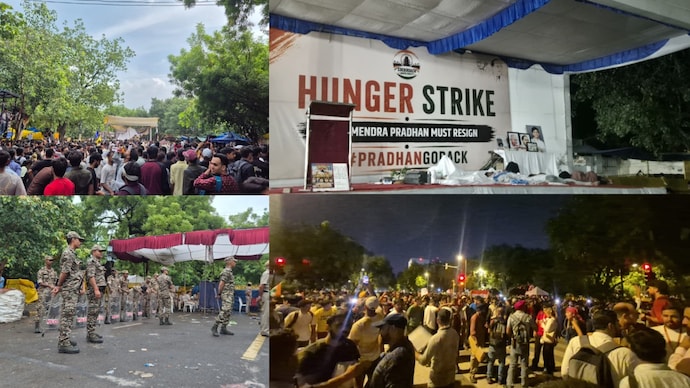
A protest is unfolding in the heat of New Delhi at Jantar Mantar, and its relevance now extends well beyond the capital. Ardian, 19, from South Delhi is calling it "Generation Z's movement", with thousands of young people participating in what is, for many, their first experience of organised dissent. They have spent nights under tarpaulin sheets, discovered that democracy often depends as much on endurance as on elections, and gradually transformed from participants into custodians of the movement.
A paper leak, the Chief Justice's remarks and ensuing developments gave many an opportunity to make them heard as they felt.
The Cockroach Janta Party was formed in May, the founder, Abhijeet Dipke, landed in India on June 6 and, within days on June 25, the protest was announced demanding the resignation of the Education Minister under whom the NEET had been leaked twice.
The youth gathering hopes for change, demands a better education system key to all problems.
Since the protest began in June, its trajectory has exceeded almost every expectation of success.
The July 20 announcement of the march towards Parliament turned tragic for many members of Gen Z, who came to the protest site without even informing their parents.
Many suffered injuries from tear gas shells, while others sustained pellet gun injuries, as exclusively reported by our journalists.
We heard the voices of many innocent protesters, and we also tried to understand from the crowd what was diluting the major issue by bringing other concerns into the movement, as the protest site gradually became a platform for every issue, not just the paper leak or those related to education.
At length, students and young people who had been missing during the first 20 days of the protest began gathering
The protest gained fresh momentum after Sonam Wangchuk joined it, announcing an indefinite hunger strike following his 'Tortoise Walk' to Delhi. The fast ended late on the night of July 23.
What began with barely 500 participants eventually swelled to more than 50,000 people by July, transforming the agitation into one of the largest youth-led demonstrations in recent years.
From Day 1, the sense of responsibility expected of a protest appeared to be missing from the CJP-led agitation, which later evolved into a people's movement. Following the events of July 20, questions were raised about Abhijeet Dipke's accountability and his handling of what transpired that.
"The kind of responsibility expected from someone who claims to be the voice of thousands or lakhs of people includes managing the crowd. People cannot simply be left on their own. As a leader, Mr. Dipke did not act responsibly on several occasions," said Aditya, a 23-year-old freelancer from Gurugram.
The long queues for entry and crowd outside the main protest tells a new story that Gen Z is writing.
FROM JULY 1 TO JULY 22
Between July 1 and July 22, Jantar Mantar was visited 6 times by me not with a camera or mic, and each visit revealed a protest that had changed in ways impossible to grasp from speeches and slogans alone.
The slogans grew more intense each time. Patience seemed to be wearing thin, but so did determination and hope. Yet they continued to believe in the Gandhian way of raising their voice.
After witnessing the atmosphere and energy at Jantar Mantar, it was difficult not to wonder what it might have looked like almost a century ago, when lakhs of people decided to walk behind one man against the British.
Many recited the silent protest as a tool to defeat the establishment, belonging to a different community and not like them.
What initially looked to be another way of mirroring soon grew into a very flexible opportunity. Now the youngsters are in charge of everything at Jantar Mantar.
Volunteers, the young ones, offered medicines to the needy, transported food, collected garbage, guided newcomers through the site and maintained order, not because they were instructed to, but because it felt more like a responsibility and believed the movement depended on them.
Nandini, along with five or six other volunteers, led cleanliness drives, urging people to keep the protest site clean, act responsibly and refrain from using abusive or vulgar language.
For the organisers, however, the central demand never changed.
"Our demand is the resignation of the Education Minister. He is responsible for this entire blunder. Students have lost their lives because of the ministry's failure. Our protest will continue until accountability is fixed and meaningful reforms are implemented," said Sourav Das, spokesperson for CJP.
In early July, the protest was still finding its footing. Volunteers struggled with logistics, food distribution was uneven and enthusiasm often substituted for organisation.
Student organisations such as AISA, AISF and SFI provided much of the initial structure, but over the following weeks the movement expanded well beyond university campuses.
In the early days of the protest, there were no Zomato or Blinkit delivery personnel at the site. The situation changed dramatically after July 20, when support surged.
Food deliveries began arriving from across India and even from abroad, with protesters saying meals had been ordered for them by supporters in countries such as Qatar and Canada.
By the later visits, the crowd had become a cross-section of India. UPSC aspirants stood beside unemployed graduates, college students, schoolchildren who had skipped classes, professionals on leave and families who had travelled overnight to reach Delhi.
Protesters had arrived from Mumbai, Chhattisgarh, Jharkhand, West Bengal, Bihar, Rajasthan and Punjab, many with no organisational affiliation but a shared conviction that they needed to be present.
OVER 60 PROTESTORS, A WIDER VIEW FROM GROUND
Conversations with more than 60 people over five visits offered a firsthand view of the protest's evolution. The first three visits came after newsroom hours, when the speeches had ended and ordinary conversations revealed what the stage often could not.
The fourth followed the events of July 20, while the fifth was spent almost entirely within the rhythm of the protest itself, sharing meals with demonstrators, listening to their stories and briefly joining volunteers who collected nearly 15 kilograms of garbage after the Municipal Corporation of Delhi suspended regular waste collection at the site following July 20.
I was offered food and water bottles and was treated with respect as a member of the press. I was flabbergasted because the reels circulating online painted a picture of the media not being welcomed.
Every single individual I spoke to was attentive and openly shared their views.
Among those volunteers was Nandini from Haldwani, who viewed even cleaning the protest site as part of the movement's larger purpose.
"I am trying to bring more people under one umbrella," she said. "The idea is to fix something that is broken. Our strength lies in our unity."
For Ekanch, a writer from Mumbai who arrived on July 22, the protest represented something more personal than a political campaign.
"I can express everything through my creativity," he said. "Most often, that creativity dies in schools. Something has to change, and we young people have to think about our future."
THE CROWD, THE CONVICTION, THE CHANGE
There is no denying that not everyone joining the protest was associated with the education issue or the paper leak. As the movement gained attention after July 20, the range of demands also widened.
Slogans calling for azaadi, expressions of religious sentiment and the presence of Nihangs at the forefront became part of the protest landscape.
During reporting, we also observed the presence of elements unrelated to the core issue.
There were instances of misbehaviour, the use of abusive language and visible political participation. Leaders and workers associated with Chandrashekhar Ravan's Azad Samaj Party, the Aam Aadmi Party, farmers' unions, women's rights groups and several farmer leaders were also present at the protest site.
What struck me most was the atmosphere. Protesters expressed themselves through posters, rap music, folk songs, poetry and conversation.
Karmesh, a 22-year-old student from Maharashtra, performed songs he had written specifically for the movement, turning the protest site into something that felt as much like a public forum as a political demonstration.
On July 1, media presence was sparse and public support remained limited, but morale was unmistakably high.
The atmosphere after July 20 had transformed.
News of the protest had spread nationally and internationally.
Television crews multiplied, international outlets such as the BBC and Al Jazeera reached the site, and the movement acquired a visibility that few had anticipated in its early days.
The diversity of the crowd reflected that transformation. I met an 84-year-old participant whose resolve had not diminished with age, and a ten-year-old child who could explain why thousands had gathered.
Moksh, a 19-year-old tattoo artist and school dropout, sees the protest as a place for "change." "The site has become a battleground for us. We are fighting for what we deserve, not what they want us to settle for," Moksh told India Today.
The parents of a 21-year-old UPSC aspirant told me they had joined because the protest was no longer simply about an examination leak but about the uncertainty confronting an entire generation.
Not everyone viewed the movement with unqualified optimism. A 73-year-old observer offered a more measured perspective.
"The protest has energy," he said. "These youths are here for change, but change what, the system, the minister or everything? Even if the resignation comes, the larger problems will remain."
The protest itself also became harder to access. With every visit, police presence intensified. Barricades multiplied, frisking became stricter, walk-through scanners appeared and surveillance increased.
Yet inside those barricades, the movement continued to grow. Familiar faces remained, while thousands of newcomers arrived each day.
Among them was Upasna, who travelled from Mumbai with her husband because, in her words, "People must be held accountable. Dharmendra Pradhan should resign and reforms must follow."
Others were less convinced by the movement's internal functioning. Aditya, a marketing professional from Gurugram, argued that its leadership had failed to organise a protest that was rapidly outgrowing itself.
Over nearly four weeks, Jantar Mantar changed dramatically. What began as a relatively modest student-led demonstration evolved into a nationwide movement attracting political leaders, public figures, students, professionals and ordinary citizens.
The hunger strike announced by Sonam Wangchuk which ended late in the night on July 23 brought another surge of participation, while donations transformed makeshift camps into functioning living spaces with mattresses, blankets and community kitchens.
By the end of my sixth visit, it was clear that the protest had become about much more than the resignation of a minister. For many who occupied Jantar Mantar, it had become a space where frustrations accumulated over the years found a collective voice.
The generation leading the protest against the system is demanding accountability. They are far from carefree, demonstrating that they can bring about change through collective action and a spirit of peaceful resistance.
A protest is unfolding in the heat of New Delhi at Jantar Mantar, and its relevance now extends well beyond the capital. Ardian, 19, from South Delhi is calling it "Generation Z's movement", with thousands of young people participating in what is, for many, their first experience of organised dissent. They have spent nights under tarpaulin sheets, discovered that democracy often depends as much on endurance as on elections, and gradually transformed from participants into custodians of the movement.
A paper leak, the Chief Justice's remarks and ensuing developments gave many an opportunity to make them heard as they felt.
The Cockroach Janta Party was formed in May, the founder, Abhijeet Dipke, landed in India on June 6 and, within days on June 25, the protest was announced demanding the resignation of the Education Minister under whom the NEET had been leaked twice.
The youth gathering hopes for change, demands a better education system key to all problems.
Since the protest began in June, its trajectory has exceeded almost every expectation of success.
The July 20 announcement of the march towards Parliament turned tragic for many members of Gen Z, who came to the protest site without even informing their parents.
Many suffered injuries from tear gas shells, while others sustained pellet gun injuries, as exclusively reported by our journalists.
We heard the voices of many innocent protesters, and we also tried to understand from the crowd what was diluting the major issue by bringing other concerns into the movement, as the protest site gradually became a platform for every issue, not just the paper leak or those related to education.
At length, students and young people who had been missing during the first 20 days of the protest began gathering
The protest gained fresh momentum after Sonam Wangchuk joined it, announcing an indefinite hunger strike following his 'Tortoise Walk' to Delhi. The fast ended late on the night of July 23.
What began with barely 500 participants eventually swelled to more than 50,000 people by July, transforming the agitation into one of the largest youth-led demonstrations in recent years.
From Day 1, the sense of responsibility expected of a protest appeared to be missing from the CJP-led agitation, which later evolved into a people's movement. Following the events of July 20, questions were raised about Abhijeet Dipke's accountability and his handling of what transpired that.
"The kind of responsibility expected from someone who claims to be the voice of thousands or lakhs of people includes managing the crowd. People cannot simply be left on their own. As a leader, Mr. Dipke did not act responsibly on several occasions," said Aditya, a 23-year-old freelancer from Gurugram.
The long queues for entry and crowd outside the main protest tells a new story that Gen Z is writing.
FROM JULY 1 TO JULY 22
Between July 1 and July 22, Jantar Mantar was visited 6 times by me not with a camera or mic, and each visit revealed a protest that had changed in ways impossible to grasp from speeches and slogans alone.
The slogans grew more intense each time. Patience seemed to be wearing thin, but so did determination and hope. Yet they continued to believe in the Gandhian way of raising their voice.
After witnessing the atmosphere and energy at Jantar Mantar, it was difficult not to wonder what it might have looked like almost a century ago, when lakhs of people decided to walk behind one man against the British.
Many recited the silent protest as a tool to defeat the establishment, belonging to a different community and not like them.
What initially looked to be another way of mirroring soon grew into a very flexible opportunity. Now the youngsters are in charge of everything at Jantar Mantar.
Volunteers, the young ones, offered medicines to the needy, transported food, collected garbage, guided newcomers through the site and maintained order, not because they were instructed to, but because it felt more like a responsibility and believed the movement depended on them.
Nandini, along with five or six other volunteers, led cleanliness drives, urging people to keep the protest site clean, act responsibly and refrain from using abusive or vulgar language.
For the organisers, however, the central demand never changed.
"Our demand is the resignation of the Education Minister. He is responsible for this entire blunder. Students have lost their lives because of the ministry's failure. Our protest will continue until accountability is fixed and meaningful reforms are implemented," said Sourav Das, spokesperson for CJP.
In early July, the protest was still finding its footing. Volunteers struggled with logistics, food distribution was uneven and enthusiasm often substituted for organisation.
Student organisations such as AISA, AISF and SFI provided much of the initial structure, but over the following weeks the movement expanded well beyond university campuses.
In the early days of the protest, there were no Zomato or Blinkit delivery personnel at the site. The situation changed dramatically after July 20, when support surged.
Food deliveries began arriving from across India and even from abroad, with protesters saying meals had been ordered for them by supporters in countries such as Qatar and Canada.
By the later visits, the crowd had become a cross-section of India. UPSC aspirants stood beside unemployed graduates, college students, schoolchildren who had skipped classes, professionals on leave and families who had travelled overnight to reach Delhi.
Protesters had arrived from Mumbai, Chhattisgarh, Jharkhand, West Bengal, Bihar, Rajasthan and Punjab, many with no organisational affiliation but a shared conviction that they needed to be present.
OVER 60 PROTESTORS, A WIDER VIEW FROM GROUND
Conversations with more than 60 people over five visits offered a firsthand view of the protest's evolution. The first three visits came after newsroom hours, when the speeches had ended and ordinary conversations revealed what the stage often could not.
The fourth followed the events of July 20, while the fifth was spent almost entirely within the rhythm of the protest itself, sharing meals with demonstrators, listening to their stories and briefly joining volunteers who collected nearly 15 kilograms of garbage after the Municipal Corporation of Delhi suspended regular waste collection at the site following July 20.
I was offered food and water bottles and was treated with respect as a member of the press. I was flabbergasted because the reels circulating online painted a picture of the media not being welcomed.
Every single individual I spoke to was attentive and openly shared their views.
Among those volunteers was Nandini from Haldwani, who viewed even cleaning the protest site as part of the movement's larger purpose.
"I am trying to bring more people under one umbrella," she said. "The idea is to fix something that is broken. Our strength lies in our unity."
For Ekanch, a writer from Mumbai who arrived on July 22, the protest represented something more personal than a political campaign.
"I can express everything through my creativity," he said. "Most often, that creativity dies in schools. Something has to change, and we young people have to think about our future."
THE CROWD, THE CONVICTION, THE CHANGE
There is no denying that not everyone joining the protest was associated with the education issue or the paper leak. As the movement gained attention after July 20, the range of demands also widened.
Slogans calling for azaadi, expressions of religious sentiment and the presence of Nihangs at the forefront became part of the protest landscape.
During reporting, we also observed the presence of elements unrelated to the core issue.
There were instances of misbehaviour, the use of abusive language and visible political participation. Leaders and workers associated with Chandrashekhar Ravan's Azad Samaj Party, the Aam Aadmi Party, farmers' unions, women's rights groups and several farmer leaders were also present at the protest site.
What struck me most was the atmosphere. Protesters expressed themselves through posters, rap music, folk songs, poetry and conversation.
Karmesh, a 22-year-old student from Maharashtra, performed songs he had written specifically for the movement, turning the protest site into something that felt as much like a public forum as a political demonstration.
On July 1, media presence was sparse and public support remained limited, but morale was unmistakably high.
The atmosphere after July 20 had transformed.
News of the protest had spread nationally and internationally.
Television crews multiplied, international outlets such as the BBC and Al Jazeera reached the site, and the movement acquired a visibility that few had anticipated in its early days.
The diversity of the crowd reflected that transformation. I met an 84-year-old participant whose resolve had not diminished with age, and a ten-year-old child who could explain why thousands had gathered.
Moksh, a 19-year-old tattoo artist and school dropout, sees the protest as a place for "change." "The site has become a battleground for us. We are fighting for what we deserve, not what they want us to settle for," Moksh told India Today.
The parents of a 21-year-old UPSC aspirant told me they had joined because the protest was no longer simply about an examination leak but about the uncertainty confronting an entire generation.
Not everyone viewed the movement with unqualified optimism. A 73-year-old observer offered a more measured perspective.
"The protest has energy," he said. "These youths are here for change, but change what, the system, the minister or everything? Even if the resignation comes, the larger problems will remain."
The protest itself also became harder to access. With every visit, police presence intensified. Barricades multiplied, frisking became stricter, walk-through scanners appeared and surveillance increased.
Yet inside those barricades, the movement continued to grow. Familiar faces remained, while thousands of newcomers arrived each day.
Among them was Upasna, who travelled from Mumbai with her husband because, in her words, "People must be held accountable. Dharmendra Pradhan should resign and reforms must follow."
Others were less convinced by the movement's internal functioning. Aditya, a marketing professional from Gurugram, argued that its leadership had failed to organise a protest that was rapidly outgrowing itself.
Over nearly four weeks, Jantar Mantar changed dramatically. What began as a relatively modest student-led demonstration evolved into a nationwide movement attracting political leaders, public figures, students, professionals and ordinary citizens.
The hunger strike announced by Sonam Wangchuk which ended late in the night on July 23 brought another surge of participation, while donations transformed makeshift camps into functioning living spaces with mattresses, blankets and community kitchens.
By the end of my sixth visit, it was clear that the protest had become about much more than the resignation of a minister. For many who occupied Jantar Mantar, it had become a space where frustrations accumulated over the years found a collective voice.
The generation leading the protest against the system is demanding accountability. They are far from carefree, demonstrating that they can bring about change through collective action and a spirit of peaceful resistance.
A protest is unfolding in the heat of New Delhi at Jantar Mantar, and its relevance now extends well beyond the capital. Ardian, 19, from South Delhi is calling it "Generation Z's movement", with thousands of young people participating in what is, for many, their first experience of organised dissent. They have spent nights under tarpaulin sheets, discovered that democracy often depends as much on endurance as on elections, and gradually transformed from participants into custodians of the movement.
A paper leak, the Chief Justice's remarks and ensuing developments gave many an opportunity to make them heard as they felt.
The Cockroach Janta Party was formed in May, the founder, Abhijeet Dipke, landed in India on June 6 and, within days on June 25, the protest was announced demanding the resignation of the Education Minister under whom the NEET had been leaked twice.
The youth gathering hopes for change, demands a better education system key to all problems.
Since the protest began in June, its trajectory has exceeded almost every expectation of success.
The July 20 announcement of the march towards Parliament turned tragic for many members of Gen Z, who came to the protest site without even informing their parents.
Many suffered injuries from tear gas shells, while others sustained pellet gun injuries, as exclusively reported by our journalists.
We heard the voices of many innocent protesters, and we also tried to understand from the crowd what was diluting the major issue by bringing other concerns into the movement, as the protest site gradually became a platform for every issue, not just the paper leak or those related to education.
At length, students and young people who had been missing during the first 20 days of the protest began gathering
The protest gained fresh momentum after Sonam Wangchuk joined it, announcing an indefinite hunger strike following his 'Tortoise Walk' to Delhi. The fast ended late on the night of July 23.
What began with barely 500 participants eventually swelled to more than 50,000 people by July, transforming the agitation into one of the largest youth-led demonstrations in recent years.
From Day 1, the sense of responsibility expected of a protest appeared to be missing from the CJP-led agitation, which later evolved into a people's movement. Following the events of July 20, questions were raised about Abhijeet Dipke's accountability and his handling of what transpired that.
"The kind of responsibility expected from someone who claims to be the voice of thousands or lakhs of people includes managing the crowd. People cannot simply be left on their own. As a leader, Mr. Dipke did not act responsibly on several occasions," said Aditya, a 23-year-old freelancer from Gurugram.
The long queues for entry and crowd outside the main protest tells a new story that Gen Z is writing.
FROM JULY 1 TO JULY 22
Between July 1 and July 22, Jantar Mantar was visited 6 times by me not with a camera or mic, and each visit revealed a protest that had changed in ways impossible to grasp from speeches and slogans alone.
The slogans grew more intense each time. Patience seemed to be wearing thin, but so did determination and hope. Yet they continued to believe in the Gandhian way of raising their voice.
After witnessing the atmosphere and energy at Jantar Mantar, it was difficult not to wonder what it might have looked like almost a century ago, when lakhs of people decided to walk behind one man against the British.
Many recited the silent protest as a tool to defeat the establishment, belonging to a different community and not like them.
What initially looked to be another way of mirroring soon grew into a very flexible opportunity. Now the youngsters are in charge of everything at Jantar Mantar.
Volunteers, the young ones, offered medicines to the needy, transported food, collected garbage, guided newcomers through the site and maintained order, not because they were instructed to, but because it felt more like a responsibility and believed the movement depended on them.
Nandini, along with five or six other volunteers, led cleanliness drives, urging people to keep the protest site clean, act responsibly and refrain from using abusive or vulgar language.
For the organisers, however, the central demand never changed.
"Our demand is the resignation of the Education Minister. He is responsible for this entire blunder. Students have lost their lives because of the ministry's failure. Our protest will continue until accountability is fixed and meaningful reforms are implemented," said Sourav Das, spokesperson for CJP.
In early July, the protest was still finding its footing. Volunteers struggled with logistics, food distribution was uneven and enthusiasm often substituted for organisation.
Student organisations such as AISA, AISF and SFI provided much of the initial structure, but over the following weeks the movement expanded well beyond university campuses.
In the early days of the protest, there were no Zomato or Blinkit delivery personnel at the site. The situation changed dramatically after July 20, when support surged.
Food deliveries began arriving from across India and even from abroad, with protesters saying meals had been ordered for them by supporters in countries such as Qatar and Canada.
By the later visits, the crowd had become a cross-section of India. UPSC aspirants stood beside unemployed graduates, college students, schoolchildren who had skipped classes, professionals on leave and families who had travelled overnight to reach Delhi.
Protesters had arrived from Mumbai, Chhattisgarh, Jharkhand, West Bengal, Bihar, Rajasthan and Punjab, many with no organisational affiliation but a shared conviction that they needed to be present.
OVER 60 PROTESTORS, A WIDER VIEW FROM GROUND
Conversations with more than 60 people over five visits offered a firsthand view of the protest's evolution. The first three visits came after newsroom hours, when the speeches had ended and ordinary conversations revealed what the stage often could not.
The fourth followed the events of July 20, while the fifth was spent almost entirely within the rhythm of the protest itself, sharing meals with demonstrators, listening to their stories and briefly joining volunteers who collected nearly 15 kilograms of garbage after the Municipal Corporation of Delhi suspended regular waste collection at the site following July 20.
I was offered food and water bottles and was treated with respect as a member of the press. I was flabbergasted because the reels circulating online painted a picture of the media not being welcomed.
Every single individual I spoke to was attentive and openly shared their views.
Among those volunteers was Nandini from Haldwani, who viewed even cleaning the protest site as part of the movement's larger purpose.
"I am trying to bring more people under one umbrella," she said. "The idea is to fix something that is broken. Our strength lies in our unity."
For Ekanch, a writer from Mumbai who arrived on July 22, the protest represented something more personal than a political campaign.
"I can express everything through my creativity," he said. "Most often, that creativity dies in schools. Something has to change, and we young people have to think about our future."
THE CROWD, THE CONVICTION, THE CHANGE
There is no denying that not everyone joining the protest was associated with the education issue or the paper leak. As the movement gained attention after July 20, the range of demands also widened.
Slogans calling for azaadi, expressions of religious sentiment and the presence of Nihangs at the forefront became part of the protest landscape.
During reporting, we also observed the presence of elements unrelated to the core issue.
There were instances of misbehaviour, the use of abusive language and visible political participation. Leaders and workers associated with Chandrashekhar Ravan's Azad Samaj Party, the Aam Aadmi Party, farmers' unions, women's rights groups and several farmer leaders were also present at the protest site.
What struck me most was the atmosphere. Protesters expressed themselves through posters, rap music, folk songs, poetry and conversation.
Karmesh, a 22-year-old student from Maharashtra, performed songs he had written specifically for the movement, turning the protest site into something that felt as much like a public forum as a political demonstration.
On July 1, media presence was sparse and public support remained limited, but morale was unmistakably high.
The atmosphere after July 20 had transformed.
News of the protest had spread nationally and internationally.
Television crews multiplied, international outlets such as the BBC and Al Jazeera reached the site, and the movement acquired a visibility that few had anticipated in its early days.
The diversity of the crowd reflected that transformation. I met an 84-year-old participant whose resolve had not diminished with age, and a ten-year-old child who could explain why thousands had gathered.
Moksh, a 19-year-old tattoo artist and school dropout, sees the protest as a place for "change." "The site has become a battleground for us. We are fighting for what we deserve, not what they want us to settle for," Moksh told India Today.
The parents of a 21-year-old UPSC aspirant told me they had joined because the protest was no longer simply about an examination leak but about the uncertainty confronting an entire generation.
Not everyone viewed the movement with unqualified optimism. A 73-year-old observer offered a more measured perspective.
"The protest has energy," he said. "These youths are here for change, but change what, the system, the minister or everything? Even if the resignation comes, the larger problems will remain."
The protest itself also became harder to access. With every visit, police presence intensified. Barricades multiplied, frisking became stricter, walk-through scanners appeared and surveillance increased.
Yet inside those barricades, the movement continued to grow. Familiar faces remained, while thousands of newcomers arrived each day.
Among them was Upasna, who travelled from Mumbai with her husband because, in her words, "People must be held accountable. Dharmendra Pradhan should resign and reforms must follow."
Others were less convinced by the movement's internal functioning. Aditya, a marketing professional from Gurugram, argued that its leadership had failed to organise a protest that was rapidly outgrowing itself.
Over nearly four weeks, Jantar Mantar changed dramatically. What began as a relatively modest student-led demonstration evolved into a nationwide movement attracting political leaders, public figures, students, professionals and ordinary citizens.
The hunger strike announced by Sonam Wangchuk which ended late in the night on July 23 brought another surge of participation, while donations transformed makeshift camps into functioning living spaces with mattresses, blankets and community kitchens.
By the end of my sixth visit, it was clear that the protest had become about much more than the resignation of a minister. For many who occupied Jantar Mantar, it had become a space where frustrations accumulated over the years found a collective voice.
The generation leading the protest against the system is demanding accountability. They are far from carefree, demonstrating that they can bring about change through collective action and a spirit of peaceful resistance.

