Iran-US war: The three phases that explain how we got here
Why has the Iran-US war flared up again? The answer lies in a ceasefire that resolved little and a strait that has become the conflict's centre of gravity.
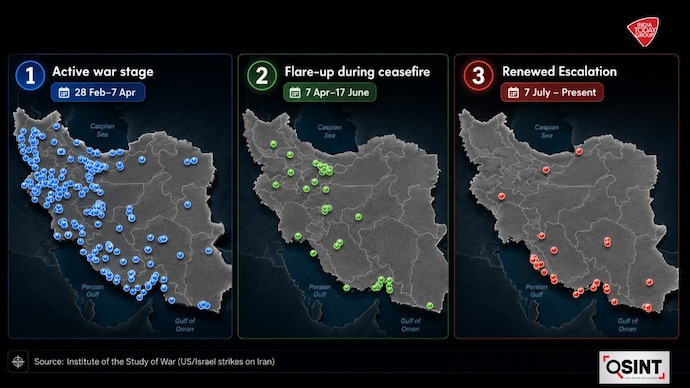


More than four months into the US-Iran conflict, this is no longer the same war. It has changed in both geography and intensity. Rather than one continuous confrontation, it has evolved through three distinct phases, each with its own aggressor and strategic objective.
Military strike patterns and the changing geography of attacks point to a conflict that is being fought on very different terms.
The latest phase began on July 7, when Iranian forces struck commercial vessels off Oman's coast, triggering the heaviest exchange of fire between Washington and Tehran since the ceasefire in early April.
The infographic below by India Today’s OSINT team shows a change in US strike pattern and the intensity against Iran across the three phases of conflict.
India Today Open Source Intelligence (OSINT) team analysed military strike patterns, commercial shipping movements, official statements, the Memorandum of Understanding (MoU), geolocated conflict data and ship-tracking data to reconstruct how the conflict has evolved through three distinct operational phases.
The first was the aggression phase, from February 28, when US and Israeli strikes killed Iran's Supreme Leader Ali Khamenei, to the ceasefire in the first week of April. Washington and Israel were the initiators, and their stated objective of preventing Iran from developing a nuclear weapon gradually evolved into open calls for regime change.
The second was the flare-up phase, running from the ceasefire to the signing of the Memorandum of Understanding (MoU) on June 17. This period was marked by isolated incidents rather than sustained fighting, with both sides keeping their responses limited and their objectives tactical.
The third, and current, re-escalation phase breaks that pattern. For the first time in this war, Iran has struck first and set the terms of the confrontation, targeting commercial vessels along the Omani route through the Strait of Hormuz in an apparent bid to force shipping onto a corridor it seeks to control, with Washington now responding.
The graphic below by India Today shows that while Iran's attacks during the active phase of the war were dispersed across the Persian Gulf and the Strait of Hormuz, the renewed escalation is characterised by a tight concentration of attacks along the US-backed Omani shipping corridor.
WHY THE WAR HAS ENTERED A NEW PHASE
The changing operational tempo is reflected in the Institute for the Study of War (ISW) geolocated events dataset. Between February 28 and April 7, it records more than 1,200 conflict events, reflecting sustained military operations led primarily by Israel, supported by regular U.S. strikes and Iranian retaliation across multiple fronts.
Following the ceasefire, the operational tempo collapsed. Between April 7 and June 17, the ISW dataset records just 54 events. Most were isolated flare-ups linked either to tensions in the Strait of Hormuz or renewed activity on the Israel-Lebanon front, while Israel's operational footprint shrank considerably.
However, the relative lull in the second phase never guaranteed that the conflict would remain contained. Running through the crisis was a more fundamental disagreement over what the Memorandum of Understanding (MoU) actually meant.
Washington has repeatedly claimed that Iran agreed to suspend its nuclear programme, a claim Tehran has never publicly acknowledged. Iran, meanwhile, has consistently argued that Clause 5 gives it a central role in regulating future traffic through the Strait of Hormuz, a position the United States has largely avoided addressing in public.
That difference matters because it changes how each side interprets the current fighting. Tehran increasingly presents its military actions not simply as retaliation, but as enforcement of what it believes are rights recognised under the MoU.
The renewed escalation, therefore, should not come as a surprise. Trump has already declared the ceasefire "over," only to claim hours later that Iran still wants a deal. It would hardly be surprising if he were to argue tomorrow that the latest exchanges still fall "within" the ceasefire because, in that part of the world, firing fewer missiles is often treated as evidence that the ceasefire is holding.
In purely military terms, Trump may not be entirely wrong.
The fighting has not yet returned to the scale witnessed during the opening weeks of the war. Compared with the weeks immediately after the ceasefire, however, the operational tempo has risen sharply.
The post-MoU period marks the real turning point. Israel has remained comparatively restrained, while Iran has increasingly dictated the pace of escalation. The ISW dataset records renewed concentrations of US-attributed military activity in early July, with July 8 and July 12 emerging as the busiest days of the current phase.
Washington's response reflects that change. Since July 7, the United States has launched more than 300 strikes inside Iran, according to US Central Command (CENTCOM). Unlike the ceasefire period, when operations were largely confined to Iran's southern coastline, the latest campaign has expanded deeper into Iranian territory. CENTCOM said the strikes targeted air defence systems, coastal radars, missile and drone capabilities, and IRGC small boats, while marking the first operational use of US one-way attack sea drones alongside fighter aircraft, naval vessels and aerial drones.
HORMUZ IS NOW THE BATTLEFIELD
If the changing operational tempo explains how the war has evolved, the geography of Iran's attacks explains where the conflict is now headed.
During the first phase, Iran's attacks on commercial shipping were dispersed across the Persian Gulf and the Strait of Hormuz. The ceasefire reduced those attacks to isolated incidents.
Since July 7, however, the pattern has changed dramatically. Rather than targeting shipping across the Gulf, Iran has concentrated its attacks around the eastern entrance to the Strait of Hormuz, particularly along the Omani shipping corridor designated by the United States as the preferred route for commercial vessels. CENTCOM continues to insist that international navigation remains open.
That pattern closely mirrors Tehran's objective. Iranian officials argue that future commercial transit should take place through arrangements negotiated by Iran and Oman as part of the Strait's future administration. Concentrating military pressure on the US-backed corridor appears designed not simply to disrupt shipping, but to challenge the credibility of Washington's security architecture while reinforcing Tehran's claim that navigation through Hormuz will ultimately depend on its terms.
Additionally, as the Strait of Hormuz emerged as the central battleground of the war, Iran established the Persian Gulf Strait Authority (PGSA), signalling that its objective had expanded beyond military pressure to building an institutional framework for regulating commercial shipping through the waterway.
While CENTCOM maintains that commercial traffic continues, Kpler ship-tracking data shows only six commercial vessels transited the Strait on Sunday, the lowest daily volume in five weeks.
The changing pattern of attacks, the shifting geography of the battlefield and the evolving strategic objective all point in the same direction: the battlefield might have narrowed, but the stakes have grown. What began as a campaign over Iran's nuclear programme is increasingly becoming a contest over who ultimately determines access to one of the world's most strategically important waterways.
More than four months into the US-Iran conflict, this is no longer the same war. It has changed in both geography and intensity. Rather than one continuous confrontation, it has evolved through three distinct phases, each with its own aggressor and strategic objective.
Military strike patterns and the changing geography of attacks point to a conflict that is being fought on very different terms.
The latest phase began on July 7, when Iranian forces struck commercial vessels off Oman's coast, triggering the heaviest exchange of fire between Washington and Tehran since the ceasefire in early April.
The infographic below by India Today’s OSINT team shows a change in US strike pattern and the intensity against Iran across the three phases of conflict.
India Today Open Source Intelligence (OSINT) team analysed military strike patterns, commercial shipping movements, official statements, the Memorandum of Understanding (MoU), geolocated conflict data and ship-tracking data to reconstruct how the conflict has evolved through three distinct operational phases.
The first was the aggression phase, from February 28, when US and Israeli strikes killed Iran's Supreme Leader Ali Khamenei, to the ceasefire in the first week of April. Washington and Israel were the initiators, and their stated objective of preventing Iran from developing a nuclear weapon gradually evolved into open calls for regime change.
The second was the flare-up phase, running from the ceasefire to the signing of the Memorandum of Understanding (MoU) on June 17. This period was marked by isolated incidents rather than sustained fighting, with both sides keeping their responses limited and their objectives tactical.
The third, and current, re-escalation phase breaks that pattern. For the first time in this war, Iran has struck first and set the terms of the confrontation, targeting commercial vessels along the Omani route through the Strait of Hormuz in an apparent bid to force shipping onto a corridor it seeks to control, with Washington now responding.
The graphic below by India Today shows that while Iran's attacks during the active phase of the war were dispersed across the Persian Gulf and the Strait of Hormuz, the renewed escalation is characterised by a tight concentration of attacks along the US-backed Omani shipping corridor.
WHY THE WAR HAS ENTERED A NEW PHASE
The changing operational tempo is reflected in the Institute for the Study of War (ISW) geolocated events dataset. Between February 28 and April 7, it records more than 1,200 conflict events, reflecting sustained military operations led primarily by Israel, supported by regular U.S. strikes and Iranian retaliation across multiple fronts.
Following the ceasefire, the operational tempo collapsed. Between April 7 and June 17, the ISW dataset records just 54 events. Most were isolated flare-ups linked either to tensions in the Strait of Hormuz or renewed activity on the Israel-Lebanon front, while Israel's operational footprint shrank considerably.
However, the relative lull in the second phase never guaranteed that the conflict would remain contained. Running through the crisis was a more fundamental disagreement over what the Memorandum of Understanding (MoU) actually meant.
Washington has repeatedly claimed that Iran agreed to suspend its nuclear programme, a claim Tehran has never publicly acknowledged. Iran, meanwhile, has consistently argued that Clause 5 gives it a central role in regulating future traffic through the Strait of Hormuz, a position the United States has largely avoided addressing in public.
That difference matters because it changes how each side interprets the current fighting. Tehran increasingly presents its military actions not simply as retaliation, but as enforcement of what it believes are rights recognised under the MoU.
The renewed escalation, therefore, should not come as a surprise. Trump has already declared the ceasefire "over," only to claim hours later that Iran still wants a deal. It would hardly be surprising if he were to argue tomorrow that the latest exchanges still fall "within" the ceasefire because, in that part of the world, firing fewer missiles is often treated as evidence that the ceasefire is holding.
In purely military terms, Trump may not be entirely wrong.
The fighting has not yet returned to the scale witnessed during the opening weeks of the war. Compared with the weeks immediately after the ceasefire, however, the operational tempo has risen sharply.
The post-MoU period marks the real turning point. Israel has remained comparatively restrained, while Iran has increasingly dictated the pace of escalation. The ISW dataset records renewed concentrations of US-attributed military activity in early July, with July 8 and July 12 emerging as the busiest days of the current phase.
Washington's response reflects that change. Since July 7, the United States has launched more than 300 strikes inside Iran, according to US Central Command (CENTCOM). Unlike the ceasefire period, when operations were largely confined to Iran's southern coastline, the latest campaign has expanded deeper into Iranian territory. CENTCOM said the strikes targeted air defence systems, coastal radars, missile and drone capabilities, and IRGC small boats, while marking the first operational use of US one-way attack sea drones alongside fighter aircraft, naval vessels and aerial drones.
HORMUZ IS NOW THE BATTLEFIELD
If the changing operational tempo explains how the war has evolved, the geography of Iran's attacks explains where the conflict is now headed.
During the first phase, Iran's attacks on commercial shipping were dispersed across the Persian Gulf and the Strait of Hormuz. The ceasefire reduced those attacks to isolated incidents.
Since July 7, however, the pattern has changed dramatically. Rather than targeting shipping across the Gulf, Iran has concentrated its attacks around the eastern entrance to the Strait of Hormuz, particularly along the Omani shipping corridor designated by the United States as the preferred route for commercial vessels. CENTCOM continues to insist that international navigation remains open.
That pattern closely mirrors Tehran's objective. Iranian officials argue that future commercial transit should take place through arrangements negotiated by Iran and Oman as part of the Strait's future administration. Concentrating military pressure on the US-backed corridor appears designed not simply to disrupt shipping, but to challenge the credibility of Washington's security architecture while reinforcing Tehran's claim that navigation through Hormuz will ultimately depend on its terms.
Additionally, as the Strait of Hormuz emerged as the central battleground of the war, Iran established the Persian Gulf Strait Authority (PGSA), signalling that its objective had expanded beyond military pressure to building an institutional framework for regulating commercial shipping through the waterway.
While CENTCOM maintains that commercial traffic continues, Kpler ship-tracking data shows only six commercial vessels transited the Strait on Sunday, the lowest daily volume in five weeks.
The changing pattern of attacks, the shifting geography of the battlefield and the evolving strategic objective all point in the same direction: the battlefield might have narrowed, but the stakes have grown. What began as a campaign over Iran's nuclear programme is increasingly becoming a contest over who ultimately determines access to one of the world's most strategically important waterways.

