
He spent 27 years in ITI classrooms. Now, this Tamil Nadu teacher is rethinking lessons

Many ITI students find technical concepts difficult but respond better to hands-on learning. Tamil Nadu instructor Kester Dason is bridging this gap through quizzes, digital tools and interactive classroom activities after nearly 27 years in vocational education.
 Last UpdatedNov 28, 2026 10:53 IST
 Published by
A blackboard can sometimes make a learner hesitant, while a workshop can bring out an entirely different side. Kester Dason has witnessed this transformation among his ITI trainees. It inspired the instructor, who has spent nearly 27 years in vocational education, to find ways of making classroom learning more interactive.
A 12-day residential training programme in August 2025 proved to be a turning point for Kester, an instructor at an Industrial Training Institute (ITI) in Tamil Nadu. As reported by The Better India, the programme introduced him to new ways of engaging students and prompted him to rethink how lessons were delivered.
He began looking for ways to make technical concepts easier to grasp by involving trainees in the learning process. Instead of relying on one-way instruction, he encouraged discussion, questions and classroom activities that allowed students to learn through participation.
WHEN THE WORKSHOP WAS MORE INTERESTING THAN THE CLASSROOM
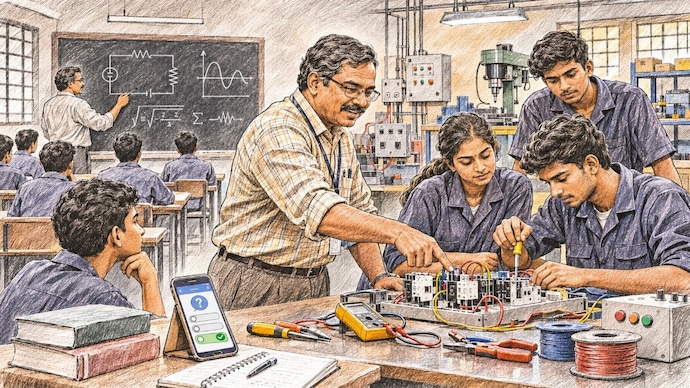
For Kester, the biggest challenge was getting trainees to connect with subjects they often found difficult. Teaching wireman courses at an ITI in Tamil Nadu, he works with students, many of whom have studied only up to Class 8 before joining the institute. Mathematical calculations, formulas and technical explanations can sometimes leave them struggling to keep up.
But the picture changes in the workshop. When given wires, tools and equipment, these trainees are eager to get involved. They learn by testing things themselves, making mistakes and figuring out how equipment works.
Kester saw an opportunity in this difference. If practical sessions could spark such enthusiasm, why should theory lessons remain restricted to textbooks and explanations? He began looking for ways to make classroom teaching more engaging and less dependent on lectures, presentations and videos.
The training programme introduced him to methods such as quizzes, icebreakers, digital tools and interactive exercises, offering him new ways to bring students into the learning process.
FROM LECTURES TO INTERACTIVE LEARNING
Among the techniques introduced during the programme was Kahoot, an online quiz platform that lets students attempt questions on their mobile phones and see their results instantly. Kester found it useful for turning revision into an interactive exercise, allowing trainees to check how much they had understood instead of simply going through the same material again.
He also started experimenting with activities at the beginning of lessons, using them to draw students into a topic before introducing its technical aspects.
Another important learning was that classroom participation could not be measured in the same way as everyone. Some trainees were reluctant to speak up, while others faced language barriers. Putting them on the spot with questions did not necessarily help. Kester began recognising the need for teaching methods that allowed learners with different confidence levels to contribute without feeling uncomfortable.
Beyond digital tools and classroom activities, the programme covered technical instruction related to specific trades, practical training, lesson preparation and student assessment. Instructors also delivered demonstration lessons, which were evaluated on their technical understanding, communication and ability to hold learners' attention.
The focus was on developing well-rounded instructors who could combine sound trade knowledge with effective teaching practices.
80 STUDENTS WHO CLEARED A RECRUITMENT EXAMINATION
For Kester, the real measure of his teaching lies in how well his students progress beyond the ITI. He currently trains around 40 students and says the shift towards interactive lessons has led to a 10-15 per cent rise in attendance and a 10-20 per cent improvement in student performance.
His former trainees have also made their mark in competitive selections. Around 80 of them cleared the written examination conducted for Tamil Nadu Electricity Board recruitment and advanced to the practical selection round. Others went on to pursue diploma programmes or take part in state-level skill competitions.
For Kester, these outcomes reinforce the importance of vocational training in equipping young people with industry-relevant skills and opening up employment pathways.
His ambitions now extend beyond teaching his own batch of trainees. He hopes to take up the role of a training officer, which would give him the opportunity to guide other instructors and introduce them to teaching practices that have worked in his classroom.
Having spent nearly 27 years in vocational education, Kester continues to look for ways to improve how skills are taught. His journey shows how a willingness to revisit established methods can bring fresh energy to classrooms and create opportunities for both learners and fellow educators.