
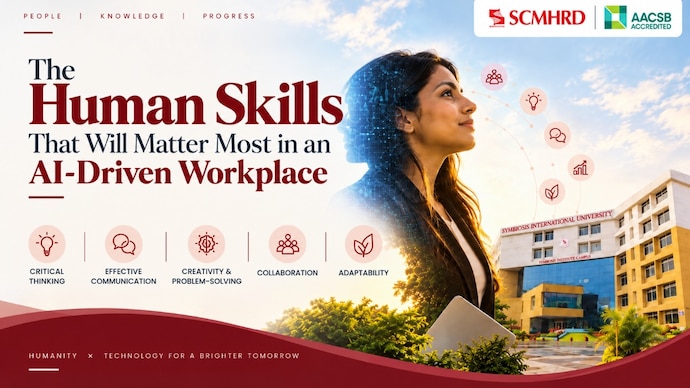
The Human Skills That Will Matter Most in an AI-Driven Workplace

At SCMHRD, the focus is therefore not limited to developing academic or technological competence.
 Last UpdatedOct 1, 2026 12:19 IST
  Published by
As we see it, artificial intelligence will continue to transform the workplace, but technical knowledge alone will not define professional success. What will increasingly differentiate individuals is their ability to think critically, communicate effectively, adapt to change, make sound judgements, and collaborate seamlessly with both people and technology.
At SCMHRD, our focus is therefore not limited to developing academic or technological competence. We want to build well-rounded professionals who combine these capabilities with strong human skills. In an AI-driven future, I believe this combination of technology, judgement, adaptability, and human capability will be critical to creating meaningful and lasting professional impact.
Below are answers to some of the key questions about the human skills that will matter most in the evolving workplace.
Q1. As AI becomes part of almost every workplace, which human skills will become most important? AI can automate tasks and process information, but skills such as critical thinking, communication, creativity, adaptability, people management and empathy remain distinctly human. Professionals will need to interpret information, make sound judgements, understand people and work effectively in changing environments. At SCMHRD, developing these capabilities alongside domain knowledge can help students become more effective and future-ready professionals.
Q2. Why will critical thinking become more important as AI adoption grows? AI can provide answers quickly, but professionals still need to question, evaluate and contextualise those answers. Critical thinking enables individuals to identify inaccuracies, assess different perspectives and make informed decisions. As AI becomes more accessible, the ability to ask the right questions and exercise independent judgement will become a key professional advantage. At SCMHRD we have created customer AI’s which help students apply their minds to get the results. This is what makes our AI ecosystem different.
Q3. Can creativity and problem-solving still give professionals an edge when AI can generate ideas? Yes, absolutely. AI can generate ideas, alternatives, and even possible solutions, but the real advantage will come from knowing which idea matters, how to apply it, and whether it solves the right problem.
I believe creativity in the AI era will be less about producing ideas from scratch and more about asking better questions, connecting seemingly unrelated possibilities,understanding context, and turning ideas into meaningful outcomes. Similarly,problem-solving will require judgement, empathy, experimentation, and the ability to make decisions when the information is incomplete.
AI can enhance human creativity, but it does not eliminate the need for it. Professionals who can combine their own judgement and problem-solving ability with AI will have a much stronger edge than those who simply depend on AI-generated answers.
Q4. Why will communication and collaboration remain important in an AI-driven workplace? Workplaces are becoming increasingly collaborative, with teams often working across functions, cultures and geographies. The ability to communicate ideas clearly, listen, negotiate and build relationships will remain essential.At SCMHRD, collaborative learning and interactions with peers and industry can help students develop the interpersonal skills needed to work effectively in diverse professional environments.
Q5. How can students prepare themselves for jobs that may look very different in the future? Students need to develop a mindset of continuous learning and adaptability. Instead of preparing for one specific role, tool, or technology,they must build the ability to learn continuously, respond to change, and apply their knowledge in unfamiliar situations.
This also means education cannot remain limited to theory. Students need exposure to real-world problems,inter-disciplinary learning, industry perspectives, and opportunities to experiment and build.
At SCMHRD, we therefore do not see AI merely as part of the curriculum; we see it as part of the larger learning ecosystem. For us, it is more important that students use AI to build solutions, solve problems, test ideas, and create applications than simply learn the theory of AI. The real capability lies in knowing how to apply technology meaningfully.
Q6. What will ultimately distinguish successful professionals in an AI-driven workplace? The most successful professionals will be those who can combine technological awareness with strong human capabilities. Knowing how to use AI will be important, but knowing when to question it, how to apply its outputs and how to work with people will be equally critical. The role of institutions such as SCMHRDis therefore not just to prepare students to use emerging technologies but to develop thoughtful, adaptable and responsible professionals who can lead in a rapidly changing world.