Wangchuk might end his hunger strike today. No two fasts end the same way
Activist Sonam Wangchuk will most likely end his fast today even as CJP supporters march to Parliament. But if India's history of hunger strikes tells us anything, it is that the end of such protests has never followed a fixed pattern, or produced the same result twice.

Every hunger strike begins with a belief — that refusing food can achieve what dialogue and petitions could not. For centuries, fasting has been a tool of protest. In the modern era, Mahatma Gandhi transformed hunger strikes into one of the world's most resilient forms of non-violent protests. But if one looks at the history of hunger strikes in India and across the world, it shows that no two protests have been resolved in the same way.
Some hunger strikes concluded with negotiations, leading to policy changes. Others, with assurances of changes by the authorities. Some ended in death, with the protester's sacrifice not always resulting in the change they sought. And in prolonged cases, where the protesters didn't budge, authorities intervened through force-feeding to prevent deaths.
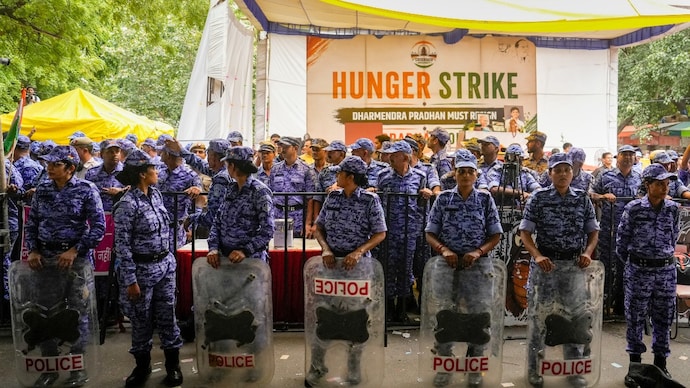
That history is once again in focus as Ladakhi activist Sonam Wangchuk was shifted from New Delhi's Jantar Mantar protest site to Safdarjung Hospital on Saturday morning, on the 21st day of being on an indefinite hunger strike. Even after being admitted to the hospital as a precaution against health complications, Wangchuk has continued to refuse food and medical treatment.
His wife, Gitanjali J Angmo, has shared a message saying Wangchuk wants the movement to continue, and has urged supporters to participate in the July 20 "Chalo Sansad" march to Parliament, against systemic accountability following NEET-UG paper leaks.
In a note from the hospital, Wangchuk outlined three circumstances under which he said he was willing to end his hunger strike.
Wangchuk, as of now, remains under continuous medical observation and is being counselled to accept treatment.
Whether his hunger strike leads to negotiation with the authorities, medical intervention, or something else, remains to be seen, especially because there is no pattern in how such strikes have ended over the decades.
Since Independence, some hunger strikes have reshaped India's political map, others have influenced legislation or public policy, while several have ended without any result.
Every hunger strike tested the resolve of both the protester and the state. But more than the duration of the fast, it has been the political context, public support, and the willingness of stakeholders to engage that have shaped how these protests eventually concluded.
Here's a look at some of Independent India's and the world's most defining hunger strikes, and the course they took.
A HUNGER STRIKE THAT CREATED ANDHRA, RESHAPED INDIA'S MAP
Among the most consequential hunger strikes in Independent India was that of Gandhian activist Potti Sriramulu.
On October 19, 1952, Sriramulu began a fast unto death in Madras (now known as Chennai), demanding a separate state for Telugu-speaking people. Before this, he had undertaken fasts on social issues, including temple entry for Dalits.
Sriramulu continued his fast for 58 days. The central government, led by Prime Minister Jawaharlal Nehru, was initially reluctant to reorganise states on linguistic lines. Sriramulu died on the intervening night of December 15–16, 1952.
His death triggered widespread protests and violence across Telugu-speaking regions. Public buildings were attacked, transport services were disrupted, and demonstrations intensified.
Four days later, on December 19, 1952, Nehru announced that a separate Andhra State would be created. The state came into existence on October 1, 1953, carved out of the erstwhile Madras State, becoming India's first linguistic state.
The episode later paved the way for the broader reorganisation of states on linguistic lines.
SIXTEEN YEARS WITHOUT FOOD: IROM SHARMILA'S FIGHT AGAINST AFSPA
If Sriramulu's fast showed the political impact of a protest ending in death, Manipur's activist Irom Sharmila's hunger strike shows how a hunger strike can continue for years without achieving its principal demand.
Sharmila began her fast on November 5, 2000, after the killing of 10 civilians in Malom, Manipur. She demanded the repeal of the Armed Forces (Special Powers) Act (AFSPA), which grants special powers to the armed forces in areas declared disturbed. The law has long been contentious, with supporters describing it as essential for counter-insurgency operations, and critics arguing that it enables human rights violations by granting sweeping legal protections to security forces.
Over the next 16 years, she was repeatedly arrested under the then-applicable law relating to attempt to suicide and was force-fed through a nasogastric tube while in judicial custody at a hospital. Her detention and release became a recurring cycle as she refused to end her protest.
In August 2016, Sharmila finally broke her fast by tasting honey, saying she would pursue her campaign through electoral politics instead. In 2017, she formed her own political party, the Peoples' Resurgence and Justice Alliance (PRJA), and contested the Manipur Assembly election, although unsuccessfully.
While AFSPA has since been withdrawn from several areas in the Northeast, her central demand for its complete repeal had not been met when she ended her fast.
ANNA HAZARE'S HUNGER STRIKE DURING ANTI-CORRUPTION MOVEMENT
Social activist Anna Hazare's anti-corruption movement in 2011 showed another way hunger strikes could conclude.
Hazare began fasting at New Delhi's Jantar Mantar in April 2011, demanding a stronger anti-corruption law through the Jan Lokpal Bill. A second, larger fast at Ramlila Maidan in August that year drew nationwide participation and became one of Independent India's biggest public movements.
The August fast lasted 13 days. Parliament eventually adopted a "Sense of the House" resolution, addressing three key principles raised by the movement. Hazare then ended his fast by accepting coconut water and honey.
The campaign did not immediately result in the Jan Lokpal Bill sought by activists. However, it significantly influenced the national debate on corruption and contributed to the eventual enactment of the Lokpal and Lokayuktas Act, 2013, although the final law differed from the original draft proposed by the movement.
Hazare has undertaken several other hunger strikes over the years. He fasted for governance reforms, the appointment of the Lokayukta in Maharashtra and farmers' welfare. Many of these fasts ended after governments provided written assurances or agreed to consider their demands, but the assurances did not always translate into full or immediate implementation.
MEDHA PATKAR'S NARMADA BACHAO ANDOLAN FASTS
Social activist Medha Patkar has repeatedly gone on hunger strike to campaign for the rights of people displaced by development projects. As one of the leading faces of the Narmada Bachao Andolan, she undertook multiple fasts demanding proper rehabilitation for families affected by the Sardar Sarovar Dam project on the Narmada River.
In 2006, Patkar observed a 20-day indefinite hunger strike in New Delhi, seeking a halt to the dam's construction. The protest drew national attention and prompted the Supreme Court to seek reports on the rehabilitation of displaced families.
However, construction of the dam continued under judicial oversight.
In 2011, Patkar again went on a 13-day hunger strike against the redevelopment of Mumbai's Golibar slums, alleging that residents were being evicted without adequate rehabilitation.
The protest led to discussions with the Maharashtra government and judicial scrutiny of the rehabilitation process.
Even though the projects themselves largely continued, Medha Patkar's hunger strikes brought displacement and rehabilitation into the national headlines.
WHEN A HUNGER STRIKE ENDED IN DEATH, AND NO RESOLUTION
Environmental activist and IIT Kanpur professor GD Agrawal, later known as Swami Gyan Swaroop Sanand, repeatedly used fasting to campaign for the protection of the Ganga river.
One of his earlier fasts in 2009 led to the suspension of hydroelectric projects on a stretch of the Bhagirathi River.
In 2018, at the age of 86, Agrawal began another indefinite fast in Haridwar. He demanded legislation for the protection of the Ganga, the cancellation of hydroelectric projects on the river and stronger safeguards against activities affecting its ecology.
After fasting for 111 days, he stopped taking water orally. He was shifted to a hospital but died on October 11, 2018.
Unlike his earlier protests, the 2018 fast ended without the comprehensive policy changes he had sought. His death renewed debate over river conservation, but the protest itself concluded without a negotiated settlement.
HUNGER STRIKES BEYOND INDIA
The use of fasting as a political tool has a long global history.
One of the best-known international examples came in 1981, when Irish republican Bobby Sands and nine other prisoners died during a hunger strike in Northern Ireland's Maze Prison while demanding political prisoner status. Although the British government did not formally concede the prisoners' demands during the strike, the episode drew global attention and intensified political tensions in Northern Ireland.
In the early 20th century, suffragettes in Britain used hunger strikes while imprisoned for demanding women's voting rights, with many subjected to force-feeding. The suffragette movement became a major catalyst in securing women's right to vote, although the larger voting rights came from a combination of peaceful lobbying and women's contributions during The Great War.
American labour leader Cesar Chavez, in 1968, used fasting to protest during the United Farm Workers movement. His best-known fast, in 1968, lasted 25 days. It drew national attention to poor wages, unsafe working conditions, and the lack of labour rights faced by farmworkers. Chavez later undertook additional fasts in 1972 and 1988 to protest labour practices and the usage of pesticides that endangered farmworkers' lives.
Palestinian prisoners have also undertaken prolonged hunger strikes over issues including administrative detention.
Like in India, across countries too, the outcomes have varied widely.
As Sonam Wangchuk continues his fast from a hospital bed, it might be too early to predict how it will conclude.