
AI engineering jobs rise by 51%, Vijayawada sees highest growth: India LinkedIn Head
At a Business Today event, LinkedIn India said AI hiring is spreading beyond major tech hubs and changing how companies recruit. The shift points to faster skill changes, new AI roles and wider access to careers in smaller cities.

The conversation around artificial intelligence and jobs often begins with one question: Will AI take away jobs?
But the more important question may be: What will the jobs that remain look like?
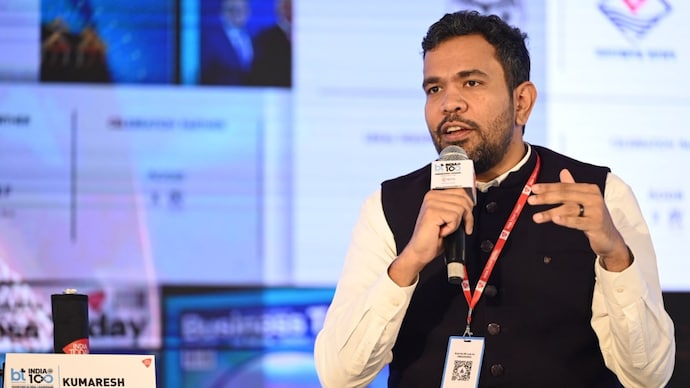
At the Business Today India at 100: India’s Manufacturing Champions event, in a conversation with Kumaresh Pattabiraman, India Country Head at LinkedIn, the discussion on manufacturing jobs in the AI age moved beyond job displacement. It looked at the new roles being created, the skills employers are beginning to value and why the next wave of AI opportunities may not be concentrated only in Bengaluru, Hyderabad or other technology hubs.
And the numbers suggest that this shift is already underway.
Since 2023, 2 million new AI-related jobs have been added globally, including 311,000 in India, according to LinkedIn data shared by Pattabiraman. AI engineering roles in India alone have risen 51% in the past year.
AI JOBS ARE GROWING AND FAST
Pattabiraman said the biggest difference between AI and earlier technology waves such as mobile, personal computers and the internet is the speed at which it is spreading.
“Someone in like a tier two, tier three city, getting access to AI is happening faster than they had access to the internet, the mobile, or the PC,” he said.
That speed is already showing up in employment data. While some tasks within existing jobs may be automated, others will be augmented by AI, while skills that remain uniquely human could become even more valuable.
For India, he said, the challenge is to prepare workers for this rapid change by continuously tracking which skills are becoming more valuable.
VIJAYAWADA IS THE NEW AI SURPRISE
The AI jobs story is also moving beyond Bengaluru and Hyderabad.
Vijayawada, for instance, recorded a 46% increase in AI engineering roles in just one year, according to LinkedIn data shared at the event.
“You wouldn't have predicted that,” PattabiRaman said, pointing to the emergence of a new AI engineering hub outside India's traditional technology centres.
The shift is being helped by easier access to AI tools and learning. LinkedIn's data also shows that professionals in this generation are learning at twice the global average, while spending 50% more time on LinkedIn Learning than the global average.
For tier-2 and tier-3 city students and professionals, that could mean access to AI careers is no longer tied as closely to where they live.
THE THREE AI JOBS TO WATCH
Some of the newest roles are already carrying AI in their titles.
Asked which emerging jobs young people should watch, Pattabiraman named three:
Generative AI engineer
AI practitioner
Prompt engineer
But he said, a bigger change may be happening in jobs whose titles have not changed.
A social media manager, for example, may still have the same designation, but the skills required for the role have changed significantly, with professionals increasingly expected to work with AI-powered content tools.
His advice for a young professional is to identify a problem they want to solve and combine AI skills with capabilities that remain distinctly human.
YOUR DEGREE MAY NOT BE ENOUGH ANY MORE
The hiring process itself is changing.
With AI agents helping candidates apply to jobs, recruiters can receive hundreds or even thousands of applications within hours. Pattabiraman said this is making it harder to distinguish candidates based simply on their resumes.
As a result, 46% of recruiters are now using skills to make hiring decisions, according to LinkedIn data he shared. Candidates are increasingly expected to demonstrate what they can actually do rather than simply list a skill or qualification.
“It's not just don't take my word or an agent's word for my skills. Show it to me,” he said.
That means a portfolio of real work could become increasingly important for professionals across knowledge-based jobs, much as it has traditionally been for designers and architects.
THE NEXT GENERATION COULD HAVE TWICE THE JOBS
The future of work may not simply mean fewer jobs. It could mean a much larger and constantly changing job market.
Pattabiraman said the generation entering the workforce over the next decade could have twice as many jobs as the previous generation. At the same time, he pointed to another major shift: LinkedIn expects 75% of job skills in India to change by 2030.
That makes adaptability as important as technical expertise.
“Skills is a factor. So, regardless of age, the ability to pick up new ways of working fast is what matters at this time,” he said.
For a 22-year-old entering the workforce, his advice is therefore less about picking one job title and more about picking a problem worth solving, and learning to combine AI with human judgement.
INDIA'S AI ADVANTAGE IS NOT JUST ABOUT ENGINEERS
India's opportunity, Pattabiraman argued, is also tied to its ability to develop talent for the global economy.
He pointed to LinkedIn's own evolution in India. After years of building infrastructure and operations, the company now has two product lines being built entirely from India, with teams spanning engineering, product management, design, data science and marketing.
He linked this to the wider growth of global capability centres, where companies are increasingly building complete business capabilities in India rather than simply outsourcing individual tasks.
“India has such a brilliant opportunity, but it's also one that we need to grab right now,” he said.
For India's manufacturing workforce, the lesson from the AI transition may therefore be simple: the safest job is not necessarily the one AI cannot touch. It may be the one where the worker can learn fast enough to change with it.