

In these Indian homes, men cook. But the society can't digest it

Even in urban households, where both partners work and share domestic responsibilities, a man chopping vegetables, packing lunches, or cooking for his family surprises people.
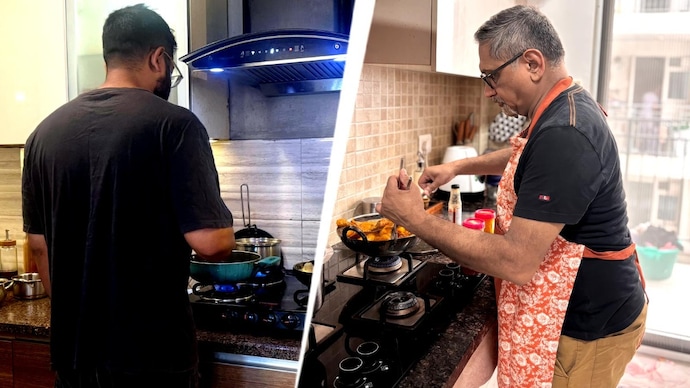
Patriarchy runs so deep that a man cooking for his family on an ordinary day still draws surprised looks, for him and his wife alike. (Photos: Special Arrangement/India Today)

New Delhi,UPDATED: Sep 6, 2026 23:39 IST
“Arrey bhaiya, why are you cooking?” a new house help at Jaya’s home almost screamed when she spotted her husband Snehil* making chicken curry one morning. Even after Snehil told her that he enjoyed cooking and did it almost every day, the house help couldn’t help asking Jaya why she didn’t cook, and suggesting that she should start doing so to keep her husband happy.
Not many men help with household chores in Indian homes anyway. And even when they do, somehow, women still end up bearing the brunt. A whole pack of people - many of them women themselves - are always ready to attack the wife with sharp taunts, guilt-tripping her for not taking care of the home. Suddenly, the woman is not a good wife and the husband is a 'joru ka ghulaam'.
Even in urban households, where both partners work and share domestic responsibilities, a man chopping vegetables, packing lunches, or cooking for his family can surprise people. Even as conversations around gender roles become increasingly common, wives are still judged for what they do - or fail to do - at home.
“You are not a good wife,” author Sayantan Ghosh’s wife was repeatedly told by people who often saw her husband in the kitchen. Ghosh shared her plight in a long post on X, pointing out that while professional chefs like Ranveer Brar and Sanjeev Kapoor are admired across the country, the narrative takes a U-turn when a family man steps into the kitchen.
“Anindita (my wife) has repeatedly heard that perhaps there is something wrong with her because I cook at home. Maybe she is not a good wife. Maybe she is not a good mother. The judgement comes so easily,” he wrote.
Rhythm*, a teacher from Noida, found herself grappling with similar thoughts - “Am I not a good wife?” - after her marriage. Those around her, including her mother-in-law and some friends, suggested that she should spend more time in the kitchen and not leave the “heavy-duty” cooking to her husband.
“During family gatherings, nobody says anything when a woman is cooking as well as serving everyone. The party goes on, with people chit-chatting and giggling. But the moment a man decides to do the same thing in the same kind of setting, it leaves everyone shocked,” Rhythm shared.
“Luckily, my husband loves to cook, and I just help him with serving and other light stuff. He has no issues with me not being able to contribute much in that area. And now I have learnt how to ignore such comments and not let them affect me,” she added.
Patriarchy has long been a key ingredient in Indian home kitchens, quietly running the show from behind jars of achaar, countless bottles of condiments and those big containers of atta. From planning meals and cleaning the kitchen before and after cooking to ensuring nutrition and preparing food that everyone enjoys, much of the emotional and physical labour has largely been carried by women.
One reason we Indians love ghar ka khaana so much is that it often comes with a familiar arrangement: the mother cooks and serves while everyone else sits down to eat. Of course, hygiene, cost and the appeal of eating at home are factors too. But our attachment to home-cooked food is also deeply rooted in patriarchy, bearing the coating of love and emotions.
This patriarchy runs so deep that when society sees a man kneading dough, making chapatis or preparing lunch for his family on an ordinary day, both he and his wife are met with surprised looks.
Take Mumbai-based Shivam Trivedi, whose mother was shocked to see him make dinner after he came home from work while his wife took some time to rest after returning from her office. Trivedi had been living away from his family for over a decade. He had moved cities, changed colleges and even switched jobs, while his parents continued to live in Lucknow. Naturally, he had learnt cooking as a survival skill, and his mother knew it too. But now that he was married, she expected the cooking to be taken care of by her daughter-in-law.
“At first, I thought maybe I was a bad cook. But then I realised it was the mindset. She herself never had the liberty of getting help in the kitchen from my father while living in a joint family, and hence the expectation,” Trivedi told us.
In some cases, it is relatives; in others, even a house help feels entitled to comment and offer unsolicited advice to women simply because they let their husbands take charge of the kitchen.
But of course, not all homes are the same. Charu Sahay, a 58-year-old teacher, says having a husband who cooks has never been an issue.
“When my husband cooks at home, people usually just enjoy the food. They never ask me, ‘Why aren’t you cooking?’ Sometimes, house helps and cooks are surprised - ‘Didi, bhaiya bhi cook karte hain?’ But he cooks really well, and everyone loves his food.
“Whenever we have a party, people look forward to the different dishes he makes - salads, cocktails and more. But the best part for me is that when I leave for school in the morning, I don’t have to worry about the kitchen. I don’t have to think about what will happen if the cook doesn’t come. That’s something I really enjoy.
“The kitchen is not a responsibility that only women can handle. Men are equally good at it,” she says. Well, exactly!
- Ends