How to check your car's mileage? Know the most accurate method
According to Union Minister Nitin Gadkari, only authorised dealer equipment can accurately measure fuel efficiency. While dashboard readings have limitations, motorists can still estimate real-world mileage with reasonable accuracy using the right methods.
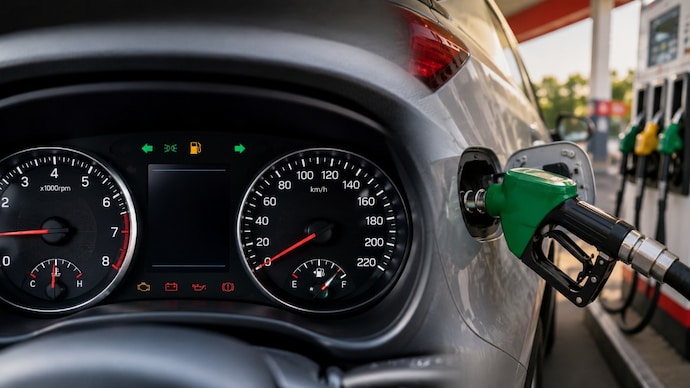
Amid the ongoing debate over the impact of E20 petrol on fuel efficiency, Union Road Transport and Highways Minister Nitin Gadkari has said that motorists cannot measure their vehicle's mileage on their own.
Responding to a journalist during an interview, Gadkari said a car's fuel efficiency "can only be checked using a company-authorised dealer's machine" after the journalist claimed her vehicle's mileage had dropped from around 11kmpl to 7kmpl following the widespread availability of E20 petrol.
The statement has sparked discussion among motorists, many of whom routinely monitor fuel economy through the instrument cluster or by calculating it manually after refuelling. So, is Gadkari correct?
Dashboard mileage is useful, but not perfect
Almost every modern car sold today displays fuel economy on the instrument cluster or infotainment system. This figure is calculated by the vehicle's Engine Control Unit (ECU), which estimates fuel consumption using data from fuel injectors, engine load, throttle position, speed and distance travelled.
However, it is an estimate rather than a direct measurement.
The displayed mileage can vary depending on driving conditions, tyre pressure, gradients, idling time, air-conditioner usage and even how recently the trip computer was reset. Several independent tests have shown that the difference between the displayed fuel economy and actual fuel consumption can range from around 2% to 10%, depending on the vehicle and driving conditions.
In other words, the instrument cluster provides a good indication of trends such as whether mileage has improved or worsened, but should not be treated as an exact measurement.
The tank-to-tank method remains the gold standard
For everyday motorists, the most reliable way to measure real-world fuel efficiency is the tank-to-tank method.
This method does not require specialised equipment and is widely used to check mileage.
Here's how to do it:
Fill the fuel tank to the automatic cut-off at the same fuel station and, ideally, the same pump.
- Reset the trip meter to zero.
- Drive normally until the next refill.
- Refill the tank again to the automatic cut-off.
- Note the litres filled and the distance travelled.
- Divide kilometres travelled by litres filled to calculate kmpl.
Formula:
Fuel efficiency = Distance travelled Fuel added
For example, if you drive 520km and the next refill requires 40 litres, your actual fuel economy is:
520 40 = 13kmpl
Repeating this over three or four fuel tanks gives a much more accurate average and minimises errors caused by slight differences in fuel level or driving conditions.
What about authorised dealer equipment?
Manufacturers and authorised service centres do have access to diagnostic equipment that can read detailed engine parameters, injector performance and ECU data. Such tools are valuable for identifying faults that may be affecting fuel consumption, such as malfunctioning sensors or improper fuel injection.
However, these diagnostic machines do not directly measure real-world fuel economy under everyday driving conditions.
For official fuel-efficiency certification, manufacturers rely on laboratory tests conducted under standardised drive cycles using precision equipment under controlled conditions, not dealership diagnostic scanners.
The suggestion that motorists cannot measure their vehicle's fuel efficiency without authorised dealer equipment is not entirely accurate. The tank-to-tank method remains one of the simplest and most reliable ways for owners to calculate real-world mileage and is widely accepted across the automotive industry.
For most drivers, the dashboard is best viewed as a convenient indicator, while the tank-to-tank calculation is the closest practical measure of how efficiently a vehicle is actually using fuel in everyday conditions.
Subscribe to Auto Today Magazine
Amid the ongoing debate over the impact of E20 petrol on fuel efficiency, Union Road Transport and Highways Minister Nitin Gadkari has said that motorists cannot measure their vehicle's mileage on their own.
Responding to a journalist during an interview, Gadkari said a car's fuel efficiency "can only be checked using a company-authorised dealer's machine" after the journalist claimed her vehicle's mileage had dropped from around 11kmpl to 7kmpl following the widespread availability of E20 petrol.
The statement has sparked discussion among motorists, many of whom routinely monitor fuel economy through the instrument cluster or by calculating it manually after refuelling. So, is Gadkari correct?
Dashboard mileage is useful, but not perfect
Almost every modern car sold today displays fuel economy on the instrument cluster or infotainment system. This figure is calculated by the vehicle's Engine Control Unit (ECU), which estimates fuel consumption using data from fuel injectors, engine load, throttle position, speed and distance travelled.
However, it is an estimate rather than a direct measurement.
The displayed mileage can vary depending on driving conditions, tyre pressure, gradients, idling time, air-conditioner usage and even how recently the trip computer was reset. Several independent tests have shown that the difference between the displayed fuel economy and actual fuel consumption can range from around 2% to 10%, depending on the vehicle and driving conditions.
In other words, the instrument cluster provides a good indication of trends such as whether mileage has improved or worsened, but should not be treated as an exact measurement.
The tank-to-tank method remains the gold standard
For everyday motorists, the most reliable way to measure real-world fuel efficiency is the tank-to-tank method.
This method does not require specialised equipment and is widely used to check mileage.
Here's how to do it:
Fill the fuel tank to the automatic cut-off at the same fuel station and, ideally, the same pump.
- Reset the trip meter to zero.
- Drive normally until the next refill.
- Refill the tank again to the automatic cut-off.
- Note the litres filled and the distance travelled.
- Divide kilometres travelled by litres filled to calculate kmpl.
Formula:
Fuel efficiency = Distance travelled Fuel added
For example, if you drive 520km and the next refill requires 40 litres, your actual fuel economy is:
520 40 = 13kmpl
Repeating this over three or four fuel tanks gives a much more accurate average and minimises errors caused by slight differences in fuel level or driving conditions.
What about authorised dealer equipment?
Manufacturers and authorised service centres do have access to diagnostic equipment that can read detailed engine parameters, injector performance and ECU data. Such tools are valuable for identifying faults that may be affecting fuel consumption, such as malfunctioning sensors or improper fuel injection.
However, these diagnostic machines do not directly measure real-world fuel economy under everyday driving conditions.
For official fuel-efficiency certification, manufacturers rely on laboratory tests conducted under standardised drive cycles using precision equipment under controlled conditions, not dealership diagnostic scanners.
The suggestion that motorists cannot measure their vehicle's fuel efficiency without authorised dealer equipment is not entirely accurate. The tank-to-tank method remains one of the simplest and most reliable ways for owners to calculate real-world mileage and is widely accepted across the automotive industry.
For most drivers, the dashboard is best viewed as a convenient indicator, while the tank-to-tank calculation is the closest practical measure of how efficiently a vehicle is actually using fuel in everyday conditions.
Subscribe to Auto Today Magazine

