China's first Fields Medal winner Yu Deng just solved a 126-year-old math puzzle
The 2026 Fields Medal winners have been announced, with China's Yu Deng making history as the country's first recipient. Here's who won, why the award matters, and what the four mathematicians actually discovered in simple language.
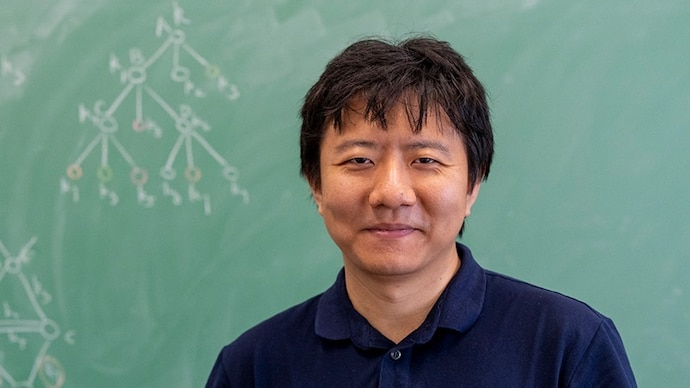
For decades, China produced some of the world's brightest mathematicians. Yet one prize remained just out of reach.
That finally changed this week.
Yu Deng has become the first mathematician from China to win the Fields Medal, often called the Nobel Prize of mathematics. Awarded once every four years to researchers under 40, it is the highest honour young mathematicians can receive. This year, four winners were recognised for solving problems that have challenged the field for years, sometimes decades.
WHAT DID YU DENG ACTUALLY DO?
At first glance, Deng's work sounds impossibly technical. It revolves around something called the Boltzmann equation, a mathematical formula physicists have used since the 19th century to describe how gases behave.
The mystery was this: we know gases are made of countless tiny particles colliding with one another. We also have equations describing the behaviour of the gas as a whole. But proving, with complete mathematical rigour, how one leads to the other had remained an enormous challenge.
Deng helped bridge that gap.
By starting with the motion of individual hard sphere particles and showing how their interactions naturally produce the large scale behaviour described by the Boltzmann equation, he connected the microscopic and macroscopic worlds. His work also tackled similar questions in wave motion and quantum systems, giving mathematicians new tools to understand complex physical phenomena.
In simple terms, he helped explain how billions of tiny interactions combine to produce the everyday behaviour we observe around us.
THE OTHER THREE WINNERS
The 2026 Fields Medals also recognised three other extraordinary breakthroughs.
Hong Wang, based at New York University, became only the third woman ever to receive the medal. Her work transformed harmonic analysis and geometric measure theory, including major advances on the famous Kakeya problem, which asks how little space is needed to rotate a needle through every possible direction.
John Pardon was honoured for breakthroughs in geometry and topology. His work introduced powerful new methods for studying curved spaces, knots and three dimensional shapes, solving several long-standing problems.
Jacob Tsimerman was recognised for reshaping modern arithmetic geometry by bringing ideas from mathematical logic into the field. His work helped resolve major conjectures, including the celebrated Andr Oort conjecture for Siegel modular varieties.
WHY IS YU DENG CALLED CHINA'S FIRST WINNER?
While fellow winner Hong Wang was also born in China, Yu Deng is being called China's first winner. The distinction lies in representation which is how the Fields Medal is awarded.
Wang is an American mathematician who works at New York University, while Yu Deng is the first mathematician representing China to receive the Fields Medal. That is why the award has been widely described as China's first Fields Medal.
WHY THIS MOMENT MATTERS
Every Fields Medal celebrates remarkable mathematics. But Yu Deng's win also marks a historic milestone.
China has long been a powerhouse in mathematical research, yet it had never produced a Fields Medal winner until now. Deng's achievement finally places the country on one of mathematics' most exclusive lists.
At the same time, the four winners show just how broad modern mathematics has become. Their work ranges from the motion of gases and quantum systems to abstract geometry and the hidden structure of numbers, proving that even the most theoretical ideas can reshape how we understand the universe.
For decades, China produced some of the world's brightest mathematicians. Yet one prize remained just out of reach.
That finally changed this week.
Yu Deng has become the first mathematician from China to win the Fields Medal, often called the Nobel Prize of mathematics. Awarded once every four years to researchers under 40, it is the highest honour young mathematicians can receive. This year, four winners were recognised for solving problems that have challenged the field for years, sometimes decades.
WHAT DID YU DENG ACTUALLY DO?
At first glance, Deng's work sounds impossibly technical. It revolves around something called the Boltzmann equation, a mathematical formula physicists have used since the 19th century to describe how gases behave.
The mystery was this: we know gases are made of countless tiny particles colliding with one another. We also have equations describing the behaviour of the gas as a whole. But proving, with complete mathematical rigour, how one leads to the other had remained an enormous challenge.
Deng helped bridge that gap.
By starting with the motion of individual hard sphere particles and showing how their interactions naturally produce the large scale behaviour described by the Boltzmann equation, he connected the microscopic and macroscopic worlds. His work also tackled similar questions in wave motion and quantum systems, giving mathematicians new tools to understand complex physical phenomena.
In simple terms, he helped explain how billions of tiny interactions combine to produce the everyday behaviour we observe around us.
THE OTHER THREE WINNERS
The 2026 Fields Medals also recognised three other extraordinary breakthroughs.
Hong Wang, based at New York University, became only the third woman ever to receive the medal. Her work transformed harmonic analysis and geometric measure theory, including major advances on the famous Kakeya problem, which asks how little space is needed to rotate a needle through every possible direction.
John Pardon was honoured for breakthroughs in geometry and topology. His work introduced powerful new methods for studying curved spaces, knots and three dimensional shapes, solving several long-standing problems.
Jacob Tsimerman was recognised for reshaping modern arithmetic geometry by bringing ideas from mathematical logic into the field. His work helped resolve major conjectures, including the celebrated Andr Oort conjecture for Siegel modular varieties.
WHY IS YU DENG CALLED CHINA'S FIRST WINNER?
While fellow winner Hong Wang was also born in China, Yu Deng is being called China's first winner. The distinction lies in representation which is how the Fields Medal is awarded.
Wang is an American mathematician who works at New York University, while Yu Deng is the first mathematician representing China to receive the Fields Medal. That is why the award has been widely described as China's first Fields Medal.
WHY THIS MOMENT MATTERS
Every Fields Medal celebrates remarkable mathematics. But Yu Deng's win also marks a historic milestone.
China has long been a powerhouse in mathematical research, yet it had never produced a Fields Medal winner until now. Deng's achievement finally places the country on one of mathematics' most exclusive lists.
At the same time, the four winners show just how broad modern mathematics has become. Their work ranges from the motion of gases and quantum systems to abstract geometry and the hidden structure of numbers, proving that even the most theoretical ideas can reshape how we understand the universe.
For decades, China produced some of the world's brightest mathematicians. Yet one prize remained just out of reach.
That finally changed this week.
Yu Deng has become the first mathematician from China to win the Fields Medal, often called the Nobel Prize of mathematics. Awarded once every four years to researchers under 40, it is the highest honour young mathematicians can receive. This year, four winners were recognised for solving problems that have challenged the field for years, sometimes decades.
WHAT DID YU DENG ACTUALLY DO?
At first glance, Deng's work sounds impossibly technical. It revolves around something called the Boltzmann equation, a mathematical formula physicists have used since the 19th century to describe how gases behave.
The mystery was this: we know gases are made of countless tiny particles colliding with one another. We also have equations describing the behaviour of the gas as a whole. But proving, with complete mathematical rigour, how one leads to the other had remained an enormous challenge.
Deng helped bridge that gap.
By starting with the motion of individual hard sphere particles and showing how their interactions naturally produce the large scale behaviour described by the Boltzmann equation, he connected the microscopic and macroscopic worlds. His work also tackled similar questions in wave motion and quantum systems, giving mathematicians new tools to understand complex physical phenomena.
In simple terms, he helped explain how billions of tiny interactions combine to produce the everyday behaviour we observe around us.
THE OTHER THREE WINNERS
The 2026 Fields Medals also recognised three other extraordinary breakthroughs.
Hong Wang, based at New York University, became only the third woman ever to receive the medal. Her work transformed harmonic analysis and geometric measure theory, including major advances on the famous Kakeya problem, which asks how little space is needed to rotate a needle through every possible direction.
John Pardon was honoured for breakthroughs in geometry and topology. His work introduced powerful new methods for studying curved spaces, knots and three dimensional shapes, solving several long-standing problems.
Jacob Tsimerman was recognised for reshaping modern arithmetic geometry by bringing ideas from mathematical logic into the field. His work helped resolve major conjectures, including the celebrated Andr Oort conjecture for Siegel modular varieties.
WHY IS YU DENG CALLED CHINA'S FIRST WINNER?
While fellow winner Hong Wang was also born in China, Yu Deng is being called China's first winner. The distinction lies in representation which is how the Fields Medal is awarded.
Wang is an American mathematician who works at New York University, while Yu Deng is the first mathematician representing China to receive the Fields Medal. That is why the award has been widely described as China's first Fields Medal.
WHY THIS MOMENT MATTERS
Every Fields Medal celebrates remarkable mathematics. But Yu Deng's win also marks a historic milestone.
China has long been a powerhouse in mathematical research, yet it had never produced a Fields Medal winner until now. Deng's achievement finally places the country on one of mathematics' most exclusive lists.
At the same time, the four winners show just how broad modern mathematics has become. Their work ranges from the motion of gases and quantum systems to abstract geometry and the hidden structure of numbers, proving that even the most theoretical ideas can reshape how we understand the universe.

