ACs finally reach IIM Calcutta hostels. The decision that could change campuses
IIM Calcutta is finally air-conditioning its hostel rooms, bringing an end to a defining chapter of campus life. The move reflects a broader challenge confronting India's older educational institutions as summers become increasingly harsh.
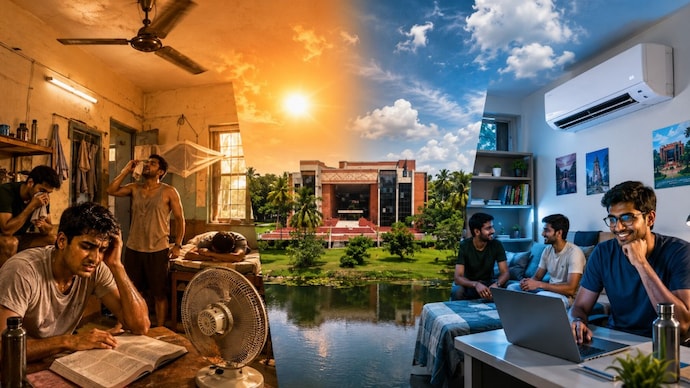
Every summer, the hostels at IIM Calcutta settled into a rhythm of their own. The steady hum of ceiling fans. Doors were left open through the night despite the mosquitoes. Damp bedsheets. Mattresses were dragged into corridors where the air moved just enough to make sleep possible.
For generations of students, enduring Kolkata's oppressive summer was less an inconvenience than an unwritten rite of passage.
Now, that rhythm is changing.
Towering stacks of boxed air-conditioners have begun appearing across the campus, a sight that generations of students would have struggled to imagine.
After years of appeals, hostel rooms are finally being air-conditioned, bringing an end to one of IIM Calcutta's oldest campus traditions. More than a long-awaited comfort upgrade, the move signals something larger: India's universities are beginning to adapt to a climate they were never built for.
Students have also taken to X to document the transformation, sharing photographs and videos of newly installed air-conditioners in hostel blocks. For many alumni and current students, the images mark the end of a defining feature of campus life, one that had endured for decades despite repeated demands for change.
THE SUMMER CAMPUSES WERE NEVER BUILT FOR
When most of India's IITs and IIMs were designed in the 1960s, '70s and '80s, hostel architecture followed a simple philosophy: thick walls, cross-ventilation, ceiling fans and shade trees. For decades, it worked.
But the climate changed.
Today's summers bear little resemblance to those of four decades ago. Heatwaves are lasting longer, nights are staying warmer, and cities like Kolkata are increasingly grappling with the dangerous combination of high temperatures and humidity, where the body struggles to cool itself naturally.
The India Meteorological Department has repeatedly expanded heatwave alerts, while climate researchers warn that humid heat events are becoming more frequent and more intense.
In those conditions, a ceiling fan often does little more than circulate hot air. Hostel rooms designed for another era have become some of the least climate-resilient spaces on campus.
WHEN SURVIVING SUMMER BECAME CAMPUS CULTURE
Every institution has its legends. At IIM Calcutta, one of them survived April and May.
Alumni recall sleeping in corridors, taking multiple cold showers, leaving doors open until dawn and stretching out on hostel floors in search of a cooler spot. There was even a running joke: if you could survive a Kolkata summer in the hostel, corporate boardrooms would feel easy.
For years, those stories were told with nostalgia.
As temperatures climb, they sound less like campus folklore and more like reminders of infrastructure struggling to keep pace with a changing climate.
The installation of air-conditioners at IIM Calcutta marks more than the end of a long-standing student demand. It reflects a recognition that yesterday's infrastructure cannot comfortably serve tomorrow's students.
For years, executive accommodation at the Management Development Centre was air-conditioned while generations of students endured non-air-conditioned hostels. That divide is now beginning to disappear.
A Reddit post by an IIM Calcutta student claiming to be among the first MBA students to spend a night in a hostel room with a functioning air-conditioner reflects the excitement surrounding the rollout.
TWO GENERATIONS OF CAMPUSES
The IIM ecosystem increasingly reflects two generations of infrastructure.
Older campuses such as Ahmedabad, Calcutta, Bangalore and Lucknow largely expanded around hostel blocks built decades ago, long before extreme heat became a defining challenge. Many newer IIMs --- including Sambalpur, Nagpur, Jammu and Visakhapatnam, were developed in an era when air-conditioned accommodation had become increasingly common.
Some have gone even further. The Indian Institute of Management Kozhikode (IIM Kozhikode) has long provided centrally air-conditioned hostels, while IIM Raipur's new campus incorporates radiant cooling systems across hostel blocks. Several newer campuses have also built air-conditioning into their residential infrastructure from the outset.
Where students study is increasingly influenced by when their campus was built. The issue has already moved beyond inconvenience.
During the 2024 heatwave, students at IIM Amritsar staged an unusual protest by moving their bedding into the hostel mess, the only comfortably air-conditioned space available—and slept there through the night. Images of the protest spread quickly online.
The message was simple: students were no longer asking for luxury. They were asking for sleep.
THE IITS FACE THE SAME CHALLENGE
The debate extends well beyond management schools.
Many of India's oldest IIT hostels were never designed to support hundreds of air-conditioners running simultaneously. Ageing electrical systems, limited transformer capacity and decades-old wiring make large-scale retrofitting technically difficult and financially expensive.
The result is a dilemma confronting many public institutions: preserve ageing infrastructure or redesign campuses for a climate that has fundamentally changed.
A CAMPUS FOR A DIFFERENT CLIMATE
When IIM Calcutta opened its doors in 1961, few could have imagined that a ceiling fan would one day be inadequate for a Kolkata summer.
But campuses, like cities, are products of the climate they were built for.
Separately, IIM Calcutta is pursuing a proposed Rs 500-crore green campus expansion, including new hostels and academic infrastructure, after securing a renewed No Objection Certificate (NOC) from the West Bengal government. The expansion reflects the institute's longer-term plans to modernise its campus.
The boxes of air-conditioners arriving at IIM Calcutta mark the end of one of the institute's oldest rites of passage. They also mark the beginning of something larger: India's universities quietly redesigning themselves for a future their architects never had to imagine.
In a country growing hotter every year, thermal comfort is no longer a luxury. It is becoming essential infrastructure.
Every summer, the hostels at IIM Calcutta settled into a rhythm of their own. The steady hum of ceiling fans. Doors were left open through the night despite the mosquitoes. Damp bedsheets. Mattresses were dragged into corridors where the air moved just enough to make sleep possible.
For generations of students, enduring Kolkata's oppressive summer was less an inconvenience than an unwritten rite of passage.
Now, that rhythm is changing.
Towering stacks of boxed air-conditioners have begun appearing across the campus, a sight that generations of students would have struggled to imagine.
After years of appeals, hostel rooms are finally being air-conditioned, bringing an end to one of IIM Calcutta's oldest campus traditions. More than a long-awaited comfort upgrade, the move signals something larger: India's universities are beginning to adapt to a climate they were never built for.
Students have also taken to X to document the transformation, sharing photographs and videos of newly installed air-conditioners in hostel blocks. For many alumni and current students, the images mark the end of a defining feature of campus life, one that had endured for decades despite repeated demands for change.
THE SUMMER CAMPUSES WERE NEVER BUILT FOR
When most of India's IITs and IIMs were designed in the 1960s, '70s and '80s, hostel architecture followed a simple philosophy: thick walls, cross-ventilation, ceiling fans and shade trees. For decades, it worked.
But the climate changed.
Today's summers bear little resemblance to those of four decades ago. Heatwaves are lasting longer, nights are staying warmer, and cities like Kolkata are increasingly grappling with the dangerous combination of high temperatures and humidity, where the body struggles to cool itself naturally.
The India Meteorological Department has repeatedly expanded heatwave alerts, while climate researchers warn that humid heat events are becoming more frequent and more intense.
In those conditions, a ceiling fan often does little more than circulate hot air. Hostel rooms designed for another era have become some of the least climate-resilient spaces on campus.
WHEN SURVIVING SUMMER BECAME CAMPUS CULTURE
Every institution has its legends. At IIM Calcutta, one of them survived April and May.
Alumni recall sleeping in corridors, taking multiple cold showers, leaving doors open until dawn and stretching out on hostel floors in search of a cooler spot. There was even a running joke: if you could survive a Kolkata summer in the hostel, corporate boardrooms would feel easy.
For years, those stories were told with nostalgia.
As temperatures climb, they sound less like campus folklore and more like reminders of infrastructure struggling to keep pace with a changing climate.
The installation of air-conditioners at IIM Calcutta marks more than the end of a long-standing student demand. It reflects a recognition that yesterday's infrastructure cannot comfortably serve tomorrow's students.
For years, executive accommodation at the Management Development Centre was air-conditioned while generations of students endured non-air-conditioned hostels. That divide is now beginning to disappear.
A Reddit post by an IIM Calcutta student claiming to be among the first MBA students to spend a night in a hostel room with a functioning air-conditioner reflects the excitement surrounding the rollout.
TWO GENERATIONS OF CAMPUSES
The IIM ecosystem increasingly reflects two generations of infrastructure.
Older campuses such as Ahmedabad, Calcutta, Bangalore and Lucknow largely expanded around hostel blocks built decades ago, long before extreme heat became a defining challenge. Many newer IIMs --- including Sambalpur, Nagpur, Jammu and Visakhapatnam, were developed in an era when air-conditioned accommodation had become increasingly common.
Some have gone even further. The Indian Institute of Management Kozhikode (IIM Kozhikode) has long provided centrally air-conditioned hostels, while IIM Raipur's new campus incorporates radiant cooling systems across hostel blocks. Several newer campuses have also built air-conditioning into their residential infrastructure from the outset.
Where students study is increasingly influenced by when their campus was built. The issue has already moved beyond inconvenience.
During the 2024 heatwave, students at IIM Amritsar staged an unusual protest by moving their bedding into the hostel mess, the only comfortably air-conditioned space available—and slept there through the night. Images of the protest spread quickly online.
The message was simple: students were no longer asking for luxury. They were asking for sleep.
THE IITS FACE THE SAME CHALLENGE
The debate extends well beyond management schools.
Many of India's oldest IIT hostels were never designed to support hundreds of air-conditioners running simultaneously. Ageing electrical systems, limited transformer capacity and decades-old wiring make large-scale retrofitting technically difficult and financially expensive.
The result is a dilemma confronting many public institutions: preserve ageing infrastructure or redesign campuses for a climate that has fundamentally changed.
A CAMPUS FOR A DIFFERENT CLIMATE
When IIM Calcutta opened its doors in 1961, few could have imagined that a ceiling fan would one day be inadequate for a Kolkata summer.
But campuses, like cities, are products of the climate they were built for.
Separately, IIM Calcutta is pursuing a proposed Rs 500-crore green campus expansion, including new hostels and academic infrastructure, after securing a renewed No Objection Certificate (NOC) from the West Bengal government. The expansion reflects the institute's longer-term plans to modernise its campus.
The boxes of air-conditioners arriving at IIM Calcutta mark the end of one of the institute's oldest rites of passage. They also mark the beginning of something larger: India's universities quietly redesigning themselves for a future their architects never had to imagine.
In a country growing hotter every year, thermal comfort is no longer a luxury. It is becoming essential infrastructure.
Every summer, the hostels at IIM Calcutta settled into a rhythm of their own. The steady hum of ceiling fans. Doors were left open through the night despite the mosquitoes. Damp bedsheets. Mattresses were dragged into corridors where the air moved just enough to make sleep possible.
For generations of students, enduring Kolkata's oppressive summer was less an inconvenience than an unwritten rite of passage.
Now, that rhythm is changing.
Towering stacks of boxed air-conditioners have begun appearing across the campus, a sight that generations of students would have struggled to imagine.
After years of appeals, hostel rooms are finally being air-conditioned, bringing an end to one of IIM Calcutta's oldest campus traditions. More than a long-awaited comfort upgrade, the move signals something larger: India's universities are beginning to adapt to a climate they were never built for.
Students have also taken to X to document the transformation, sharing photographs and videos of newly installed air-conditioners in hostel blocks. For many alumni and current students, the images mark the end of a defining feature of campus life, one that had endured for decades despite repeated demands for change.
THE SUMMER CAMPUSES WERE NEVER BUILT FOR
When most of India's IITs and IIMs were designed in the 1960s, '70s and '80s, hostel architecture followed a simple philosophy: thick walls, cross-ventilation, ceiling fans and shade trees. For decades, it worked.
But the climate changed.
Today's summers bear little resemblance to those of four decades ago. Heatwaves are lasting longer, nights are staying warmer, and cities like Kolkata are increasingly grappling with the dangerous combination of high temperatures and humidity, where the body struggles to cool itself naturally.
The India Meteorological Department has repeatedly expanded heatwave alerts, while climate researchers warn that humid heat events are becoming more frequent and more intense.
In those conditions, a ceiling fan often does little more than circulate hot air. Hostel rooms designed for another era have become some of the least climate-resilient spaces on campus.
WHEN SURVIVING SUMMER BECAME CAMPUS CULTURE
Every institution has its legends. At IIM Calcutta, one of them survived April and May.
Alumni recall sleeping in corridors, taking multiple cold showers, leaving doors open until dawn and stretching out on hostel floors in search of a cooler spot. There was even a running joke: if you could survive a Kolkata summer in the hostel, corporate boardrooms would feel easy.
For years, those stories were told with nostalgia.
As temperatures climb, they sound less like campus folklore and more like reminders of infrastructure struggling to keep pace with a changing climate.
The installation of air-conditioners at IIM Calcutta marks more than the end of a long-standing student demand. It reflects a recognition that yesterday's infrastructure cannot comfortably serve tomorrow's students.
For years, executive accommodation at the Management Development Centre was air-conditioned while generations of students endured non-air-conditioned hostels. That divide is now beginning to disappear.
A Reddit post by an IIM Calcutta student claiming to be among the first MBA students to spend a night in a hostel room with a functioning air-conditioner reflects the excitement surrounding the rollout.
TWO GENERATIONS OF CAMPUSES
The IIM ecosystem increasingly reflects two generations of infrastructure.
Older campuses such as Ahmedabad, Calcutta, Bangalore and Lucknow largely expanded around hostel blocks built decades ago, long before extreme heat became a defining challenge. Many newer IIMs --- including Sambalpur, Nagpur, Jammu and Visakhapatnam, were developed in an era when air-conditioned accommodation had become increasingly common.
Some have gone even further. The Indian Institute of Management Kozhikode (IIM Kozhikode) has long provided centrally air-conditioned hostels, while IIM Raipur's new campus incorporates radiant cooling systems across hostel blocks. Several newer campuses have also built air-conditioning into their residential infrastructure from the outset.
Where students study is increasingly influenced by when their campus was built. The issue has already moved beyond inconvenience.
During the 2024 heatwave, students at IIM Amritsar staged an unusual protest by moving their bedding into the hostel mess, the only comfortably air-conditioned space available—and slept there through the night. Images of the protest spread quickly online.
The message was simple: students were no longer asking for luxury. They were asking for sleep.
THE IITS FACE THE SAME CHALLENGE
The debate extends well beyond management schools.
Many of India's oldest IIT hostels were never designed to support hundreds of air-conditioners running simultaneously. Ageing electrical systems, limited transformer capacity and decades-old wiring make large-scale retrofitting technically difficult and financially expensive.
The result is a dilemma confronting many public institutions: preserve ageing infrastructure or redesign campuses for a climate that has fundamentally changed.
A CAMPUS FOR A DIFFERENT CLIMATE
When IIM Calcutta opened its doors in 1961, few could have imagined that a ceiling fan would one day be inadequate for a Kolkata summer.
But campuses, like cities, are products of the climate they were built for.
Separately, IIM Calcutta is pursuing a proposed Rs 500-crore green campus expansion, including new hostels and academic infrastructure, after securing a renewed No Objection Certificate (NOC) from the West Bengal government. The expansion reflects the institute's longer-term plans to modernise its campus.
The boxes of air-conditioners arriving at IIM Calcutta mark the end of one of the institute's oldest rites of passage. They also mark the beginning of something larger: India's universities quietly redesigning themselves for a future their architects never had to imagine.
In a country growing hotter every year, thermal comfort is no longer a luxury. It is becoming essential infrastructure.

