Who is Hiten Dharpure? Meet the 17-year-old behind the world's smallest robotic arm
At just 17, Nagpur's Hiten Dharpure earned a Guinness World Record by building the world's smallest fully functional robotic arm. From robotics and AI to accessibility-focused innovation, the young engineer is proving that age is no barrier to creating world-class technology.
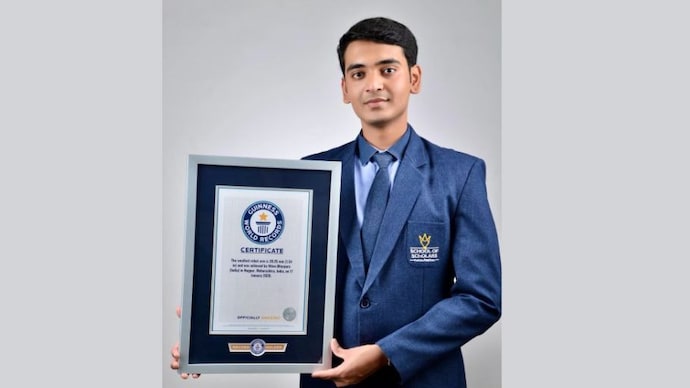
For most teenagers, life at 17 revolves around school, exams and college plans. For Hiten Dharpure from Nagpur, it has also meant spending countless hours designing and building robots. That passion has now earned him a Guinness World Record for creating the world's smallest fully functional robotic arm, measuring just 39.25 millimetres.
Officially measured at just 39.250 millimetres, the electro-mechanical robotic arm surpassed the previous Guinness World Record of 44.49 millimetres by 5.24 millimetres. Despite its tiny size, the device can grip and lift small objects with remarkable precision, demonstrating that cutting-edge engineering can thrive even on a miniature scale.
More than a record-breaking feat, the achievement reflects years of curiosity, persistence and a drive to push the boundaries of micro-robotics.
A NEW GUINNESS WORLD RECORD
The robotic arm, officially measured at 39.250 mm (1.54 inches), surpassed the previous Guinness World Record of 44.49 mm, improving it by 5.24 mm.
According to Guinness World Records, the title was officially awarded to Hiten Dharpure (India) in Nagpur, Maharashtra, with the record achieved on January 17, 2026.
Despite its miniature size, the robotic arm is fully functional. It is capable of independently gripping and manipulating small objects, demonstrating that engineering precision does not always require large-scale machines.
ENGINEERED FROM SCRATCH
What makes the achievement even more remarkable is that the robotic arm was designed and developed entirely from the ground up.
Hiten engineered the device using advanced CAD software before fabricating it through high-precision FDM 3D printing to minimise spatial waste. The arm is powered by micro servo motors and controlled through a precision PWM module, enabling smooth three-axis independent movement while delivering enough torque to perform gripping functions.
Sharing the milestone, Hiten described the record as more than just a personal achievement.
"This achievement represents more than a world record; it is a testament to the power of accessible technology and the Viksit Bharat vision. It proves that world-class innovation can start right from our own homes, capable of pushing the physical limits of micro-manufacturing."
Following the achievement, Hiten was felicitated by Union Minister Nitin Gadkari, who has recognised his work on multiple occasions.
Expressing his gratitude, Hiten said the minister's encouragement for young engineers has been a major source of motivation and has inspired him to continue taking on new technological challenges.
This marks the third time that Hiten has been honoured by Gadkari for his contributions to technology and innovation.
A YOUNG INNOVATOR WITH MULTIPLE WORLD RECORDS
The robotic arm is only the latest addition to Hiten's growing list of achievements.
The 17-year-old innovator has previously earned a Guinness World Record for developing the World's Smallest AI Weather Station. He also secured recognition from the Worldwide Book of Records for creating a synchronised robotic dance sequence using self-designed and 3D-printed robots.
In addition, he has been acknowledged by the India Book of Records for completing 801 STEM and coding certifications, reflecting his sustained interest in science, engineering and technology from a young age.
TECHNOLOGY WITH A PURPOSE
Beyond world records, Hiten focuses on developing technology that addresses real-world challenges.
One of his notable projects is HastaVaani, an offline Indian Sign Language (ISL) translation mobile application developed from scratch to help bridge communication barriers for the deaf community. His work spans artificial intelligence, embedded systems, robotics, offline AI models, full-stack mobile app development and accessibility-focused technology.
Currently, a student at School of Scholars, Nagpur, Hiten says his goal is to continue building solutions that combine software and hardware to create meaningful social impact.
Hiten Dharpure's latest Guinness World Record is more than a feat of miniaturisation. It is a reminder that breakthrough innovation can emerge from a teenager's workshop as much as from a research laboratory. As India continues to encourage home-grown engineering talent, achievements like his show that age is no barrier to building technology capable of making a mark on the global stage.
For most teenagers, life at 17 revolves around school, exams and college plans. For Hiten Dharpure from Nagpur, it has also meant spending countless hours designing and building robots. That passion has now earned him a Guinness World Record for creating the world's smallest fully functional robotic arm, measuring just 39.25 millimetres.
Officially measured at just 39.250 millimetres, the electro-mechanical robotic arm surpassed the previous Guinness World Record of 44.49 millimetres by 5.24 millimetres. Despite its tiny size, the device can grip and lift small objects with remarkable precision, demonstrating that cutting-edge engineering can thrive even on a miniature scale.
More than a record-breaking feat, the achievement reflects years of curiosity, persistence and a drive to push the boundaries of micro-robotics.
A NEW GUINNESS WORLD RECORD
The robotic arm, officially measured at 39.250 mm (1.54 inches), surpassed the previous Guinness World Record of 44.49 mm, improving it by 5.24 mm.
According to Guinness World Records, the title was officially awarded to Hiten Dharpure (India) in Nagpur, Maharashtra, with the record achieved on January 17, 2026.
Despite its miniature size, the robotic arm is fully functional. It is capable of independently gripping and manipulating small objects, demonstrating that engineering precision does not always require large-scale machines.
ENGINEERED FROM SCRATCH
What makes the achievement even more remarkable is that the robotic arm was designed and developed entirely from the ground up.
Hiten engineered the device using advanced CAD software before fabricating it through high-precision FDM 3D printing to minimise spatial waste. The arm is powered by micro servo motors and controlled through a precision PWM module, enabling smooth three-axis independent movement while delivering enough torque to perform gripping functions.
Sharing the milestone, Hiten described the record as more than just a personal achievement.
"This achievement represents more than a world record; it is a testament to the power of accessible technology and the Viksit Bharat vision. It proves that world-class innovation can start right from our own homes, capable of pushing the physical limits of micro-manufacturing."
Following the achievement, Hiten was felicitated by Union Minister Nitin Gadkari, who has recognised his work on multiple occasions.
Expressing his gratitude, Hiten said the minister's encouragement for young engineers has been a major source of motivation and has inspired him to continue taking on new technological challenges.
This marks the third time that Hiten has been honoured by Gadkari for his contributions to technology and innovation.
A YOUNG INNOVATOR WITH MULTIPLE WORLD RECORDS
The robotic arm is only the latest addition to Hiten's growing list of achievements.
The 17-year-old innovator has previously earned a Guinness World Record for developing the World's Smallest AI Weather Station. He also secured recognition from the Worldwide Book of Records for creating a synchronised robotic dance sequence using self-designed and 3D-printed robots.
In addition, he has been acknowledged by the India Book of Records for completing 801 STEM and coding certifications, reflecting his sustained interest in science, engineering and technology from a young age.
TECHNOLOGY WITH A PURPOSE
Beyond world records, Hiten focuses on developing technology that addresses real-world challenges.
One of his notable projects is HastaVaani, an offline Indian Sign Language (ISL) translation mobile application developed from scratch to help bridge communication barriers for the deaf community. His work spans artificial intelligence, embedded systems, robotics, offline AI models, full-stack mobile app development and accessibility-focused technology.
Currently, a student at School of Scholars, Nagpur, Hiten says his goal is to continue building solutions that combine software and hardware to create meaningful social impact.
Hiten Dharpure's latest Guinness World Record is more than a feat of miniaturisation. It is a reminder that breakthrough innovation can emerge from a teenager's workshop as much as from a research laboratory. As India continues to encourage home-grown engineering talent, achievements like his show that age is no barrier to building technology capable of making a mark on the global stage.

