8-year-old builds offline AI storytelling device using Rs 760 microcontroller
Laksh has built a voice-controlled AI storytelling device that runs entirely offline on an ESP32 chip. The project shows how open-source models and low-cost hardware can power compact AI tools without cloud access.
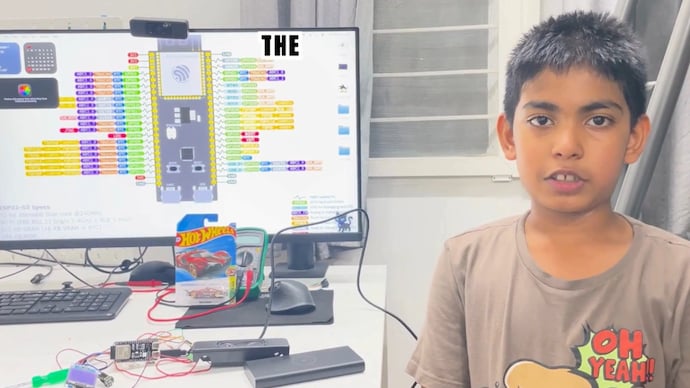
An eight-year-old developer has built a voice-controlled artificial intelligence (AI) storytelling device that runs completely offline using an $8 microcontroller.
Laksh, co-founder of Projects by Laksh, developed the device using an ESP32-S3 microcontroller, an INMP441 microphone, an I2S speaker, and a MAX98357A amplifier. The system does not require Wi-Fi, cloud services or APIs to work.
The AI can create short stories, read them aloud, display simple animations and respond to voice commands such as "play", "pause", "resume" and "next story."
BUILT ON AN OPEN-SOURCE AI MODEL
Laksh built the project by modifying an open-source language model called TinyStories LLM for ESP32, created by developer slvDev. The original model was designed to generate stories on the ESP32 microcontroller without an internet connection.
Laksh added several new features, including voice interaction, playback controls and animations. The result is a small AI device that users can control through spoken commands.
The source code for the original project is available on GitHub, where developers can build on the existing model or create their own versions.
DEMO SHOWS AI IN ACTION
In a demonstration of the device, Laksh introduced the project and explained that it runs entirely on the ESP32 chip.
When given the voice command, "Make a funny story," the AI responded by generating a new story. It then read the story aloud while displaying animations on the device. Users could control the storytelling using simple voice commands to play, pause, resume or move to the next story.
The demonstration showed that all processing takes place on the device itself, without connecting to the internet.
NEXT STEP IS BETTER VOICE QUALITY
Laksh said the current limitation is the quality of the text-to-speech (TTS) system running on the ESP32. While the AI can generate and read stories, the spoken English voice still sounds basic.
He said improving the text-to-speech output is the next goal for the project.
Laksh follows a flexible online education model designed to fit around his larger mission. Rather than attending a conventional school full-time, he learns through a program that gives him the freedom to travel, explore new environments, and pursue independent learning.
As a result, much of his day-to-day interaction is with adults, particularly founders and entrepreneurs.
The project highlights how open-source AI models and low-cost hardware can be combined to build offline AI applications. It also shows that small language models can run on compact devices without relying on cloud computing, making them useful in places where internet access is limited or unavailable.
An eight-year-old developer has built a voice-controlled artificial intelligence (AI) storytelling device that runs completely offline using an $8 microcontroller.
Laksh, co-founder of Projects by Laksh, developed the device using an ESP32-S3 microcontroller, an INMP441 microphone, an I2S speaker, and a MAX98357A amplifier. The system does not require Wi-Fi, cloud services or APIs to work.
The AI can create short stories, read them aloud, display simple animations and respond to voice commands such as "play", "pause", "resume" and "next story."
BUILT ON AN OPEN-SOURCE AI MODEL
Laksh built the project by modifying an open-source language model called TinyStories LLM for ESP32, created by developer slvDev. The original model was designed to generate stories on the ESP32 microcontroller without an internet connection.
Laksh added several new features, including voice interaction, playback controls and animations. The result is a small AI device that users can control through spoken commands.
The source code for the original project is available on GitHub, where developers can build on the existing model or create their own versions.
DEMO SHOWS AI IN ACTION
In a demonstration of the device, Laksh introduced the project and explained that it runs entirely on the ESP32 chip.
When given the voice command, "Make a funny story," the AI responded by generating a new story. It then read the story aloud while displaying animations on the device. Users could control the storytelling using simple voice commands to play, pause, resume or move to the next story.
The demonstration showed that all processing takes place on the device itself, without connecting to the internet.
NEXT STEP IS BETTER VOICE QUALITY
Laksh said the current limitation is the quality of the text-to-speech (TTS) system running on the ESP32. While the AI can generate and read stories, the spoken English voice still sounds basic.
He said improving the text-to-speech output is the next goal for the project.
Laksh follows a flexible online education model designed to fit around his larger mission. Rather than attending a conventional school full-time, he learns through a program that gives him the freedom to travel, explore new environments, and pursue independent learning.
As a result, much of his day-to-day interaction is with adults, particularly founders and entrepreneurs.
The project highlights how open-source AI models and low-cost hardware can be combined to build offline AI applications. It also shows that small language models can run on compact devices without relying on cloud computing, making them useful in places where internet access is limited or unavailable.
An eight-year-old developer has built a voice-controlled artificial intelligence (AI) storytelling device that runs completely offline using an $8 microcontroller.
Laksh, co-founder of Projects by Laksh, developed the device using an ESP32-S3 microcontroller, an INMP441 microphone, an I2S speaker, and a MAX98357A amplifier. The system does not require Wi-Fi, cloud services or APIs to work.
The AI can create short stories, read them aloud, display simple animations and respond to voice commands such as "play", "pause", "resume" and "next story."
BUILT ON AN OPEN-SOURCE AI MODEL
Laksh built the project by modifying an open-source language model called TinyStories LLM for ESP32, created by developer slvDev. The original model was designed to generate stories on the ESP32 microcontroller without an internet connection.
Laksh added several new features, including voice interaction, playback controls and animations. The result is a small AI device that users can control through spoken commands.
The source code for the original project is available on GitHub, where developers can build on the existing model or create their own versions.
DEMO SHOWS AI IN ACTION
In a demonstration of the device, Laksh introduced the project and explained that it runs entirely on the ESP32 chip.
When given the voice command, "Make a funny story," the AI responded by generating a new story. It then read the story aloud while displaying animations on the device. Users could control the storytelling using simple voice commands to play, pause, resume or move to the next story.
The demonstration showed that all processing takes place on the device itself, without connecting to the internet.
NEXT STEP IS BETTER VOICE QUALITY
Laksh said the current limitation is the quality of the text-to-speech (TTS) system running on the ESP32. While the AI can generate and read stories, the spoken English voice still sounds basic.
He said improving the text-to-speech output is the next goal for the project.
Laksh follows a flexible online education model designed to fit around his larger mission. Rather than attending a conventional school full-time, he learns through a program that gives him the freedom to travel, explore new environments, and pursue independent learning.
As a result, much of his day-to-day interaction is with adults, particularly founders and entrepreneurs.
The project highlights how open-source AI models and low-cost hardware can be combined to build offline AI applications. It also shows that small language models can run on compact devices without relying on cloud computing, making them useful in places where internet access is limited or unavailable.

