Can Gujarat find water, power for its Rs 6 lakh crore data-centre dream?
The Bhupendra Patel government aims to make Gujarat India's best destination for data centres and is targeting 7.5 GW worth of capacity
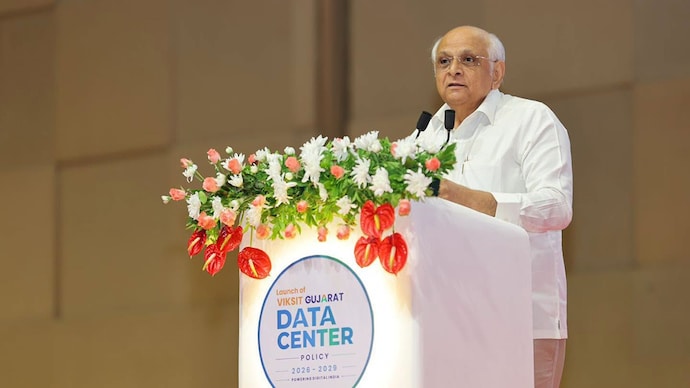
“The Viksit Gujarat Data Centre Policy 2026-29 will make Gujarat the best destination in India for setting up data centres,” Patel said. “It will strengthen cloud services, artificial intelligence, e-commerce, digital governance and smart manufacturing.”
Deputy chief minister Harsh Sanghavi said Dholera “is moving forward as the world's largest data centre city”. That is a huge promise. Dholera is building wide roads, underground pipes and a big solar park. A semiconductor factory is under construction by Tata. Yet a lot is still on the drawing board. The Dholera international airport, with two runways, is expected to start partial operations this year. About 5 per cent of the total 920 sq km area of Dholera Smart City is currently under development as an ‘activation area’. Six other companies have been allotted land in the ‘activation area’, and there is scope for several more.
So what is a data centre? Think of it as a giant building full of computers that store and handle the world's data—every email, video, photo and AI chat lives inside. Every government wants more of them because they power the internet and AI boom, and they make a state look modern and ready for the future.
But here's a catch: data centres don't create many jobs. Building one employs thousands of workers for a while. Once it's running, though, a huge hall of machines may need only a few hundred people at best. States don't earn much in direct wages either. They hope to gain in other ways, such as land deals, selling electricity, taxes from the businesses that grow around them, and the pride of hosting global giants like, say, Google or Amazon.
But the hardest part is water and power. Data-centre computers run very hot and must be cooled, often with water, and a lot of it. They also consume electricity like a small city. Gujarat says it is “power-surplus” and will use seawater, not farmers' water, for cooling. But desalination plants—the machines that turn seawater into fresh water—are costly. Around the world, the biggest headache for data centres isn't money. It's getting enough power and water ready on time.
Gujarat may be power-surplus currently, but doesn’t have enough to meet the roaring needs of semiconductor manufacturing plants and data centres. The sharpest challenge is water. The state’s drinking, irrigation and industrial water supply needs are largely met by the Narmada water and groundwater—but barely.
Diverting significant water for new-age industries would require the state to set up new sources of water, which would most likely be desalination plants. In Dholera, a desalination capacity of 20 million litres a day (MLD) is active, which suffices the current needs of the ‘activation area’.
On July 9, Dholera Industrial City Development Limited (DICDL) floated a tender for consultancy services for a proposed 200 MLD seawater desalination plant at the Dholera Special Investment Region (DSIR). The exact water requirement at full scale operation of the DSIR is not yet known. Thus the speed of scaling of desalination plants will be a critical factor in these promises turning into reality.
To win the race, Gujarat is offering generous deals—a Re 1 discount on every unit of electricity for 20 years, no stamp duty, and money back on many taxes. Only very big projects (150 MW and above) qualify, so this is aimed at global ‘hyperscalers’, not small players.
Gujarat is not alone, or even first. Tamil Nadu, Uttar Pradesh, Karnataka, Telangana, Maharashtra and Odisha all wrote data-centre policies years ago. Today, Maharashtra, led by Mumbai, is India's clear leader. Across the country, companies have already promised tens of billions of dollars—Google alone is spending about $6 billion on a 1 GW project in Andhra Pradesh.
What arguably stands out in Gujarat's offer is the very long, very rich list of freebies, and the sheer size of the target. The policy says 7.5 GW, but science and technology minister Arjun Modhwadia said the state has “received proposals for data centres with a total capacity of 10 gigawatts”.
For scale, all of India today runs on roughly 2 GW of data centres. Gujarat alone is promising several times that. “India, despite generating nearly 20 per cent of the world's data, has only about 3 per cent of global data centre capacity. This represents a tremendous opportunity,” said state science and technology secretary P. Bharati.
The world's largest data centre hub is the ‘Data Center Alley’ in Northern Virginia, United States. It already has around 16 to 20 GW running or being built, more than double Dholera's entire dream, and it took decades to get there. The Gujarat policy is bold on paper, but whether the state can pour the water and switch on the power on time is what will decide if the Rs 6 lakh crore ever lands.
Subscribe to India Today Magazine
“The Viksit Gujarat Data Centre Policy 2026-29 will make Gujarat the best destination in India for setting up data centres,” Patel said. “It will strengthen cloud services, artificial intelligence, e-commerce, digital governance and smart manufacturing.”
Deputy chief minister Harsh Sanghavi said Dholera “is moving forward as the world's largest data centre city”. That is a huge promise. Dholera is building wide roads, underground pipes and a big solar park. A semiconductor factory is under construction by Tata. Yet a lot is still on the drawing board. The Dholera international airport, with two runways, is expected to start partial operations this year. About 5 per cent of the total 920 sq km area of Dholera Smart City is currently under development as an ‘activation area’. Six other companies have been allotted land in the ‘activation area’, and there is scope for several more.
So what is a data centre? Think of it as a giant building full of computers that store and handle the world's data—every email, video, photo and AI chat lives inside. Every government wants more of them because they power the internet and AI boom, and they make a state look modern and ready for the future.
But here's a catch: data centres don't create many jobs. Building one employs thousands of workers for a while. Once it's running, though, a huge hall of machines may need only a few hundred people at best. States don't earn much in direct wages either. They hope to gain in other ways, such as land deals, selling electricity, taxes from the businesses that grow around them, and the pride of hosting global giants like, say, Google or Amazon.
But the hardest part is water and power. Data-centre computers run very hot and must be cooled, often with water, and a lot of it. They also consume electricity like a small city. Gujarat says it is “power-surplus” and will use seawater, not farmers' water, for cooling. But desalination plants—the machines that turn seawater into fresh water—are costly. Around the world, the biggest headache for data centres isn't money. It's getting enough power and water ready on time.
Gujarat may be power-surplus currently, but doesn’t have enough to meet the roaring needs of semiconductor manufacturing plants and data centres. The sharpest challenge is water. The state’s drinking, irrigation and industrial water supply needs are largely met by the Narmada water and groundwater—but barely.
Diverting significant water for new-age industries would require the state to set up new sources of water, which would most likely be desalination plants. In Dholera, a desalination capacity of 20 million litres a day (MLD) is active, which suffices the current needs of the ‘activation area’.
On July 9, Dholera Industrial City Development Limited (DICDL) floated a tender for consultancy services for a proposed 200 MLD seawater desalination plant at the Dholera Special Investment Region (DSIR). The exact water requirement at full scale operation of the DSIR is not yet known. Thus the speed of scaling of desalination plants will be a critical factor in these promises turning into reality.
To win the race, Gujarat is offering generous deals—a Re 1 discount on every unit of electricity for 20 years, no stamp duty, and money back on many taxes. Only very big projects (150 MW and above) qualify, so this is aimed at global ‘hyperscalers’, not small players.
Gujarat is not alone, or even first. Tamil Nadu, Uttar Pradesh, Karnataka, Telangana, Maharashtra and Odisha all wrote data-centre policies years ago. Today, Maharashtra, led by Mumbai, is India's clear leader. Across the country, companies have already promised tens of billions of dollars—Google alone is spending about $6 billion on a 1 GW project in Andhra Pradesh.
What arguably stands out in Gujarat's offer is the very long, very rich list of freebies, and the sheer size of the target. The policy says 7.5 GW, but science and technology minister Arjun Modhwadia said the state has “received proposals for data centres with a total capacity of 10 gigawatts”.
For scale, all of India today runs on roughly 2 GW of data centres. Gujarat alone is promising several times that. “India, despite generating nearly 20 per cent of the world's data, has only about 3 per cent of global data centre capacity. This represents a tremendous opportunity,” said state science and technology secretary P. Bharati.
The world's largest data centre hub is the ‘Data Center Alley’ in Northern Virginia, United States. It already has around 16 to 20 GW running or being built, more than double Dholera's entire dream, and it took decades to get there. The Gujarat policy is bold on paper, but whether the state can pour the water and switch on the power on time is what will decide if the Rs 6 lakh crore ever lands.
Subscribe to India Today Magazine

