Stop ghosting us: At CJP protest, students say internet ban has left them in limbo
"They can hear our slogans, but they won't let our messages through." Inside the internet blackout that students say is making Delhi's CJP protest even harder to navigate.
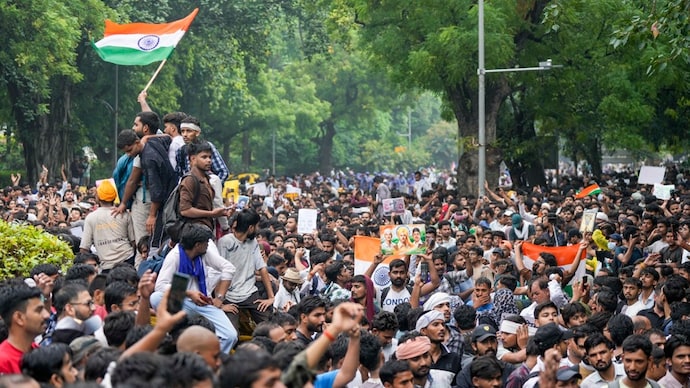
Every protest has its soundtrack. At the ongoing CJP student protest in Delhi, it is the familiar rhythm of slogans, speeches and applause. But in between those sounds, there is a silence, one that students say has been imposed on them.
With internet services suspended around the protest site and several nearby Metro stations shut, many students claim they are struggling to stay connected with their families, locate fellow protesters, coordinate movement and even verify information coming from the stage.
For some, the internet shutdown is not just an inconvenience. They describe it as another barrier in an already difficult protest.
'WE CAN'T EVEN TELL OUR PARENTS WHERE WE ARE'
Twenty-year-old Yashika Arya, attending the protest for the third time, says the internet shutdown became painfully evident during the July 20 Parliament march.
"We were at the protest when the internet suddenly stopped working. No updates about what was happening could reach anyone. We couldn't even tell our parents where we were or what was happening to us," she says, adding that the communication blackout leaves protesters vulnerable.
"If something happens to us tomorrow, we won't even be able to tell anyone where we are."
Yashika also claims that protesters have faced lathi charges, abusive remarks, and intimidation.
"The internet shutdown means we can't even protect ourselves by informing people about what's happening. If someone gets separated in the crowd, finding them becomes incredibly difficult," she says.
"Some students in my group had absolutely no network on their phones. If you get lost in a crowd, nobody knows where you are."
Despite everything, she says she feels safer among fellow protesters than elsewhere.
"I feel safer with the people protesting here than I do around the Delhi Police."
Yashika also says women participating in the protest have received rape and acid attack threats online.
"People troll us on social media, abuse us and even threaten us with rape and acid attacks. But here, among the protesters, I still feel safe," she says.
'IF SOMEONE GETS LOST, THERE IS NO WAY TO REACH THEM'
Nineteen-year-old Harshita says this is her third day at the protest. She is not an official volunteer but found herself helping distribute food after noticing the rush.
"I'm not a food distribution volunteer. I just saw that people needed help distributing food, so I started helping," she says.
What frustrated her most, she says, was trying to communicate without internet.
"The internet is completely shut down. Yesterday and the day before, even the mobile network was jammed. If someone gets separated from the group, you can't hear them properly over a call in such a huge crowd, text messages don't go through, and there's no way to contact anyone."
The Delhi Metro closures have made reaching the protest difficult.
"All the Metro stations within about two kilometres are closed. Whether someone wants to come to the protest or even needs to go to a hospital, nobody is listening, even if you tell them it's an emergency," she adds.
COORDINATION WITHOUT COMMUNICATION
For twenty-six-year-old Naureen, who has been camping at the protest site since July 20, the biggest challenge is coordination.
"If we need to post something or share a message, we have to leave the protest site and walk towards a Metro station where we might get internet."
She says the shutdown creates confusion even within the protest.
"Without communication, one thing is announced from the stage, but people hear something completely different. It creates confusion, panic and misinformation because the correct information doesn't reach everyone."
Naureen says many supporters are unable to reach the protest because organisers cannot guide them online.
"Many people keep asking us where they should come because the Metro stations are shut. If the internet wasn't blocked, we could have guided them," she says.
She believes the shutdown is aimed at limiting public awareness. "All of this is happening so that people don't see what's really happening here and fewer people come out in support."
Even so, her appeal remains one of restraint.
"I just want to appeal to everyone protesting to keep this movement peaceful. Don't let anyone who wants to make this protest look violent succeed. Be responsible and don't let anyone hijack what we're trying to do," she says.
'DON'T GHOST US'
Among the youngest protesters is Yashi, a Class 12 student from Uttar Pradesh, attending the protest for the first time.
She says the internet shutdown only isolates people further.
"I don't think the internet should be banned here. If it is, people won't stay informed, and those here won't even be able to connect with the people they know," she says.
Like many others gathered there, she says she wants accountability and change.
"I want resignations and a better education system. They should listen to us, come up with solutions, and stop ghosting us," she says.
She ends on a hopeful note. "I'm really happy this protest is happening, and I just hope it doesn't go to waste."
At the CJP protest site, placards continue to rise above the crowd and slogans continue to echo through central Delhi. But students say another battle is unfolding quietly, one over communication itself.
Whether it is a parent trying to reach their child, volunteers coordinating food distribution, protesters locating missing friends or supporters searching for the nearest open metro station, many here argue that losing internet connectivity has made an already demanding protest even harder to navigate.
For them, the loudest message isn't just being shouted from the stage. It is the one they say they are unable to send.
Every protest has its soundtrack. At the ongoing CJP student protest in Delhi, it is the familiar rhythm of slogans, speeches and applause. But in between those sounds, there is a silence, one that students say has been imposed on them.
With internet services suspended around the protest site and several nearby Metro stations shut, many students claim they are struggling to stay connected with their families, locate fellow protesters, coordinate movement and even verify information coming from the stage.
For some, the internet shutdown is not just an inconvenience. They describe it as another barrier in an already difficult protest.
'WE CAN'T EVEN TELL OUR PARENTS WHERE WE ARE'
Twenty-year-old Yashika Arya, attending the protest for the third time, says the internet shutdown became painfully evident during the July 20 Parliament march.
"We were at the protest when the internet suddenly stopped working. No updates about what was happening could reach anyone. We couldn't even tell our parents where we were or what was happening to us," she says, adding that the communication blackout leaves protesters vulnerable.
"If something happens to us tomorrow, we won't even be able to tell anyone where we are."
Yashika also claims that protesters have faced lathi charges, abusive remarks, and intimidation.
"The internet shutdown means we can't even protect ourselves by informing people about what's happening. If someone gets separated in the crowd, finding them becomes incredibly difficult," she says.
"Some students in my group had absolutely no network on their phones. If you get lost in a crowd, nobody knows where you are."
Despite everything, she says she feels safer among fellow protesters than elsewhere.
"I feel safer with the people protesting here than I do around the Delhi Police."
Yashika also says women participating in the protest have received rape and acid attack threats online.
"People troll us on social media, abuse us and even threaten us with rape and acid attacks. But here, among the protesters, I still feel safe," she says.
'IF SOMEONE GETS LOST, THERE IS NO WAY TO REACH THEM'
Nineteen-year-old Harshita says this is her third day at the protest. She is not an official volunteer but found herself helping distribute food after noticing the rush.
"I'm not a food distribution volunteer. I just saw that people needed help distributing food, so I started helping," she says.
What frustrated her most, she says, was trying to communicate without internet.
"The internet is completely shut down. Yesterday and the day before, even the mobile network was jammed. If someone gets separated from the group, you can't hear them properly over a call in such a huge crowd, text messages don't go through, and there's no way to contact anyone."
The Delhi Metro closures have made reaching the protest difficult.
"All the Metro stations within about two kilometres are closed. Whether someone wants to come to the protest or even needs to go to a hospital, nobody is listening, even if you tell them it's an emergency," she adds.
COORDINATION WITHOUT COMMUNICATION
For twenty-six-year-old Naureen, who has been camping at the protest site since July 20, the biggest challenge is coordination.
"If we need to post something or share a message, we have to leave the protest site and walk towards a Metro station where we might get internet."
She says the shutdown creates confusion even within the protest.
"Without communication, one thing is announced from the stage, but people hear something completely different. It creates confusion, panic and misinformation because the correct information doesn't reach everyone."
Naureen says many supporters are unable to reach the protest because organisers cannot guide them online.
"Many people keep asking us where they should come because the Metro stations are shut. If the internet wasn't blocked, we could have guided them," she says.
She believes the shutdown is aimed at limiting public awareness. "All of this is happening so that people don't see what's really happening here and fewer people come out in support."
Even so, her appeal remains one of restraint.
"I just want to appeal to everyone protesting to keep this movement peaceful. Don't let anyone who wants to make this protest look violent succeed. Be responsible and don't let anyone hijack what we're trying to do," she says.
'DON'T GHOST US'
Among the youngest protesters is Yashi, a Class 12 student from Uttar Pradesh, attending the protest for the first time.
She says the internet shutdown only isolates people further.
"I don't think the internet should be banned here. If it is, people won't stay informed, and those here won't even be able to connect with the people they know," she says.
Like many others gathered there, she says she wants accountability and change.
"I want resignations and a better education system. They should listen to us, come up with solutions, and stop ghosting us," she says.
She ends on a hopeful note. "I'm really happy this protest is happening, and I just hope it doesn't go to waste."
At the CJP protest site, placards continue to rise above the crowd and slogans continue to echo through central Delhi. But students say another battle is unfolding quietly, one over communication itself.
Whether it is a parent trying to reach their child, volunteers coordinating food distribution, protesters locating missing friends or supporters searching for the nearest open metro station, many here argue that losing internet connectivity has made an already demanding protest even harder to navigate.
For them, the loudest message isn't just being shouted from the stage. It is the one they say they are unable to send.
Every protest has its soundtrack. At the ongoing CJP student protest in Delhi, it is the familiar rhythm of slogans, speeches and applause. But in between those sounds, there is a silence, one that students say has been imposed on them.
With internet services suspended around the protest site and several nearby Metro stations shut, many students claim they are struggling to stay connected with their families, locate fellow protesters, coordinate movement and even verify information coming from the stage.
For some, the internet shutdown is not just an inconvenience. They describe it as another barrier in an already difficult protest.
'WE CAN'T EVEN TELL OUR PARENTS WHERE WE ARE'
Twenty-year-old Yashika Arya, attending the protest for the third time, says the internet shutdown became painfully evident during the July 20 Parliament march.
"We were at the protest when the internet suddenly stopped working. No updates about what was happening could reach anyone. We couldn't even tell our parents where we were or what was happening to us," she says, adding that the communication blackout leaves protesters vulnerable.
"If something happens to us tomorrow, we won't even be able to tell anyone where we are."
Yashika also claims that protesters have faced lathi charges, abusive remarks, and intimidation.
"The internet shutdown means we can't even protect ourselves by informing people about what's happening. If someone gets separated in the crowd, finding them becomes incredibly difficult," she says.
"Some students in my group had absolutely no network on their phones. If you get lost in a crowd, nobody knows where you are."
Despite everything, she says she feels safer among fellow protesters than elsewhere.
"I feel safer with the people protesting here than I do around the Delhi Police."
Yashika also says women participating in the protest have received rape and acid attack threats online.
"People troll us on social media, abuse us and even threaten us with rape and acid attacks. But here, among the protesters, I still feel safe," she says.
'IF SOMEONE GETS LOST, THERE IS NO WAY TO REACH THEM'
Nineteen-year-old Harshita says this is her third day at the protest. She is not an official volunteer but found herself helping distribute food after noticing the rush.
"I'm not a food distribution volunteer. I just saw that people needed help distributing food, so I started helping," she says.
What frustrated her most, she says, was trying to communicate without internet.
"The internet is completely shut down. Yesterday and the day before, even the mobile network was jammed. If someone gets separated from the group, you can't hear them properly over a call in such a huge crowd, text messages don't go through, and there's no way to contact anyone."
The Delhi Metro closures have made reaching the protest difficult.
"All the Metro stations within about two kilometres are closed. Whether someone wants to come to the protest or even needs to go to a hospital, nobody is listening, even if you tell them it's an emergency," she adds.
COORDINATION WITHOUT COMMUNICATION
For twenty-six-year-old Naureen, who has been camping at the protest site since July 20, the biggest challenge is coordination.
"If we need to post something or share a message, we have to leave the protest site and walk towards a Metro station where we might get internet."
She says the shutdown creates confusion even within the protest.
"Without communication, one thing is announced from the stage, but people hear something completely different. It creates confusion, panic and misinformation because the correct information doesn't reach everyone."
Naureen says many supporters are unable to reach the protest because organisers cannot guide them online.
"Many people keep asking us where they should come because the Metro stations are shut. If the internet wasn't blocked, we could have guided them," she says.
She believes the shutdown is aimed at limiting public awareness. "All of this is happening so that people don't see what's really happening here and fewer people come out in support."
Even so, her appeal remains one of restraint.
"I just want to appeal to everyone protesting to keep this movement peaceful. Don't let anyone who wants to make this protest look violent succeed. Be responsible and don't let anyone hijack what we're trying to do," she says.
'DON'T GHOST US'
Among the youngest protesters is Yashi, a Class 12 student from Uttar Pradesh, attending the protest for the first time.
She says the internet shutdown only isolates people further.
"I don't think the internet should be banned here. If it is, people won't stay informed, and those here won't even be able to connect with the people they know," she says.
Like many others gathered there, she says she wants accountability and change.
"I want resignations and a better education system. They should listen to us, come up with solutions, and stop ghosting us," she says.
She ends on a hopeful note. "I'm really happy this protest is happening, and I just hope it doesn't go to waste."
At the CJP protest site, placards continue to rise above the crowd and slogans continue to echo through central Delhi. But students say another battle is unfolding quietly, one over communication itself.
Whether it is a parent trying to reach their child, volunteers coordinating food distribution, protesters locating missing friends or supporters searching for the nearest open metro station, many here argue that losing internet connectivity has made an already demanding protest even harder to navigate.
For them, the loudest message isn't just being shouted from the stage. It is the one they say they are unable to send.

