Can a protest FIR stop your passport, foreign degree or career?
An FIR alone shouldn't derail a career or passport. Yet lawyers say disclosures, background checks, and delays are real concerns. That's why many students at Jantar Mantar wore masks, not to hide wrongdoing, but to protect what comes after the protest.
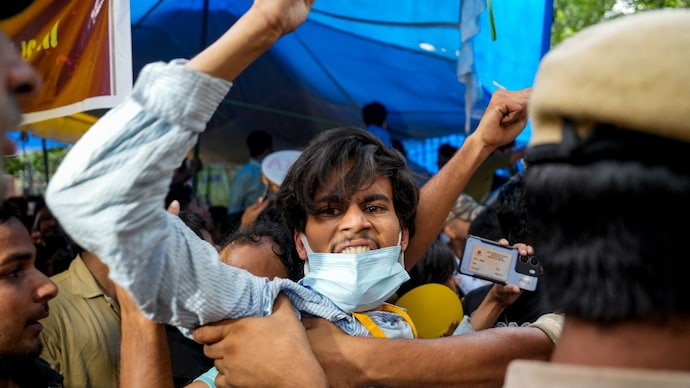
"I have no fear of police cases. What wrong are we doing? We are asking the government to meet our demands. We have no ill intentions, so why fear? We need a better education system."
Ravi, 22, a Delhi resident at Jantar Mantar, spoke these words while standing among students, many of whom had covered their faces with masks and glasses, a day before Union Education Minister Dharmendra Pradhan resigned on Saturday (July 25). Ravi is young and full of energy. He appears not to realise that even a complaint against him can later create problems in securing a job, obtaining a passport, or gaining admission abroad.
The students at the protest site told India Today Digital they were not trying to attack anyone. They had hidden their faces to protect their identities from Artificial Intelligence (AI)-powered facial recognition cameras deployed by the Delhi Police at Jantar Mantar.
Exactly a week ago, on July 20, thousands marched under the banner of the Cockroach Janta Party (CJP) in the Chalo Sansad protest. The agitation grew out of the NEET-UG paper leak. The protest turned into a confrontation with police last Monday.
Delhi Police's facial recognition system units and mobile surveillance vans at Jantar Mantar were looking at every face walking into the protest site. India Today TV later reported that the system flagged more than 2,500 people with existing criminal records. Fifteen FIRs have been registered against protesters so far in the clashes that took place in and around the protest site. However, the CJP demanded that the FIRs against students be dropped, and the Centre agreed to the demands of the outfit.
Police maintained the cameras were meant to identify criminals who might infiltrate the crowd and to protect both officers and peaceful demonstrators. Activists, however, called the same cameras an attack on privacy.
Students who turned up on July 20 and in the days that followed now face a question that goes beyond the protest. If an FIR is registered against them, or if they have a court date, what happens to their jobs, their passports, and their chances of studying or working abroad?
THE FEAR ON THE GROUND
Ashwini Verma, 28, from Azamgarh in Uttar Pradesh, spoke to India Today Digital a day before Education Minister Dharmendra Pradhan resigned. He had covered his face as he spoke to us. The June 20 lathi-charge on students made him decide to come to Delhi. A neighbour from his village had earlier travelled to the capital with just Rs 20 to protest against the education system. That story stayed with him. The July 20 action became the final trigger.
"I am preparing for the Provincial Civil Service (PCS) exam. I have a fear of a case being lodged against me, but there is an independent judiciary in this country. I believe in it. If a false case is filed against me, I will get acquitted. That is why I am protesting here. My being here is important because I am also a student suffering from this education system. Each and every voice is important. The most I can do is wear a mask. That is why I am wearing it — to differ from any false charges against me for attending the protest."
Ravi, on the other hand, was more direct in his approach. "Asking for accountability doesn't scare me from visiting the protest. It is okay if they restrict me from studying abroad. Nobody here fears police cases. Only people with bad intentions or criminals fear police cases, not students like us," he told India Today Digital.
Yet many others still covered their faces.
A SUPREME COURT LAWYER EXPLAINS WHAT CAN GO WRONG
A Supreme Court advocate who has been attending the protests regularly, speaking on condition of anonymity, said the fear is real and justified.
"If an FIR gets registered in your name, that is an entry against your identity. Tomorrow, if I go to apply for a visa or any kind of thing where I need to declare that I have an FIR against me, it does play a role in getting a visa or higher education and jobs. Even if the FIR is closed and I have been acquitted, I still have to declare it in many places, including passport, visa applications. That declaration point is happening. It does affect your system, especially depending on what work you want to do, what higher education you want to seek, what visa you are applying for. It is a very justified fear."
He added that the biggest challenge for the young people on the ground is no longer the fear of being beaten. He observed hundreds of people who were masked up.
"Their fear of getting beaten up is gone. Their fear is of having legal consequences and changing what their further steps into the future will be. That is why people wear masks. They are not showing up in masks because they are trying to do some attack. They are hiding their identity because Delhi Police is doing mass surveillance," the Supreme Court advocate explained.
WHAT THE LAW SAYS ABOUT PASSPORTS AND CASES
Bombay High Court lawyer and human rights advocate Vinod Shetty, who has handled civil liberties cases for decades, told India Today Digital the problem is not new. Institutions have come down hard on students for years. "JNU and some IITs have seen rustication and disciplinary action over FIRs against students. In the last decade, the space for open debate on campuses has narrowed because of the fear of students saying something that might land them in trouble," Shetty said.
"It will show up somewhere, but if they are not convicted, ideally, it should not make any great impact on their service. Students should not worry about it, because finally, every student movement in every generation has had a history. Students will get involved in politics and students will have cases put on them," the Bombay High Court lawyer said.
However, Shetty drew a sharper line on the methods sometimes used to frame students. He recalled the Mumbai police officer who recently threatened an 18-year-old student that if he came to the protests again, drugs would be planted in his bag. "That is a really real vicious kind of thing, and a very dangerous thing to tell children. Those kinds of drug trafficking cases are non-bailable offences which are really going to hurt. That kind of nasty thing which cops sometimes do to students is totally dangerous," Shetty said.
On surveillance itself, Shetty said, "Photographs and videography by police during processions have long been standard practice. But taking phones, numbers, and issuing middle-of-the-night notices crosses into illegality."
Courts have repeatedly clarified their position on passports. Section 6(2)(f) of the Passports Act, 1967, allows refusal if criminal proceedings are pending before a criminal court. Multiple High Courts — including Kerala, Andhra Pradesh, Jammu and Kashmir, Punjab and Haryana, and Madras — have held that mere registration of an FIR or ongoing investigation is not enough for the refusal of passports. Proceedings are considered pending only when a court has taken cognisance, usually after a charge sheet is filed.
Passport authorities have been directed not to treat an FIR alone as a disqualification. In practice, however, police verification often flags pending cases. Applicants might then need a court No Objection Certificate (NOC), and the process can delay or complicate issuance or renewal.
Senior journalist Vinod Kumar Menon recently reported in the Mumbai-based mid-day newspaper that lawyers have raised concerns over Zero FIRs being registered against student protesters. Such FIRs, filed without immediate jurisdictional clarity, can still create a record that surfaces during background checks even before a formal case takes shape.
HOW FIRs CAN AFFECT JOBS, GOVERNMENT CONTRACTS, AND WORK IN PRIVATE SECTOR
A public policy professional who works with the Odisha Chief Minister's Office and previously with the central government, speaking on condition of anonymity, described the reality for those in or near government work.
"It is very difficult [to participate in protests], especially for policy professionals who see the workings of the government. It is not just about government employees. It is also about contractors working with the government, or people working with organisations that aim to collaborate with the government — non-profit, for-profit or consulting. In some job contracts, it is explicitly mentioned that they are prohibited or discouraged from voicing opinions even in private social media spaces. If someone is participating in a protest, they have to be super mindful not to get identified in any way. Even a small detention can lead to unwarranted consequences in professional life," he said.
He pointed to the expanding surveillance architecture in India — National Grid, Netra and other systems — and the government's public statements about passport cancellation and other measures that people should be cautious about.
The Supreme Court advocate, who spoke on the condition of anonymity, noted that advocates themselves hesitate less because of professional networks and knowledge of police procedure. "Students and first-time protesters do not have that buffer. I know many who switched off their phones near Jantar Mantar, kept the mask on throughout, and avoided any digital or physical identification markers," the advocate said.
STUDYING ABROAD WITH A PENDING CASE
Foreign universities and visa authorities treat criminal records differently by country, but disclosure is usually required.
In the United States, F-1 student visa applications and Student and Exchange Visitor Information System (SEVIS) records can be affected by arrests or pending charges, even without conviction. Schools conduct their own risk assessments. Pending cases can pause admissions decisions or trigger additional scrutiny.
Canada, the United Kingdom, Australia and several European countries also require a declaration of criminal history or pending proceedings. Minor or political cases are sometimes explained successfully, especially if the applicant shows the case was for peaceful protest and has been closed or stayed. Serious charges, or any record involving violence or drugs, create far higher barriers.
Indian courts have in some instances allowed accused persons on bail to travel abroad for higher education, treating the right to education and travel as part of personal liberty under Article 21, subject to conditions.
Still, the practical sequence remains: an FIR appears in police databases, passport verification may stall, visa forms demand disclosure, and universities may pause offers until the matter is clarified. The declaration requirement does not disappear even after acquittal.
WHAT FIRST-TIME PROTESTERS NEED TO KNOW ABOUT THE LAW
Vinod Shetty advised basic preparedness for those who want to participate in protests. "Anyone going into the streets must understand the possibility of arrest. Inform family and friends. Check whether the march has permission. In Mumbai, police often allow protests with permission; problems escalate when barricades are broken or the procession turns disorderly," he said.
The Supreme Court advocate said legal rights awareness remains low. "Students detained often do not know their rights. Advocates on the ground form WhatsApp groups precisely to fill that gap. One of the demands is that FIRs and legal actions against peaceful protesters be withdrawn or closed so that the records do not follow the students for years," the Supreme Court advocate told India Today Digital.
The July 20 march and the subsequent surveillance have made the trade-off visible. An FIR is not a conviction. Courts have limited the power of passport authorities to act on FIRs alone. Yet the record exists, the declaration forms exist, and the background checks also exist.
For a generation already preparing for competitive exams, government jobs, corporate roles, or foreign degrees, that record is very real. The calculation must be made every time students decide whether to put on a mask before stepping into the street.
"I have no fear of police cases. What wrong are we doing? We are asking the government to meet our demands. We have no ill intentions, so why fear? We need a better education system."
Ravi, 22, a Delhi resident at Jantar Mantar, spoke these words while standing among students, many of whom had covered their faces with masks and glasses, a day before Union Education Minister Dharmendra Pradhan resigned on Saturday (July 25). Ravi is young and full of energy. He appears not to realise that even a complaint against him can later create problems in securing a job, obtaining a passport, or gaining admission abroad.
The students at the protest site told India Today Digital they were not trying to attack anyone. They had hidden their faces to protect their identities from Artificial Intelligence (AI)-powered facial recognition cameras deployed by the Delhi Police at Jantar Mantar.
Exactly a week ago, on July 20, thousands marched under the banner of the Cockroach Janta Party (CJP) in the Chalo Sansad protest. The agitation grew out of the NEET-UG paper leak. The protest turned into a confrontation with police last Monday.
Delhi Police's facial recognition system units and mobile surveillance vans at Jantar Mantar were looking at every face walking into the protest site. India Today TV later reported that the system flagged more than 2,500 people with existing criminal records. Fifteen FIRs have been registered against protesters so far in the clashes that took place in and around the protest site. However, the CJP demanded that the FIRs against students be dropped, and the Centre agreed to the demands of the outfit.
Police maintained the cameras were meant to identify criminals who might infiltrate the crowd and to protect both officers and peaceful demonstrators. Activists, however, called the same cameras an attack on privacy.
Students who turned up on July 20 and in the days that followed now face a question that goes beyond the protest. If an FIR is registered against them, or if they have a court date, what happens to their jobs, their passports, and their chances of studying or working abroad?
THE FEAR ON THE GROUND
Ashwini Verma, 28, from Azamgarh in Uttar Pradesh, spoke to India Today Digital a day before Education Minister Dharmendra Pradhan resigned. He had covered his face as he spoke to us. The June 20 lathi-charge on students made him decide to come to Delhi. A neighbour from his village had earlier travelled to the capital with just Rs 20 to protest against the education system. That story stayed with him. The July 20 action became the final trigger.
"I am preparing for the Provincial Civil Service (PCS) exam. I have a fear of a case being lodged against me, but there is an independent judiciary in this country. I believe in it. If a false case is filed against me, I will get acquitted. That is why I am protesting here. My being here is important because I am also a student suffering from this education system. Each and every voice is important. The most I can do is wear a mask. That is why I am wearing it — to differ from any false charges against me for attending the protest."
Ravi, on the other hand, was more direct in his approach. "Asking for accountability doesn't scare me from visiting the protest. It is okay if they restrict me from studying abroad. Nobody here fears police cases. Only people with bad intentions or criminals fear police cases, not students like us," he told India Today Digital.
Yet many others still covered their faces.
A SUPREME COURT LAWYER EXPLAINS WHAT CAN GO WRONG
A Supreme Court advocate who has been attending the protests regularly, speaking on condition of anonymity, said the fear is real and justified.
"If an FIR gets registered in your name, that is an entry against your identity. Tomorrow, if I go to apply for a visa or any kind of thing where I need to declare that I have an FIR against me, it does play a role in getting a visa or higher education and jobs. Even if the FIR is closed and I have been acquitted, I still have to declare it in many places, including passport, visa applications. That declaration point is happening. It does affect your system, especially depending on what work you want to do, what higher education you want to seek, what visa you are applying for. It is a very justified fear."
He added that the biggest challenge for the young people on the ground is no longer the fear of being beaten. He observed hundreds of people who were masked up.
"Their fear of getting beaten up is gone. Their fear is of having legal consequences and changing what their further steps into the future will be. That is why people wear masks. They are not showing up in masks because they are trying to do some attack. They are hiding their identity because Delhi Police is doing mass surveillance," the Supreme Court advocate explained.
WHAT THE LAW SAYS ABOUT PASSPORTS AND CASES
Bombay High Court lawyer and human rights advocate Vinod Shetty, who has handled civil liberties cases for decades, told India Today Digital the problem is not new. Institutions have come down hard on students for years. "JNU and some IITs have seen rustication and disciplinary action over FIRs against students. In the last decade, the space for open debate on campuses has narrowed because of the fear of students saying something that might land them in trouble," Shetty said.
"It will show up somewhere, but if they are not convicted, ideally, it should not make any great impact on their service. Students should not worry about it, because finally, every student movement in every generation has had a history. Students will get involved in politics and students will have cases put on them," the Bombay High Court lawyer said.
However, Shetty drew a sharper line on the methods sometimes used to frame students. He recalled the Mumbai police officer who recently threatened an 18-year-old student that if he came to the protests again, drugs would be planted in his bag. "That is a really real vicious kind of thing, and a very dangerous thing to tell children. Those kinds of drug trafficking cases are non-bailable offences which are really going to hurt. That kind of nasty thing which cops sometimes do to students is totally dangerous," Shetty said.
On surveillance itself, Shetty said, "Photographs and videography by police during processions have long been standard practice. But taking phones, numbers, and issuing middle-of-the-night notices crosses into illegality."
Courts have repeatedly clarified their position on passports. Section 6(2)(f) of the Passports Act, 1967, allows refusal if criminal proceedings are pending before a criminal court. Multiple High Courts — including Kerala, Andhra Pradesh, Jammu and Kashmir, Punjab and Haryana, and Madras — have held that mere registration of an FIR or ongoing investigation is not enough for the refusal of passports. Proceedings are considered pending only when a court has taken cognisance, usually after a charge sheet is filed.
Passport authorities have been directed not to treat an FIR alone as a disqualification. In practice, however, police verification often flags pending cases. Applicants might then need a court No Objection Certificate (NOC), and the process can delay or complicate issuance or renewal.
Senior journalist Vinod Kumar Menon recently reported in the Mumbai-based mid-day newspaper that lawyers have raised concerns over Zero FIRs being registered against student protesters. Such FIRs, filed without immediate jurisdictional clarity, can still create a record that surfaces during background checks even before a formal case takes shape.
HOW FIRs CAN AFFECT JOBS, GOVERNMENT CONTRACTS, AND WORK IN PRIVATE SECTOR
A public policy professional who works with the Odisha Chief Minister's Office and previously with the central government, speaking on condition of anonymity, described the reality for those in or near government work.
"It is very difficult [to participate in protests], especially for policy professionals who see the workings of the government. It is not just about government employees. It is also about contractors working with the government, or people working with organisations that aim to collaborate with the government — non-profit, for-profit or consulting. In some job contracts, it is explicitly mentioned that they are prohibited or discouraged from voicing opinions even in private social media spaces. If someone is participating in a protest, they have to be super mindful not to get identified in any way. Even a small detention can lead to unwarranted consequences in professional life," he said.
He pointed to the expanding surveillance architecture in India — National Grid, Netra and other systems — and the government's public statements about passport cancellation and other measures that people should be cautious about.
The Supreme Court advocate, who spoke on the condition of anonymity, noted that advocates themselves hesitate less because of professional networks and knowledge of police procedure. "Students and first-time protesters do not have that buffer. I know many who switched off their phones near Jantar Mantar, kept the mask on throughout, and avoided any digital or physical identification markers," the advocate said.
STUDYING ABROAD WITH A PENDING CASE
Foreign universities and visa authorities treat criminal records differently by country, but disclosure is usually required.
In the United States, F-1 student visa applications and Student and Exchange Visitor Information System (SEVIS) records can be affected by arrests or pending charges, even without conviction. Schools conduct their own risk assessments. Pending cases can pause admissions decisions or trigger additional scrutiny.
Canada, the United Kingdom, Australia and several European countries also require a declaration of criminal history or pending proceedings. Minor or political cases are sometimes explained successfully, especially if the applicant shows the case was for peaceful protest and has been closed or stayed. Serious charges, or any record involving violence or drugs, create far higher barriers.
Indian courts have in some instances allowed accused persons on bail to travel abroad for higher education, treating the right to education and travel as part of personal liberty under Article 21, subject to conditions.
Still, the practical sequence remains: an FIR appears in police databases, passport verification may stall, visa forms demand disclosure, and universities may pause offers until the matter is clarified. The declaration requirement does not disappear even after acquittal.
WHAT FIRST-TIME PROTESTERS NEED TO KNOW ABOUT THE LAW
Vinod Shetty advised basic preparedness for those who want to participate in protests. "Anyone going into the streets must understand the possibility of arrest. Inform family and friends. Check whether the march has permission. In Mumbai, police often allow protests with permission; problems escalate when barricades are broken or the procession turns disorderly," he said.
The Supreme Court advocate said legal rights awareness remains low. "Students detained often do not know their rights. Advocates on the ground form WhatsApp groups precisely to fill that gap. One of the demands is that FIRs and legal actions against peaceful protesters be withdrawn or closed so that the records do not follow the students for years," the Supreme Court advocate told India Today Digital.
The July 20 march and the subsequent surveillance have made the trade-off visible. An FIR is not a conviction. Courts have limited the power of passport authorities to act on FIRs alone. Yet the record exists, the declaration forms exist, and the background checks also exist.
For a generation already preparing for competitive exams, government jobs, corporate roles, or foreign degrees, that record is very real. The calculation must be made every time students decide whether to put on a mask before stepping into the street.
"I have no fear of police cases. What wrong are we doing? We are asking the government to meet our demands. We have no ill intentions, so why fear? We need a better education system."
Ravi, 22, a Delhi resident at Jantar Mantar, spoke these words while standing among students, many of whom had covered their faces with masks and glasses, a day before Union Education Minister Dharmendra Pradhan resigned on Saturday (July 25). Ravi is young and full of energy. He appears not to realise that even a complaint against him can later create problems in securing a job, obtaining a passport, or gaining admission abroad.
The students at the protest site told India Today Digital they were not trying to attack anyone. They had hidden their faces to protect their identities from Artificial Intelligence (AI)-powered facial recognition cameras deployed by the Delhi Police at Jantar Mantar.
Exactly a week ago, on July 20, thousands marched under the banner of the Cockroach Janta Party (CJP) in the Chalo Sansad protest. The agitation grew out of the NEET-UG paper leak. The protest turned into a confrontation with police last Monday.
Delhi Police's facial recognition system units and mobile surveillance vans at Jantar Mantar were looking at every face walking into the protest site. India Today TV later reported that the system flagged more than 2,500 people with existing criminal records. Fifteen FIRs have been registered against protesters so far in the clashes that took place in and around the protest site. However, the CJP demanded that the FIRs against students be dropped, and the Centre agreed to the demands of the outfit.
Police maintained the cameras were meant to identify criminals who might infiltrate the crowd and to protect both officers and peaceful demonstrators. Activists, however, called the same cameras an attack on privacy.
Students who turned up on July 20 and in the days that followed now face a question that goes beyond the protest. If an FIR is registered against them, or if they have a court date, what happens to their jobs, their passports, and their chances of studying or working abroad?
THE FEAR ON THE GROUND
Ashwini Verma, 28, from Azamgarh in Uttar Pradesh, spoke to India Today Digital a day before Education Minister Dharmendra Pradhan resigned. He had covered his face as he spoke to us. The June 20 lathi-charge on students made him decide to come to Delhi. A neighbour from his village had earlier travelled to the capital with just Rs 20 to protest against the education system. That story stayed with him. The July 20 action became the final trigger.
"I am preparing for the Provincial Civil Service (PCS) exam. I have a fear of a case being lodged against me, but there is an independent judiciary in this country. I believe in it. If a false case is filed against me, I will get acquitted. That is why I am protesting here. My being here is important because I am also a student suffering from this education system. Each and every voice is important. The most I can do is wear a mask. That is why I am wearing it — to differ from any false charges against me for attending the protest."
Ravi, on the other hand, was more direct in his approach. "Asking for accountability doesn't scare me from visiting the protest. It is okay if they restrict me from studying abroad. Nobody here fears police cases. Only people with bad intentions or criminals fear police cases, not students like us," he told India Today Digital.
Yet many others still covered their faces.
A SUPREME COURT LAWYER EXPLAINS WHAT CAN GO WRONG
A Supreme Court advocate who has been attending the protests regularly, speaking on condition of anonymity, said the fear is real and justified.
"If an FIR gets registered in your name, that is an entry against your identity. Tomorrow, if I go to apply for a visa or any kind of thing where I need to declare that I have an FIR against me, it does play a role in getting a visa or higher education and jobs. Even if the FIR is closed and I have been acquitted, I still have to declare it in many places, including passport, visa applications. That declaration point is happening. It does affect your system, especially depending on what work you want to do, what higher education you want to seek, what visa you are applying for. It is a very justified fear."
He added that the biggest challenge for the young people on the ground is no longer the fear of being beaten. He observed hundreds of people who were masked up.
"Their fear of getting beaten up is gone. Their fear is of having legal consequences and changing what their further steps into the future will be. That is why people wear masks. They are not showing up in masks because they are trying to do some attack. They are hiding their identity because Delhi Police is doing mass surveillance," the Supreme Court advocate explained.
WHAT THE LAW SAYS ABOUT PASSPORTS AND CASES
Bombay High Court lawyer and human rights advocate Vinod Shetty, who has handled civil liberties cases for decades, told India Today Digital the problem is not new. Institutions have come down hard on students for years. "JNU and some IITs have seen rustication and disciplinary action over FIRs against students. In the last decade, the space for open debate on campuses has narrowed because of the fear of students saying something that might land them in trouble," Shetty said.
"It will show up somewhere, but if they are not convicted, ideally, it should not make any great impact on their service. Students should not worry about it, because finally, every student movement in every generation has had a history. Students will get involved in politics and students will have cases put on them," the Bombay High Court lawyer said.
However, Shetty drew a sharper line on the methods sometimes used to frame students. He recalled the Mumbai police officer who recently threatened an 18-year-old student that if he came to the protests again, drugs would be planted in his bag. "That is a really real vicious kind of thing, and a very dangerous thing to tell children. Those kinds of drug trafficking cases are non-bailable offences which are really going to hurt. That kind of nasty thing which cops sometimes do to students is totally dangerous," Shetty said.
On surveillance itself, Shetty said, "Photographs and videography by police during processions have long been standard practice. But taking phones, numbers, and issuing middle-of-the-night notices crosses into illegality."
Courts have repeatedly clarified their position on passports. Section 6(2)(f) of the Passports Act, 1967, allows refusal if criminal proceedings are pending before a criminal court. Multiple High Courts — including Kerala, Andhra Pradesh, Jammu and Kashmir, Punjab and Haryana, and Madras — have held that mere registration of an FIR or ongoing investigation is not enough for the refusal of passports. Proceedings are considered pending only when a court has taken cognisance, usually after a charge sheet is filed.
Passport authorities have been directed not to treat an FIR alone as a disqualification. In practice, however, police verification often flags pending cases. Applicants might then need a court No Objection Certificate (NOC), and the process can delay or complicate issuance or renewal.
Senior journalist Vinod Kumar Menon recently reported in the Mumbai-based mid-day newspaper that lawyers have raised concerns over Zero FIRs being registered against student protesters. Such FIRs, filed without immediate jurisdictional clarity, can still create a record that surfaces during background checks even before a formal case takes shape.
HOW FIRs CAN AFFECT JOBS, GOVERNMENT CONTRACTS, AND WORK IN PRIVATE SECTOR
A public policy professional who works with the Odisha Chief Minister's Office and previously with the central government, speaking on condition of anonymity, described the reality for those in or near government work.
"It is very difficult [to participate in protests], especially for policy professionals who see the workings of the government. It is not just about government employees. It is also about contractors working with the government, or people working with organisations that aim to collaborate with the government — non-profit, for-profit or consulting. In some job contracts, it is explicitly mentioned that they are prohibited or discouraged from voicing opinions even in private social media spaces. If someone is participating in a protest, they have to be super mindful not to get identified in any way. Even a small detention can lead to unwarranted consequences in professional life," he said.
He pointed to the expanding surveillance architecture in India — National Grid, Netra and other systems — and the government's public statements about passport cancellation and other measures that people should be cautious about.
The Supreme Court advocate, who spoke on the condition of anonymity, noted that advocates themselves hesitate less because of professional networks and knowledge of police procedure. "Students and first-time protesters do not have that buffer. I know many who switched off their phones near Jantar Mantar, kept the mask on throughout, and avoided any digital or physical identification markers," the advocate said.
STUDYING ABROAD WITH A PENDING CASE
Foreign universities and visa authorities treat criminal records differently by country, but disclosure is usually required.
In the United States, F-1 student visa applications and Student and Exchange Visitor Information System (SEVIS) records can be affected by arrests or pending charges, even without conviction. Schools conduct their own risk assessments. Pending cases can pause admissions decisions or trigger additional scrutiny.
Canada, the United Kingdom, Australia and several European countries also require a declaration of criminal history or pending proceedings. Minor or political cases are sometimes explained successfully, especially if the applicant shows the case was for peaceful protest and has been closed or stayed. Serious charges, or any record involving violence or drugs, create far higher barriers.
Indian courts have in some instances allowed accused persons on bail to travel abroad for higher education, treating the right to education and travel as part of personal liberty under Article 21, subject to conditions.
Still, the practical sequence remains: an FIR appears in police databases, passport verification may stall, visa forms demand disclosure, and universities may pause offers until the matter is clarified. The declaration requirement does not disappear even after acquittal.
WHAT FIRST-TIME PROTESTERS NEED TO KNOW ABOUT THE LAW
Vinod Shetty advised basic preparedness for those who want to participate in protests. "Anyone going into the streets must understand the possibility of arrest. Inform family and friends. Check whether the march has permission. In Mumbai, police often allow protests with permission; problems escalate when barricades are broken or the procession turns disorderly," he said.
The Supreme Court advocate said legal rights awareness remains low. "Students detained often do not know their rights. Advocates on the ground form WhatsApp groups precisely to fill that gap. One of the demands is that FIRs and legal actions against peaceful protesters be withdrawn or closed so that the records do not follow the students for years," the Supreme Court advocate told India Today Digital.
The July 20 march and the subsequent surveillance have made the trade-off visible. An FIR is not a conviction. Courts have limited the power of passport authorities to act on FIRs alone. Yet the record exists, the declaration forms exist, and the background checks also exist.
For a generation already preparing for competitive exams, government jobs, corporate roles, or foreign degrees, that record is very real. The calculation must be made every time students decide whether to put on a mask before stepping into the street.

