I spent a night as a cockroach at CJP's Jantar Mantar protest. This is what I saw
I stayed overnight at the Cockroach Janta Party (CJP) protest site at New Delhi's Jantar Mantar without revealing my identity. I spoke to the participants, ate the food being served and overheard the conversations around fasting activist Sonam Wangchuk. I also noticed the unease over absent CJP leaders.
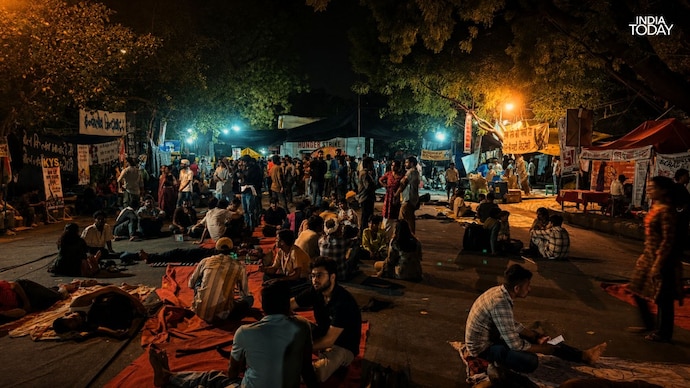
By the time Delhi's employed public was heading home and the evening traffic had begun swallowing Connaught Place, I had transformed into a cockroach. Not the kind after whom people instinctively run with their slippers, but the kind that has, over the past few weeks, found a home at New Delhi's Jantar Mantar. The Cockroach Janta Party (CJP) has been protesting here since June 28 seeking Union Education Minister Dharmendra Pradhan's resignation and activist Sonam Wangchuk is on an indefinite hunger strike here. So, for one night, I became one of them. I will tell you here about one night and the many stories.
I arrived at the protest site at Jantar Mantar around 5.30 pm, carrying my phone, an umbrella, a blanket, and the curiosity not of a journalist but of a young protester. I have been to Jantar Mantar earlier too, including on the first day the CJP, led by Abhijeet Dipke, started the protest. This time, however, I planned not to spend my time here as a journalist.
Protests are mainly remembered for fiery speeches, sloganeering, and sacrifices. Spending an entire night at Jantar Mantar, I also saw that they are built on other aspects as well.
THE FOOTFALL OF PROTESTERS WAS BEYOND EXPECTATION
While travelling to the protest site, I'd been thinking that it would be a quiet Tuesday. After all, it was a working day. I imagined lower turnout of protesters, a sparsely occupied stage, and volunteers waiting for the weekend when larger crowds return.
The first few minutes after reaching ground zero almost confirmed my assumption. Plastic chairs were mostly occupied by Delhi Police and Rapid Action Force (RAF) personnel, and some were still scattered across the protest site.
A few protesters under the banner of Left-wing students' outfits AISF, SFI and AISA sat in circles, demanding Pradhan's resignation. On the main stage were the prominent faces of the CJP.
At the entrance of the protest site, a Delhi Police personnel stopped me for a security check, called an "anti-sabotage check". Even as he inspected my bag, I struck up a conversation. I asked the cop at what time people gather in large numbers every day.
"Exactly at the time you have come," he replied.
"After 10 in the morning, very few people stay back. But wait till six in the evening. That's when they all begin arriving," the police personnel added.
Months of deployment at Jantar Mantar had made the personnel an expert observer of protest behaviour. His prediction took less than half an hour to come true. The footpath outside Jantar Mantar began delivering people.
Some walked in straight from work. College students entered in groups carrying rolled-up banners. Elderly men and women were also arriving to make the "future of their grandchildren's education secure".
NOT EVERYONE AT JANTAR MANTAR HAD COME TO PROTEST OR SEEK RESIGNATION
Interestingly, not everyone at the Jantar Mantar was participating in the protest.
Young couples wandered through the agitation zone hand in hand, stopping to read a poster before moving on. Families posed for photographs near the main stage. Groups of youths appeared more interested in filming Instagram Reels than listening to the speeches.
For one section of Delhi, Jantar Mantar remains the country's designated protest ground, where citizens gather to demand accountability from those in power.
For another, it has quietly become a place to walk, watch and spend time before heading home. However, the CJP protest is worth watching as it has embraced protesters from across the country and ideology.
PEOPLE COMING TO JANTAR MANTAR TO SUPPORT SONAM WANGCHUK
Beyond the mix of curiosity and activism in Jantar Mantar, there was one unmistakable centre of gravity. His name was activist-educationist Sonam Wangchuk.
I stood silently and observed people speak. Most frequently, I heard people mention one name, Wangchuk. "Till when will he continue his hunger strike?" "We should not lose an innovator like him," was what I heard repeatedly.
Wangchuk's fast had entered its 17th day on Tuesday. Concerns over Wangchuk's health had spiralled, and prominent personalities from diverse fields were asking him to end his fast. The concern was intense among the common people at Jantar Mantar too.
There were dozens of volunteers of the CJP coordinating different activities. Student organisations occupied separate corners. But every conversation eventually circled back to the same person. Sonam Wangchuk
Even the security personnel I spoke to had reached the same conclusion.
"People are coming to see Wangchuk," an RAF jawan, standing near the barricade, told me while watching the swelling crowd. "The crowd is because of him," he added.
SONAM WANGCHUK'S ADDRESS STUNNED PROTESTERS
The 59-year-old activist's indefinite hunger strike reached its 18th day on Wednesday. He has become much more than the face of the movement. He had become its emotional connect.
For several days, Wangchuk had largely stayed away from public addresses because of his fast. So when whispers began circulating through the gathering that he would speak on Tuesday evening, excitement spread surprisingly fast.
Within minutes, people who had been sitting in scattered groups quietly moved closer to the stage. Volunteers stopped their conversations. Camera phones rose above everyone's heads. Even those casually walking around stopped right where they were.
"We didn't know he would speak today," said a young protester standing beside me. "It was a surprise," he added.
Wangchuk started his address by acknowledging those people who had quietly embraced hunger alongside him. "Our fasting might not immediately bring resignations. But if it awakens people, then it has served its purpose," the activist said.
"One resignation alone changes very little. The day people awaken, every department of the Government of India will see change," Wangchuk added.
LIKE WANGCHUK, OTHER PROTESTERS ALSO HOLDING HUNGER STRIKES AT JANTAR MANTAR
As people dispersed from the stage after Wangchuk's speech on Tuesday evening, I decided to follow those protesters who were away from the spotlight and loud slogans. Nearly 10 protesters were silently holding an indefinite hunger strike, like Wangchuk.
While clips of Abhijeet Dipke eating kachodi, noodles and bread pakoda as Wangchuk fasted went viral, no videos of the other fasting protesters have been circulated widely.
Bahadhur Singh had travelled from Aligarh in Uttar Pradesh. Tuesday marked the 14th day of his indefinite hunger strike. Sitting cross-legged on a thin mattress, he spoke softly about the five demands that had compelled him to leave home.
"I came here for the nation and will not return home until I achieve my motives," he said.
Beside him sat Deepak Yadav from Lucknow, who had completed 10 days without food, and three who had recently started fasting.
Just towards the right side of Bahadhur's canopy, Aameen, Neha and Manish, associated with the AISA students' outfit, were observing their 17th day of hunger strike.
BAHADHUR SINGH AND THE OTHER THREE HAVE A UNIQUE STORY
What struck me most was not the duration of the hunger strikes of AISA students or of Bahadhur Singh and his team. But it was the relationships they had built.
In Bahadhur's canopy, there were a total of four people holding a hunger strike, but none of them knew each other days ago. They had never met before reaching Jantar Mantar.
Now, after weeks of sharing the same tent, the same uncertainty and the same physical discomfort had quietly turned strangers into companions. They knew each other's medicines, reminded one another to drink water and discussed health updates with the familiarity of old friends.
Earlier on Tuesday, CJP leaders had invited all the fasting protesters onto the main stage. They requested them to end their fast so that together they could persuade Wangchuk to call off his own indefinite hunger strike.
The appeal was emotional. But none accepted it.
Instead, the organisers felicitated every fasting protester with applause from the audience. The younger participants walked up to Wangchuk and touched his feet before returning to their places beneath the canopy.
THE CJP PROTEST ENTERED ITS BUSIEST SHIFT
Even as I stepped away from the canopy of the youths on hunger strike, the mood at Jantar Mantar began changing. The sun had sat, the lights on the main stage had become brighter, and the protest had entered what regulars here seemed to consider its "busiest shift".
Volunteers of the CJP hurried from one corner to another carrying extension boards and microphones. Students who had spent the day sloganeering now gathered in groups to rehearse songs. On the stage, poetry replaced political speeches for a while. A little further away, another group practised a street play they hoped to perform during the CJP's 'Sansad Chalo' or march to Parliament planned for July 20.
The protest had begun to resemble a university campus after classes rather than a site of political agitation.
Different student organisations occupied different corners. Members of the AISA, SFI, Disha and Kranti Yuva Sanghatan moved around introducing themselves to newcomers, discussing plans for the coming days. A free student library had been set up on one side of the venue. Volunteers encouraged visitors to browse through the books before returning them to the tables.
As I wandered from one group to another, I realised that this protest was running almost like a small township. Every person seemed to have quietly taken ownership of one responsibility. Some handled the stage. Some managed social media. Some looked after the fasting protesters. Others simply ensured that anyone entering the venue felt comfortable.
FOOD BECAME THE HIGHLIGHT OF THE CJP PROTEST
Amid all the chaos, the dinner arrived at 10 pm sharp. The atmosphere changed instantly. Food worked like a social glue for the CJP protest to connect people.
Large steel vessels began appearing one after another, carried carefully by volunteers weaving through the crowd. One contained rice. Another carried a thick North Indian-style gravy. Disposable plates were stacked in neat piles before volunteers quickly organised serving lines. Nobody shouted instructions. The queue simply formed on its own, as though everyone had already rehearsed it over the weeks.
I quietly joined the line. After all, I had become a cockroach for the night and had the greatest interest in food after watching the videos on social media.
Like everyone else, I waited patiently with a paper plate in my hand, listening to the conversations of those in the queue. My turn to receive rice came, and the volunteer serving rice insisted that I take a little more.
The meal was simple but, more importantly, satisfying. Rice with a semi-spiced gravy served on a paper plate while sitting cross-legged on the ground somehow tasted better.
WHO'S SPONSORING THE FOOD AT CJP PROTEST AT JANTAR MANTAR?
The rice eventually was over, but nobody complained. Instead, volunteers quickly switched to serving samosas with the remaining gravy. The line of protesters continued moving.
Then, just when everyone thought dinner had ended, another man walked in balancing a large steel vessel. His name was Rizwan. He had travelled from Seelampur-Zaffarabad carrying sweetened rice.
"I had sweet rice in the afternoon," he laughed while serving generous portions. "I thought my cockroaches should also have sweet rice tonight," he added.
Along with the sweet rice came boxes of ice cream, disappearing almost as quickly as volunteers unpacked them. Children ran excitedly towards the serving table while adults patiently waited for their turn. I got one mixed fruit candy ice cream.
Several CJP volunteers later told me that almost every day's meals were made possible through donations from supporters. Some contributed money, others cooked food at home and brought it themselves. Biscuits, drinking water and other essentials remained stocked throughout the day so that nobody visiting the protest had to leave hungry or go thirsty.
Amid the laughter surrounding dinner, one image quietly stayed with me. As it was time for the food to arrive, Sonam Wangchuk slowly turned away and slept facing the main stage's background.
Honestly, I don't know why Wangchuk turned around. Was it regarding the food being served? The timing of his action just made me assume. But this became one of the most powerful images of the entire night for me.
THEY ARE NOT SERIOUS: PROTESTERS ON ABHIJEET DIPKE
Soon after dinner, the protest found another rhythm. Discussions broke out across the venue as protesters formed smaller circles and settled into conversations of their own.
As I wandered around looking for an interesting discussion to join, one group's conversation made me stop. For the first time since the evening, I heard protesters criticising CJP founder Abhijeet Dipke and some of the outfit's prominent faces.
It was around 1 am on Wednesday. The main stage had fallen silent, with only Sonam Wangchuk sleeping while a few CJP volunteers sat nearby. Dipke, Saurav Das, Vijeta Dahiya and Ashutosh Ranka, the faces that have come to represent the CJP, were nowhere to be seen. Their absence around midnight became the subject of discussion.
"Someone from among them should stay with Sonam sir," one protester said.
"This shows they are not serious about the protest," an elderly man in the group said.
As dawn neared, the conversations gradually gave way to silence. I sat among different groups of young protesters resting after the day's activities. Some had stretched themselves on their mattresses, while others leaned against their backpacks, endlessly scrolling through the Reels they had shot during the evening.
Then came one amusing moment.
Almost at the same time, several mobile phones around me began playing Kahan Se Aaya Tha Woh from 3 Idiots. Nobody had coordinated it. The film 3 Idiots was inspired by the life and ideas of Sonam Wangchuk, who was sleeping just a few metres away. Aamir Khan played Rancho or Phunsukh Wangdu, a character said to be inspired by Wangchuk.
At around 2 am, I lied down on the blanket that I had carried with me.
By 4 am on Wednesday, Jantar Mantar had finally fallen silent. The stage lights had dimmed. Blankets had replaced banners.
Only a handful of cockroaches were still awake. Some continued humming protest songs. Others rehearsed their performances for the July 20 Parliament march.
As I quietly walked past the police barricades and stepped back into a city that was finally asleep, I realised that, one Tuesday night, I had stopped being a reporter watching the cockroaches. I had become one of them. And it is a night that will stay with me.
By the time Delhi's employed public was heading home and the evening traffic had begun swallowing Connaught Place, I had transformed into a cockroach. Not the kind after whom people instinctively run with their slippers, but the kind that has, over the past few weeks, found a home at New Delhi's Jantar Mantar. The Cockroach Janta Party (CJP) has been protesting here since June 28 seeking Union Education Minister Dharmendra Pradhan's resignation and activist Sonam Wangchuk is on an indefinite hunger strike here. So, for one night, I became one of them. I will tell you here about one night and the many stories.
I arrived at the protest site at Jantar Mantar around 5.30 pm, carrying my phone, an umbrella, a blanket, and the curiosity not of a journalist but of a young protester. I have been to Jantar Mantar earlier too, including on the first day the CJP, led by Abhijeet Dipke, started the protest. This time, however, I planned not to spend my time here as a journalist.
Protests are mainly remembered for fiery speeches, sloganeering, and sacrifices. Spending an entire night at Jantar Mantar, I also saw that they are built on other aspects as well.
THE FOOTFALL OF PROTESTERS WAS BEYOND EXPECTATION
While travelling to the protest site, I'd been thinking that it would be a quiet Tuesday. After all, it was a working day. I imagined lower turnout of protesters, a sparsely occupied stage, and volunteers waiting for the weekend when larger crowds return.
The first few minutes after reaching ground zero almost confirmed my assumption. Plastic chairs were mostly occupied by Delhi Police and Rapid Action Force (RAF) personnel, and some were still scattered across the protest site.
A few protesters under the banner of Left-wing students' outfits AISF, SFI and AISA sat in circles, demanding Pradhan's resignation. On the main stage were the prominent faces of the CJP.
At the entrance of the protest site, a Delhi Police personnel stopped me for a security check, called an "anti-sabotage check". Even as he inspected my bag, I struck up a conversation. I asked the cop at what time people gather in large numbers every day.
"Exactly at the time you have come," he replied.
"After 10 in the morning, very few people stay back. But wait till six in the evening. That's when they all begin arriving," the police personnel added.
Months of deployment at Jantar Mantar had made the personnel an expert observer of protest behaviour. His prediction took less than half an hour to come true. The footpath outside Jantar Mantar began delivering people.
Some walked in straight from work. College students entered in groups carrying rolled-up banners. Elderly men and women were also arriving to make the "future of their grandchildren's education secure".
NOT EVERYONE AT JANTAR MANTAR HAD COME TO PROTEST OR SEEK RESIGNATION
Interestingly, not everyone at the Jantar Mantar was participating in the protest.
Young couples wandered through the agitation zone hand in hand, stopping to read a poster before moving on. Families posed for photographs near the main stage. Groups of youths appeared more interested in filming Instagram Reels than listening to the speeches.
For one section of Delhi, Jantar Mantar remains the country's designated protest ground, where citizens gather to demand accountability from those in power.
For another, it has quietly become a place to walk, watch and spend time before heading home. However, the CJP protest is worth watching as it has embraced protesters from across the country and ideology.
PEOPLE COMING TO JANTAR MANTAR TO SUPPORT SONAM WANGCHUK
Beyond the mix of curiosity and activism in Jantar Mantar, there was one unmistakable centre of gravity. His name was activist-educationist Sonam Wangchuk.
I stood silently and observed people speak. Most frequently, I heard people mention one name, Wangchuk. "Till when will he continue his hunger strike?" "We should not lose an innovator like him," was what I heard repeatedly.
Wangchuk's fast had entered its 17th day on Tuesday. Concerns over Wangchuk's health had spiralled, and prominent personalities from diverse fields were asking him to end his fast. The concern was intense among the common people at Jantar Mantar too.
There were dozens of volunteers of the CJP coordinating different activities. Student organisations occupied separate corners. But every conversation eventually circled back to the same person. Sonam Wangchuk
Even the security personnel I spoke to had reached the same conclusion.
"People are coming to see Wangchuk," an RAF jawan, standing near the barricade, told me while watching the swelling crowd. "The crowd is because of him," he added.
SONAM WANGCHUK'S ADDRESS STUNNED PROTESTERS
The 59-year-old activist's indefinite hunger strike reached its 18th day on Wednesday. He has become much more than the face of the movement. He had become its emotional connect.
For several days, Wangchuk had largely stayed away from public addresses because of his fast. So when whispers began circulating through the gathering that he would speak on Tuesday evening, excitement spread surprisingly fast.
Within minutes, people who had been sitting in scattered groups quietly moved closer to the stage. Volunteers stopped their conversations. Camera phones rose above everyone's heads. Even those casually walking around stopped right where they were.
"We didn't know he would speak today," said a young protester standing beside me. "It was a surprise," he added.
Wangchuk started his address by acknowledging those people who had quietly embraced hunger alongside him. "Our fasting might not immediately bring resignations. But if it awakens people, then it has served its purpose," the activist said.
"One resignation alone changes very little. The day people awaken, every department of the Government of India will see change," Wangchuk added.
LIKE WANGCHUK, OTHER PROTESTERS ALSO HOLDING HUNGER STRIKES AT JANTAR MANTAR
As people dispersed from the stage after Wangchuk's speech on Tuesday evening, I decided to follow those protesters who were away from the spotlight and loud slogans. Nearly 10 protesters were silently holding an indefinite hunger strike, like Wangchuk.
While clips of Abhijeet Dipke eating kachodi, noodles and bread pakoda as Wangchuk fasted went viral, no videos of the other fasting protesters have been circulated widely.
Bahadhur Singh had travelled from Aligarh in Uttar Pradesh. Tuesday marked the 14th day of his indefinite hunger strike. Sitting cross-legged on a thin mattress, he spoke softly about the five demands that had compelled him to leave home.
"I came here for the nation and will not return home until I achieve my motives," he said.
Beside him sat Deepak Yadav from Lucknow, who had completed 10 days without food, and three who had recently started fasting.
Just towards the right side of Bahadhur's canopy, Aameen, Neha and Manish, associated with the AISA students' outfit, were observing their 17th day of hunger strike.
BAHADHUR SINGH AND THE OTHER THREE HAVE A UNIQUE STORY
What struck me most was not the duration of the hunger strikes of AISA students or of Bahadhur Singh and his team. But it was the relationships they had built.
In Bahadhur's canopy, there were a total of four people holding a hunger strike, but none of them knew each other days ago. They had never met before reaching Jantar Mantar.
Now, after weeks of sharing the same tent, the same uncertainty and the same physical discomfort had quietly turned strangers into companions. They knew each other's medicines, reminded one another to drink water and discussed health updates with the familiarity of old friends.
Earlier on Tuesday, CJP leaders had invited all the fasting protesters onto the main stage. They requested them to end their fast so that together they could persuade Wangchuk to call off his own indefinite hunger strike.
The appeal was emotional. But none accepted it.
Instead, the organisers felicitated every fasting protester with applause from the audience. The younger participants walked up to Wangchuk and touched his feet before returning to their places beneath the canopy.
THE CJP PROTEST ENTERED ITS BUSIEST SHIFT
Even as I stepped away from the canopy of the youths on hunger strike, the mood at Jantar Mantar began changing. The sun had sat, the lights on the main stage had become brighter, and the protest had entered what regulars here seemed to consider its "busiest shift".
Volunteers of the CJP hurried from one corner to another carrying extension boards and microphones. Students who had spent the day sloganeering now gathered in groups to rehearse songs. On the stage, poetry replaced political speeches for a while. A little further away, another group practised a street play they hoped to perform during the CJP's 'Sansad Chalo' or march to Parliament planned for July 20.
The protest had begun to resemble a university campus after classes rather than a site of political agitation.
Different student organisations occupied different corners. Members of the AISA, SFI, Disha and Kranti Yuva Sanghatan moved around introducing themselves to newcomers, discussing plans for the coming days. A free student library had been set up on one side of the venue. Volunteers encouraged visitors to browse through the books before returning them to the tables.
As I wandered from one group to another, I realised that this protest was running almost like a small township. Every person seemed to have quietly taken ownership of one responsibility. Some handled the stage. Some managed social media. Some looked after the fasting protesters. Others simply ensured that anyone entering the venue felt comfortable.
FOOD BECAME THE HIGHLIGHT OF THE CJP PROTEST
Amid all the chaos, the dinner arrived at 10 pm sharp. The atmosphere changed instantly. Food worked like a social glue for the CJP protest to connect people.
Large steel vessels began appearing one after another, carried carefully by volunteers weaving through the crowd. One contained rice. Another carried a thick North Indian-style gravy. Disposable plates were stacked in neat piles before volunteers quickly organised serving lines. Nobody shouted instructions. The queue simply formed on its own, as though everyone had already rehearsed it over the weeks.
I quietly joined the line. After all, I had become a cockroach for the night and had the greatest interest in food after watching the videos on social media.
Like everyone else, I waited patiently with a paper plate in my hand, listening to the conversations of those in the queue. My turn to receive rice came, and the volunteer serving rice insisted that I take a little more.
The meal was simple but, more importantly, satisfying. Rice with a semi-spiced gravy served on a paper plate while sitting cross-legged on the ground somehow tasted better.
WHO'S SPONSORING THE FOOD AT CJP PROTEST AT JANTAR MANTAR?
The rice eventually was over, but nobody complained. Instead, volunteers quickly switched to serving samosas with the remaining gravy. The line of protesters continued moving.
Then, just when everyone thought dinner had ended, another man walked in balancing a large steel vessel. His name was Rizwan. He had travelled from Seelampur-Zaffarabad carrying sweetened rice.
"I had sweet rice in the afternoon," he laughed while serving generous portions. "I thought my cockroaches should also have sweet rice tonight," he added.
Along with the sweet rice came boxes of ice cream, disappearing almost as quickly as volunteers unpacked them. Children ran excitedly towards the serving table while adults patiently waited for their turn. I got one mixed fruit candy ice cream.
Several CJP volunteers later told me that almost every day's meals were made possible through donations from supporters. Some contributed money, others cooked food at home and brought it themselves. Biscuits, drinking water and other essentials remained stocked throughout the day so that nobody visiting the protest had to leave hungry or go thirsty.
Amid the laughter surrounding dinner, one image quietly stayed with me. As it was time for the food to arrive, Sonam Wangchuk slowly turned away and slept facing the main stage's background.
Honestly, I don't know why Wangchuk turned around. Was it regarding the food being served? The timing of his action just made me assume. But this became one of the most powerful images of the entire night for me.
THEY ARE NOT SERIOUS: PROTESTERS ON ABHIJEET DIPKE
Soon after dinner, the protest found another rhythm. Discussions broke out across the venue as protesters formed smaller circles and settled into conversations of their own.
As I wandered around looking for an interesting discussion to join, one group's conversation made me stop. For the first time since the evening, I heard protesters criticising CJP founder Abhijeet Dipke and some of the outfit's prominent faces.
It was around 1 am on Wednesday. The main stage had fallen silent, with only Sonam Wangchuk sleeping while a few CJP volunteers sat nearby. Dipke, Saurav Das, Vijeta Dahiya and Ashutosh Ranka, the faces that have come to represent the CJP, were nowhere to be seen. Their absence around midnight became the subject of discussion.
"Someone from among them should stay with Sonam sir," one protester said.
"This shows they are not serious about the protest," an elderly man in the group said.
As dawn neared, the conversations gradually gave way to silence. I sat among different groups of young protesters resting after the day's activities. Some had stretched themselves on their mattresses, while others leaned against their backpacks, endlessly scrolling through the Reels they had shot during the evening.
Then came one amusing moment.
Almost at the same time, several mobile phones around me began playing Kahan Se Aaya Tha Woh from 3 Idiots. Nobody had coordinated it. The film 3 Idiots was inspired by the life and ideas of Sonam Wangchuk, who was sleeping just a few metres away. Aamir Khan played Rancho or Phunsukh Wangdu, a character said to be inspired by Wangchuk.
At around 2 am, I lied down on the blanket that I had carried with me.
By 4 am on Wednesday, Jantar Mantar had finally fallen silent. The stage lights had dimmed. Blankets had replaced banners.
Only a handful of cockroaches were still awake. Some continued humming protest songs. Others rehearsed their performances for the July 20 Parliament march.
As I quietly walked past the police barricades and stepped back into a city that was finally asleep, I realised that, one Tuesday night, I had stopped being a reporter watching the cockroaches. I had become one of them. And it is a night that will stay with me.

