Government university | Gearing for the AI era
Having emerged as the country's leading government university, Delhi University is betting on research, artificial intelligence and entrepreneurship to fuel its global ambitions
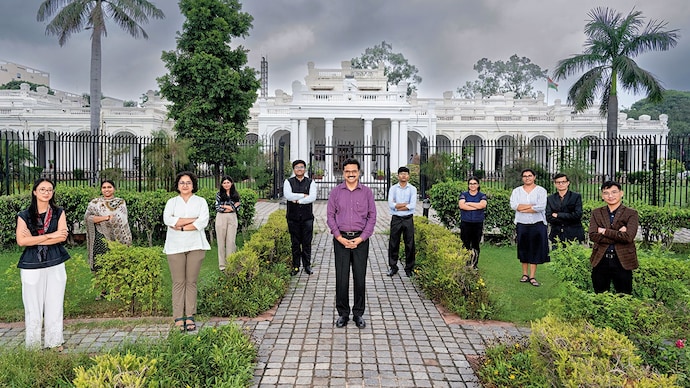
No.1: University of Delhi
No.1: University of Delhi
No.1: University of Delhi
The University of Delhi has set itself an ambitious goal: to be counted among the world’s top 200 universities within the next five years. The confidence stems from its recent progress. Over the past four years, the university, popularly known as DU, has climbed nearly 200 places in the QS World University Rankings, moving from 521 to 322.
For Professor Yogesh Singh, vice chancellor, rankings are only one measure of success, and the focus is not on chasing numbers alone. “The larger objective is to build a university that produces researchers, innovators, entrepreneurs and socially conscious graduates,” he says. Under the National Education Policy (NEP) 2020, the university is reshaping its curriculum, encouraging interdisciplinary learning and investing in research, innovation and entrepreneurship.
Instead of assessing doctoral scholars only through academic publications, DU is widening the definition of research excellence. Students who develop patents, build prototypes, create technologies with social impact or establish successful startups will also receive academic recognition.
The university plans to support promising student ventures with incubation facilities, seed funding, legal and accounting support, as well as mentoring. “The mindset has to shift from job-seeking to job creation,” says Singh. Entrepreneurship has already found a place in undergraduate education.
The implementation of NEP has also accelerated flexibility in learning. Under DU’s major-minor academic structure, students are no longer confined to a single discipline. An English major can earn a minor in journalism, a Computer Science student can study Psychology, while someone pursuing Hindu Studies can complement it with management or Computer Science. “We are making education more porous,” says Singh. “Students should be free to explore their interests instead of remaining locked into one academic silo.” New value-added courses also reflect this wider definition of education. Financial literacy has emerged as one of the university’s most popular offerings, attracting nearly 30,000 students.
Teaching methods are changing as well. Faculty members are being encouraged to move away from lecture-heavy classrooms and adopt more interactive methods, using videos, graphics and discussions instead of relying solely on the blackboard. As Singh puts it, every lecture should feel like “an episode of a web series” that leaves students wanting to know more.
Artificial Intelligence is another area the university refuses to ignore. Singh sees AI not as a threat but as a tool with which students must learn to work. DU is seeking to prepare students for jobs that may not yet exist by focusing on AI literacy, entrepreneurship, critical thinking, financial literacy, innovation, problem-solving and adaptability.
Looking ahead, DU is also expanding physically. It is preparing to launch a new college from the next academic session, offering futuristic programmes in Computer Science, AI, Data Science and Entrepreneurship.
Another enduring strength is the university’s exceptional alumni network, which spans politics, business, academia, the arts, media and the civil services. This network connects students to accomplished professionals across fields and reinforces the university’s influence far beyond its campuses.
Whether that is enough to propel DU into the world’s top 200 remains to be seen. What is already evident is that the university is seeking to redefine success through greater academic flexibility, stronger research and an education geared to a rapidly changing world.

