In the big league | India's Best Universities 2026
India's best universities owe their success to a pedagogy that is in tune with the times
At Jantar Mantar this month, and at sit-ins that spread from Delhi to multiple locations across the country, students protested an education system they say has stopped working for them. Their grievances vary by state and institution—rising fees, faculty vacancies, compromised examinations, delayed academic calendars and placement promises that evaporate by the time they graduate. Underlying them is a deeper anxiety that the degree at the end of the educational pipeline no longer guarantees the opportunity, mobility or security it once appeared to promise.
At Jantar Mantar this month, and at sit-ins that spread from Delhi to multiple locations across the country, students protested an education system they say has stopped working for them. Their grievances vary by state and institution—rising fees, faculty vacancies, compromised examinations, delayed academic calendars and placement promises that evaporate by the time they graduate. Underlying them is a deeper anxiety that the degree at the end of the educational pipeline no longer guarantees the opportunity, mobility or security it once appeared to promise.
At Jantar Mantar this month, and at sit-ins that spread from Delhi to multiple locations across the country, students protested an education system they say has stopped working for them. Their grievances vary by state and institution—rising fees, faculty vacancies, compromised examinations, delayed academic calendars and placement promises that evaporate by the time they graduate. Underlying them is a deeper anxiety that the degree at the end of the educational pipeline no longer guarantees the opportunity, mobility or security it once appeared to promise.
The protests cannot be brushed aside. They are a warning from a generation that has invested heavily in education but is increasingly uncertain about its returns. Yet they should not become the only lens through which to view Indian higher education. Alongside the failures are institutions that are expanding access, redesigning curricula, producing high-quality research, improving clinical and professional training, incubating enterprises and creating more inclusive campuses. The challenge is to distinguish those responding to a changing world from those merely adding courses, buildings and credentials.
It is in this complex backdrop that the India Today Group publishes the 2026 edition of its annual Best Universities Survey. It does not intend to just applaud institutions that already enjoy reputational advantages or to reduce a vast, varied university system to a league table. It is another way of holding up a mirror to the state of higher education by celebrating the best, identifying what they are doing differently and encouraging the rest to improve through a healthy competitive environment.
A ranking published in a year of student protest must ask more than which university appears on top. It must examine what academic leadership looks like, whether institutions are keeping pace with economic and technological change, how effectively they support students, and whether the education they provide leads to intellectual growth, professional capability and meaningful opportunity. For students and parents, its value lies in helping them ask better questions before making one of the most consequential and expensive decisions of their lives.
The need for such scrutiny has grown with the extraordinary expansion of Indian higher education. The country now has 1,293 universities, more than double the number in 2014-15. This represents a remarkable democratisation of aspiration. A university degree is no longer the preserve of a small urban elite. Families across classes, regions and social groups increasingly see higher education as the most credible route to employment, mobility and dignity.
The rise of private universities has widened choice and introduced new programmes, facilities and models of institutional management. It has also made independent assessment more necessary. The label ‘private’ does not by itself denote either excellence or inadequacy, just as the label ‘public’ does not guarantee quality. Institutions within both categories vary widely in faculty strength, research culture, infrastructure, affordability, governance and graduate outcomes. For families navigating hundreds of universities and thousands of courses, the central question is no longer about a recognised degree, but equally its educational value. The india today Best University Survey makes that assessment easier.
The expansion of institutions has been accompanied by a substantial increase in participation. The Gross Enrolment Ratio for the 18-23 age group rose from 23.7 per cent in 2014-15 to 30 per cent in 2023-24. The National Education Policy 2020 aims to raise it to 50 per cent by 2035. Female GER, at 31.2 per cent, has exceeded male GER for seven consecutive years, an indication that access for women has improved.
Enrolment, however, is only one part of the story. It records who enters the system, but not whether students find competent teachers, whether classes and examinations are held on time, whether they acquire the skills their courses promise, or whether financial, academic and social pressures force them to leave without completing their degrees.
Some of these concerns are reflected in the anger visible in the protests. They explain why a survey must evaluate more than reputation. A famous name may open doors, but it cannot compensate indefinitely for inadequate teaching, poor student support, obsolete curricula or unreliable examinations. Conversely, a less celebrated university may be improving quickly, building strong departments or producing better outcomes in a discipline.
The India Today survey seeks to capture these distinctions by assessing institutions across 120+ attributes grouped under five parameters: Reputation & Governance; Academic & Research Excellence; Infrastructure & Living Experience; Personality & Leadership Development; and Career Progression & Placement. The weight for each parameter has been kept unchanged from past years to allow meaningful comparison over time.
Together, these measures are more useful than a placement figure or a publicity claim viewed in isolation. A university may advertise its highest salary package without disclosing how many students were placed, which programmes they came from or what the median outcome was. It may showcase a new laboratory without revealing whether students regularly use it. It may announce international collaborations that produce little faculty or student exchange.
A ranking must also guard against becoming a closed club in which established institutions repeatedly confirm their established reputations. That is why the introduction of the Most Improved Universities category is significant. By measuring the percentage change in an institution’s relative position between the 2022 and 2026 rankings, it draws attention to momentum rather than inherited prestige.
For students, this can be almost as valuable as knowing which institution stands first. A university that is consistently improving its faculty, research, infrastructure and student outcomes may offer a more dynamic environment than one relying largely on its historical reputation. For university leaders, the category makes improvement visible and demonstrates that rankings need not merely reward those already at the top but create incentives for institutions further down the table.
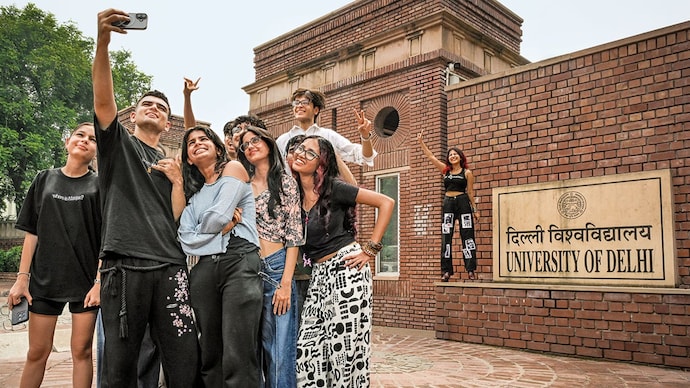
The strongest insights from this year’s survey emerge not from the names of the category leaders alone but from the choices those institutions are making. At the University of Delhi, the rise in global rankings has been accompanied by a broader definition of academic achievement. Doctoral research can now result not only in a thesis or journal article but also in a patent, prototype or startup.
Symbiosis International offers another model. Founded to assist international students in Pune, it now has 45 institutes and 105 programmes, serving about 70,000 students from more than 85 countries. Its MBA in Innovation and Entrepreneurship, which offers no conventional placements, receives 12,000 applications for 60 seats. The demand shows that many students are willing to choose enterprise creation over a guaranteed recruitment pipeline.
At AIIMS Delhi, the educational advantage lies not only in its long-standing dominance of medical rankings but also in the scale and complexity of its clinical work. Residents treat rare and difficult diseases in an intensive tertiary-care environment, making clinical exposure central to their education.
At IIT Delhi, academic excellence is being recast around flexibility, interdisciplinary learning and practical problem-solving. Its redesigned programmes allow students to combine courses across departments, while artificial intelligence and sustainability are being embedded across disciplines.
At the National Law School of India University, expansion is being matched by investments in academic capacity, residential infrastructure and inclusion. With 118 faculty members and 1,631 students as of June 2026, it is completing two academic blocks and will build hostels for nearly 3,000 students by 2028. It is also piloting AI-assisted tutoring and launching the Women’s Inclusion and Leadership in Law initiative. The latter addresses a stark imbalance: women make up 32 per cent of law graduates but only 15 per cent of the 1.8 million lawyers admitted to practice.
These initiatives across top universities prove that excellence is built around flexibility, exposure, inclusion, research and application. For, as the protests at Jantar Mantar have demonstrated, expansion without credibility will not satisfy India’s young. The institutions recognised in the Best Universities Survey demonstrate that decline is not inevitable and that the country already has different pathways to excellence. The purpose of the survey is to make those pathways visible, giving students and parents better information, rewarding institutions that perform well and challenging others to raise their standards.
METHODOLOGY | How the universities were ranked
With 765 general, 98 medical, 172 technical and 30 law universities to choose from, the India Today Group’s annual ranking of Best Universities has a special place in India’s academic calendar. It makes critical career decisions easier for aspirants, while offering recruiters, parents, alumni, policymakers, universities and the public an overview of the state of university education.
India today’s knowledge partner, Marketing and Development Research Associates (MDRA), followed a rigorous methodology while conducting the survey from March to July 2026. For the objective ranking, MDRA calibrated 120+ attributes grouped under five broad parameters—Reputation & Governance, Academic & Research Excellence, Infrastructure & Living Experience, Personality & Leadership Development and Career Progression & Placement. The ranking used current-year data provided by the universities and also gave parameter-wise scores.
A list of more than 800 qualifying universities, including Institutes of National Importance, was prepared. Postgraduate programmes in four streams—general, medical, technical and law—were evaluated. Only universities offering full-time, in-classroom courses and having produced at least three graduating batches by the end of 2025 qualified.
Experienced experts were consulted to frame the parameters for each category. The indicators and their relative weights were meticulously determined. The weights remained unchanged from past years to ensure consistency and comparability.
Comprehensive objective questionnaires for each category were sent to qualifying universities and uploaded on MDRA’s website. Formal invitations, emails, phone calls and follow-ups were used to encourage participation and clarification. Some 192 universities submitted data and supporting documents on time; 190 were ranked.
The submissions and supporting documents were then scrutinised. Data were verified with past records, mandatory disclosures, phone checks, email confirmations and university websites. Institutions were asked to correct or update insufficient or inaccurate information. An objective score was assigned under each parameter, and data normalised to ensure performance was not determined just by aggregate figures.
A perceptual survey covered 305 well-informed respondents—20 chancellors or vice-chancellors, 83 directors, deans or registrars, and 202 senior faculty members, including professors and heads of departments—across cities in four zones.
- North: Delhi-NCR, Lucknow, Jaipur and Chandigarh
- West: Mumbai, Pune, Ahmedabad and Indore
- South: Chennai, Bengaluru, Hyderabad and Coimbatore
- East: Kolkata, Bhubaneswar, Guwahati and Patna
Respondents provided national and zonal rankings in their fields of experience, assigned 75 per cent and 25 per cent weightage respectively. They also rated universities on a 10-point scale across the five parameters. The objective and perceptual scores were combined in a 50:50 ratio to arrive at the final score.
Most Improved Universities
Beginning this year, a new category, ‘Most Improved Universities’, has been introduced to highlight institutions that have made the greatest progress over five years. The ranking measures the percentage improvement in a university’s relative position between the 2022 and 2026 rankings.
The MDRA core team was led by CEO Abhishek Agrawal and included senior project director Abnish Jha, research manager Vaibhav Gupta, research executive Robin Singh and assistant managers, EDP, Manveer Singh and Mahesh Joshi.

