Medical | Clinical perfection
Along with offering expert guidance and a wide range of exposure to postgraduates, AIIMS Delhi is opening up new areas of study and updating old ones
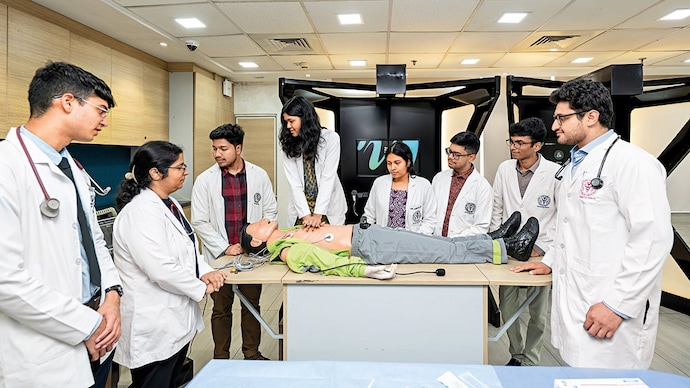
No. 1: All India Institute of Medical Sciences (AIIMS), New Delhi
No. 1: All India Institute of Medical Sciences (AIIMS), New Delhi
No. 1: All India Institute of Medical Sciences (AIIMS), New Delhi
For generations of Indian doctors, earning a postgraduate seat at the All India Institute of Medical Sciences (AIIMS), New Delhi, has represented the pinnacle of medical training. While the competition to enter the institute is legendarily tough, what truly distinguishes AIIMS is not simply its prestige but the unique ecosystem it offers—one where patient care, research, innovation and academic excellence intersect every day.
AIIMS Delhi offers one of the country’s most comprehensive portfolios of postgraduate programmes, spanning MD, MS, MDS, DM, MCh, MD in Hospital Administration, MSc Nursing, Master’s and PhD Biotechnology courses, alongside doctoral and fellowship programmes. Importantly, the curriculum is continually revised to keep pace with changing healthcare needs and advances in medicine, ensuring that residents are trained in contemporary clinical practice rather than relying on static textbooks.
Perhaps the institute’s greatest strength is its unparalleled clinical exposure. “As one of India’s busiest tertiary-care centres, AIIMS attracts patients from every state, many with rare, complex or advanced diseases that residents are unlikely to encounter elsewhere,” says Dr Nikhil Tandon, the acting director of AIIMS New Delhi.
This provides postgraduate students with experience across an extraordinary range of conditions, from routine illnesses to those needing cutting-edge transplant medicine, advanced oncology cases, genetic disorders and highly specialised surgical procedures.
“Research is equally central to postgraduate life,” adds Dr Tandon. Unlike at many medical colleges, where research remains largely thesis-driven, AIIMS encourages residents to engage with multidisciplinary research teams, clinical trials, translational medicine and laboratory science. Departments are equipped with sophisticated diagnostic and research facilities, while students regularly present their work at national and international conferences, building academic credentials early in their careers.
Another defining feature is the institute’s strong culture of super-specialisation. Students train alongside nationally recognised experts across virtually every discipline, creating opportunities for mentorship that extend well beyond residency. “The academic environment also promotes collaboration across departments, allowing physicians, surgeons, radiologists, pathologists, geneticists and basic scientists to work together on patient care and research,” says Dr Aakanksha Kumari, DM Endocrinology, AIIMS Delhi.
AIIMS has also been updating its postgraduate programmes to reflect the changing nature of medicine. This year, it introduced three new specialisations within the MSc Nursing programme. The institute has also renamed its DM Endocrinology course as DM in Endocrinology, Metabolism and Diabetes, recognising the growing importance of diabetes and metabolic disorders in clinical practice.
Training, too, is evolving alongside these changes. Depending on their specialisation, residents today work with advanced imaging, minimally invasive and robotic surgery, molecular diagnostics, precision medicine and digital health technologies that are becoming an increasingly routine part of patient care.
The Department of Community Medicine at AIIMS is another distinctive part of the curriculum. It trains postgraduate students to understand health beyond the walls of a tertiary-care centre. Residents gain hands-on experience in epidemiology, disease surveillance, health systems, biostatistics and public health research while working in urban and rural field-practice areas.
What ultimately sets AIIMS apart, however, is the stimulating environment in which this learning takes place. Residents are exposed to an extraordinary range of patients while learning from some of the country’s leading clinicians and researchers.
Life at AIIMS also extends beyond residency. The campus is home to PULSE, one of India’s best-known inter-medical festivals, bringing together students for cultural, literary, sports and research events. Residents also have access to a 24-hour central library, modern simulation and skills laboratories, sports facilities, hostels and active student societies spanning music, theatre, debating, photography and community service.
AIIMS Delhi has topped the NIRF (National Institutional Ranking Framework) Medical Rankings every year since their launch in 2016, remaining India’s highest-ranked medical institution for 10 straight years.
The institute is also increasingly embedding artificial intelligence into medical education through initiatives such as the newly launched Indo-French Centre for AI in Health, which combines research, clinical innovation and medical training.

