Private university | Out of the box pedagogy
The multifaceted approach to expanding its students' horizons has made Symbiosis one of India's foremost institutions in private education
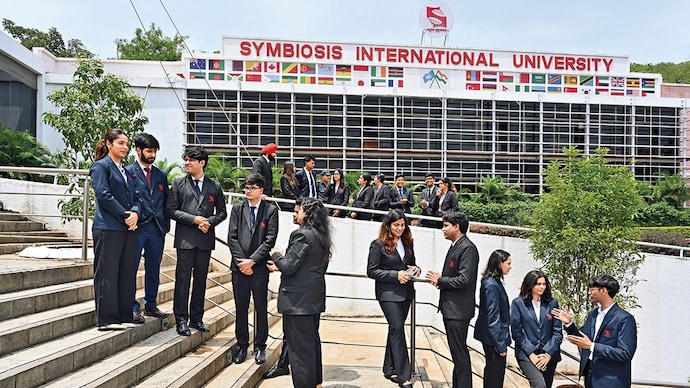
No. 1: Symbiosis International (Deemed University), Pune
No. 1: Symbiosis International (Deemed University), Pune
No. 1: Symbiosis International (Deemed University), Pune
In 1970, S.B. Mujumdar, then a professor of botany at Fergusson College, Pune, began interacting with foreign students studying in the city and writing about the difficulties they faced. He soon launched the Symbiosis International Cultural Centre to better assimilate international students. Realising that these efforts were limited in scope, Mujumdar decided to enter the education sector, beginning with the Symbiosis English Language Teaching Institute (ELTIS) for students from non-English-speaking countries. This was followed by a law college in 1977, a business management institute in 1978 and, eventually, colleges for several more disciplines.
Symbiosis acquired deemed university status in 2002. Today, Symbiosis International (Deemed University) is a multidisciplinary institution with 45 institutes, 105 courses and programmes, more than 1,300 faculty members, and around 70,000 students from across India and 85 other countries. It operates six campuses in India and one in Dubai. The university’s 400-acre Lavale campus, in the hills on Pune’s outskirts, is divided into the Hill Base and Hill Top campuses and is home to over 19,000 students.
“The main differentiator between Symbiosis and other private universities is that it was established by a teacher,” says Dr Vidya Yeravdekar, Mujumdar’s daughter and current pro-chancellor, Symbiosis International (Deemed University). In 2019, Symbiosis became the first private institution in the country to establish a medical college exclusively for women. The Symbiosis Medical College for Women has one of the lowest fee structures in the country (Rs 10 lakh annually), and is attached to a 900-bed teaching hospital that treats patients free of cost.
“We show the way, the world follows,” says Ramakrishnan Raman, vice-chancellor, pointing to how Mujumdar launched a business school at a time when few institutions were thinking along those lines. Symbiosis, he says, also has a history of thinking beyond conventional models. It introduced innovation and entrepreneurship programmes in 2015, when the government was still developing its approach to startups and entrepreneurship.
Its MBA in Innovation and Entrepreneurship does not offer placements, yet it receives around 12,000 applications for just 60 seats at a time when MBA programmes are typically judged by their placement records. Raman claims that one out of four corporate leaders at the CXO and vice-president levels is a Symbiosis alumnus. Shrirang Altekar, professor and director of the Symbiosis Institute of Business Management (SIBM), says the institute has incubated more than 100 startups. “We want students to be creators of jobs and not seekers of jobs,” he says. Around 80 per cent of the curriculum is taught by faculty members, while the remaining 20 per cent is delivered by industry professionals. For the past four years, Symbiosis has also organised The Grand Pitch, modelled on the format of TV’s Shark Tank, giving student entrepreneurs an opportunity to present their business ideas.
Abhijit Chirputkar, director of the Symbiosis Institute of Digital and Telecom Management (SIDTM), says the major focus is on interdisciplinary courses that add value. Management programmes, for instance, include credits from other disciplines. The university’s academic and extracurricular infrastructure includes research cells, badminton and pickleball courts, gyms and dining facilities with Eat Right certification. Students can participate in semester exchanges, summer schools and winter schools at partner universities across Europe, including institutions in Germany, France, the Netherlands, Portugal and Belgium. “Here, teaching is not just about academics. It also integrates the newest trends and technology through our alumni network to make us industry-ready,” says K.R. Arvind, a second-year MBA student at SIDTM.
Kevin Gandhi, an MBA student at the Symbiosis School of Banking and Finance, says the presence of students from across the world creates a multicultural experience. Avishi Upadhyaya, an MBA in Communication Management student at SIMC, says the amenities, facilities and faculty give students an edge, while events held throughout the year allow them to interact with stakeholders from diverse backgrounds.
Actor Amitabh Bachchan is professor emeritus at the Faculty of Media and Communication. Former diplomats such as Pavan K. Varma, Talmiz Ahmad and Vijay Gokhale are distinguished professors at the university. Raghav Khanna and Garima Pura, who were part of the team behind the Oscar-winning documentary, The Elephant Whisperers, are SIMC alumni.

