Technical | The reinvention laboratory
Building on its legacy, IIT Delhi is making learning more flexible, research more collaborative and innovation more closely connected to industry and society
No. 1: Indian Institute of Technology (IIT) Delhi
No. 1: Indian Institute of Technology (IIT) Delhi
No. 1: Indian Institute of Technology (IIT) Delhi
India’s premier engineering institutions are no longer defined by academic rigour alone. They are expected to produce graduates who can navigate technological disruption, collaborate across disciplines and solve complex global problems. IIT Delhi has embraced that shift with characteristic confidence. Rather than resting on its formidable reputation, the institute is reshaping itself through a more flexible curriculum, stronger global partnerships, interdisciplinary research and a renewed emphasis on innovation, communication and student well-being.
“Students are our greatest strength. Our goal is to attract the brightest minds and prepare them to become future leaders in research, innovation and society,” says Prof. Somnath Baidya Roy, Dean, Planning. A flagship initiative is ALIGN (Academic and Learning Integration for Growth and Networking), a collaboration with 18 National Institutes of Technology (NITs) that allows outstanding undergraduates to spend a year at IIT Delhi before progressing to postgraduate and doctoral studies. The programme widens opportunities for talented students while creating a larger pipeline of future researchers in India.
The institute is also deepening its global engagement. A new joint degree with Paris’s Sorbonne University in healthcare and medical technologies adds to exisiting partnerships with universities in Australia, Taiwan and elsewhere. IIT Delhi has also doubled its international postgraduate intake, reinforcing its ambition to become a more globally connected campus where international exposure is embedded through joint degrees, student exchanges and collaborative research.
Curriculum reform is central to this transformation. Undergraduate, MTech and PhD programmes now offer greater academic flexibility, enabling students to pursue interdisciplinary pathways, combine courses across departments and opt for minors with ease. The redesigned master’s programme in Cognitive Science reflects this philosophy, bringing together Neuroscience, Biology, Computer Science and AI to encourage multidisciplinary learning.
Technology is also being deployed to make learning more inclusive. Through the Manthan initiative, classroom lectures are recorded and translated into multiple Indian languages, allowing students from non-English-speaking backgrounds to revisit complex concepts in their mother tongue. AI-powered translation will further expand the programme.
Recognising that technical expertise alone is insufficient, IIT Delhi has established a Teaching-Learning Centre and a Centre for Academic Communication to help students present their research effectively and engage wider audiences. Equally important is student well-being. An Academic Progress Group provides personalised academic support, while an expanded counselling network and partnerships with hospitals ensure access to professional mental health services. “We cannot remove every pressure students face, but we can create a strong support system that helps them overcome those challenges,” says Prof. Roy.
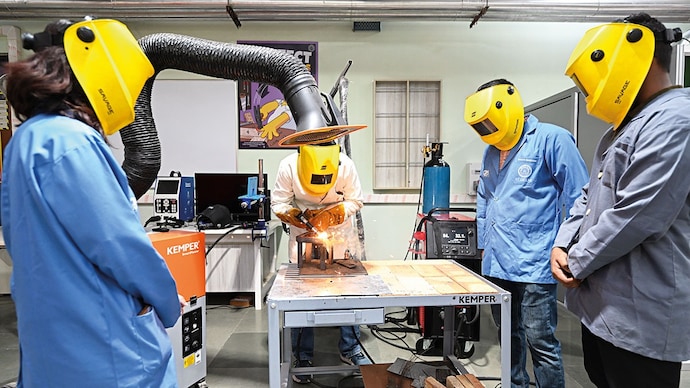
Innovation extends well beyond classrooms. Mandatory internships for undergraduate and MTech students, industry exposure for PhD scholars, active technical clubs, makerspaces (collaborative work spaces) and a well-equipped Central Workshop encourage students to transform ideas into working prototypes. Together, these initiatives are helping IIT Delhi prepare future innovators equipped to lead in an increasingly interconnected world.

