Andhra Pradesh | Naidu bets on data centres
The Andhra Pradesh CM wants to make Visakhapatnam a data centre hub, but how honest is his promise of jobs and environmental security?
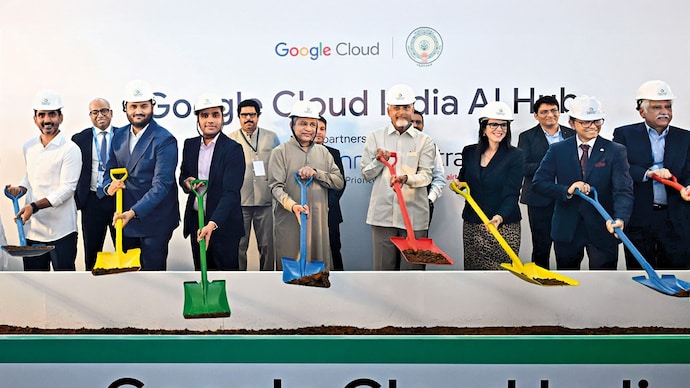
Come September 2028, and Visakhapatnam in Andhra Pradesh may become home to Google’s India AI Hub, a $15 billion (Rs 1.4 lakh crore) artificial intelligence and cloud infrastructure project Google subsidiary Raiden Infotech is developing in partnership with AdaniConnex and Airtel’s Nxtra. Andhra Pradesh chief minister N. Chandrababu Naidu presided over its groundbreaking ceremony this April. His government has also allotted 855 acres at Bhogapuram in neighbouring Vizianagaram district to Reliance Industries for a 1.5 GW (gigawatt) data centre. Several other projects are in the pipeline, including a 500 MW facility being developed by Sify in partnership with Meta.
Come September 2028, and Visakhapatnam in Andhra Pradesh may become home to Google’s India AI Hub, a $15 billion (Rs 1.4 lakh crore) artificial intelligence and cloud infrastructure project Google subsidiary Raiden Infotech is developing in partnership with AdaniConnex and Airtel’s Nxtra. Andhra Pradesh chief minister N. Chandrababu Naidu presided over its groundbreaking ceremony this April. His government has also allotted 855 acres at Bhogapuram in neighbouring Vizianagaram district to Reliance Industries for a 1.5 GW (gigawatt) data centre. Several other projects are in the pipeline, including a 500 MW facility being developed by Sify in partnership with Meta.
Come September 2028, and Visakhapatnam in Andhra Pradesh may become home to Google’s India AI Hub, a $15 billion (Rs 1.4 lakh crore) artificial intelligence and cloud infrastructure project Google subsidiary Raiden Infotech is developing in partnership with AdaniConnex and Airtel’s Nxtra. Andhra Pradesh chief minister N. Chandrababu Naidu presided over its groundbreaking ceremony this April. His government has also allotted 855 acres at Bhogapuram in neighbouring Vizianagaram district to Reliance Industries for a 1.5 GW (gigawatt) data centre. Several other projects are in the pipeline, including a 500 MW facility being developed by Sify in partnership with Meta.
Nearly three decades earlier, as CM of undivided Andhra Pradesh, Naidu had transformed Hyderabad into one of India’s foremost IT hubs, earning it the moniker, Cyberabad. In one of the defining moments of that journey, he had persuaded Bill Gates to establish the Microsoft India Development Center there. Having lost that growth engine to Telangana, Naidu is now trying to script a similar transformation for Visakhapatnam by positioning it as a hub for hyperscale data centres.
Factories of the digital economy, data centres house thousands of servers that store, process and transmit the information powering everything from digital payments and video streaming to e-commerce and cloud computing. As AI models become larger, governments and firms worldwide are racing to build facilities capable of handling unprecedented volumes of data and computing power.
The Google-led project is only the beginning. Back in October when the tech behemoth had announced what could be its largest investment in India, an elated Naidu had taken to social media to declare that the ‘G’ in Vizag—the popular name of the port city—now stood for Google. His son and the state’s minister for information technology (IT) and human resource development, Nara Lokesh, says the government ultimately wants to build a data centre ecosystem with a total capacity of 6.5 GW around Visakhapatnam. To put that in perspective, India’s total installed data centre capacity in 2025 was just about 1.5 GW; global capacity is projected to exceed 200 GW by 2030. Naidu wants Andhra Pradesh to claim a meaningful share of that growth.
Not everyone shares Naidu’s enthusiasm, though. Environmental groups warn that these energy- and water-intensive facilities could place enormous strain on the region’s natural resources and fragile ecosystems. Critics also question whether these tech giants will generate enough jobs to justify rolling out the red carpet for them.
THE JOBS THAT AREN’T?
At the Google event, Naidu declared that Visakhapatnam would become a “talent destination”, creating abundant opportunities for young people and driving “reverse migration” into Andhra Pradesh. To realise that vision, the state is offering one of the country’s most generous incentive packages. Besides land allotment at a 25 per cent concession on market value, Google and Reliance have been offered capital subsidies, exemptions from stamp duty and registration charges, reimbursement of State GST, subsidies on power and water tariffs, and exemptions from transmission and wheeling charges. Government estimates suggest incentives for Google’s project alone could exceed Rs 22,000 crore over time, while the support extended to Reliance—excluding discounted land—is of a similar scale.
Yet employment projections remain vague—the government order issued for the Google project last October promised “thousands of direct and indirect jobs”. But the May order approving incentives for Reliance’s project makes no mention of employment. That uncertainty is fuelling anxiety among local youth. Vijay (name changed), a computer science graduate from Tarluvada, watched with excitement as work began near his village after his Dalit family, like several others, gave up two acres of land for the Google project coming up there. Initially hopeful of finding work there, he has since become less certain. “I don’t knowthey now say there won’t be many jobs as such requirement is less in the data centres,” he says.
The opposition Yuvajana Sramika Rythu (YSR) Congress Party has seized upon the issue. Former industries minister Gudivada Amarnath argues that “despite public claims of large-scale employment, Google’s agreement suggests that the project may generate only around 200 direct jobs”. Speaking on condition of anonymity, one senior IT official involved in the state’s data centre initiative argues that judging such projects solely by direct jobs is “a flawed calculation”. Another official involved in negotiations with Google tells india today that direct employment at either the Google or the Reliance facility “might not be more than 1,000as is the case world over”.
But the government contends that the larger opportunity lies beyond the facilities themselves—from ancillary industries to AI infrastructure, cloud services and startups dependent on large-scale computing capacity. The first official claims that, over the next decade, this wider ecosystem could create well up to a million jobs. But even Cyberabad took nearly three decades to generate that many technology jobs. Data centres, by contrast, are inherently far less labour-intensive than software parks.
THE ENVIRONMENTAL RECKONING
If jobs are one source of scepticism, ecology is another. The debate unfolding around Visakhapatnam echoes concerns increasingly being voiced across the world. Data centre capacity is expressed in gigawatts because electricity consumption defines the scale of these facilities. They also require vast amounts of water and occupy large tracts of land—Google’s project alone spans 600 acres across three sites. In September 2025, just before Google announced its Vizag investment, it abandoned a proposed $1 billion data centre campus near Indianapolis in the US following sustained local opposition over water consumption, electricity demand and limited job creation.
Environmentalists in Visakhapatnam say similar questions deserve closer scrutiny. According to the Union ministry of power, electricity demand from data centres across India is projected to reach 13.56 GW by 2031-32. Civil society groups, including the Greater Visakhapatnam Citizens’ Forum (GVCF) and Human Rights Forum (HRF), warn that the data centres could turn into “heat islands” while placing additional stress on local water resources. Former Union finance and power secretary E.A.S. Sarma, now an environmental campaigner, argues that projects spread across hundreds of acres and consuming enormous quantities of water and electricity offer “not even a pittance” in jobs for local communities.
HRF alleges that tree-felling, hill-cutting and road construction for the Google project have already begun in the Kailasagiri forest stretch within the Simhachalam hill range, close to the Kambalakonda Wildlife Sanctuary and its ecosensitive zone. Along with GVCF, it has questioned the environmental clearance process, arguing that the project is being considered as a Category B development, thereby avoiding a more comprehensive environmental impact assessment (EIA) and wider public consultation.
The campaign has also drawn national attention. Water conservationist Rajendra Singh recently visited the Mudasarlova reservoir—one of Visakhapatnam’s principal sources of drinking water—and warned that excavation in the Simhachalam hills and construction for the data centres could disrupt the natural drainage channels feeding the reservoir. “If the place is made unliveable, what use is such development?” he asked. Water remains a vital concern. In a recent letter to Naidu, Sarma warned that diverting water from irrigation and drinking water projects to the data centres could create shortages in surrounding villages and affect agriculture. He estimates that a 1.5 GW data centre would require around 12 million gallons of water a day to cool thousands of servers.
The Andhra Pradesh government dismisses these concerns. Speaking in Mumbai in early June, Nara Lokesh welcomed a dialogue with the critics, but argued that comparisons with the US were misplaced because India has an integrated national power grid. He also rejected fears over water use, saying nearly 3,000 TMC (thousand million cubic feet) of Godavari water flows into the Bay of Bengal annually without being utilised. “Even the 6.5 GW data centres we intend to build,” he said, “will require only one TMC. In comparison, a 1 GW thermal power plant consumes seven times more water.”
Visakhapatnam MP Bharat Mathukumilli has dismissed the campaign against the data centres as “misinformation”. He argues that existing and planned water infrastructure, including the under-construction Polavaram multi-purpose irrigation project, will comfortably meet future domestic and industrial demand. He also says the data centres have secured all statutory clearances after a thorough EIA and that safeguards such as compensatory afforestation and heat-mitigation measures “will be implemented wherever required”.
It may not be enough to suppress the concerns. Even sections of Visakhapatnam’s IT industry are urging the government to release a detailed white paper to address concerns surrounding the data centre projects. Only then will Naidu’s dream of turning Vizag into India’s data centre hub be saved from becoming a nightmare.

